
Germany's Defence Ministry to send Ukraine first military aid, including 5,000 protective helmets
Meanwhile, Czechia has confirmed the transfer to Ukraine of 4,006 152mm artillery shells.
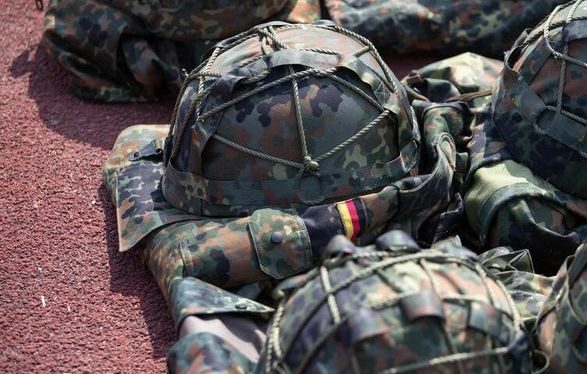
Under international pressure, Germany has finally agreed to send Ukraine its first military aid, which, however, will not include defensive weapons: 5,000 protective helmets will be delivered to Ukraine.
Meanwhile, the Czech Defence Ministry has approved the free transfer to Ukraine of 4,006 152mm artillery shells.
Meanwhile, Australia is ready to increase gas supplies to Europe in response to blackmail and reduced supplies from Russia.
Aid from Germany
German Defence Minister Christine Lambrecht said Berlin will supply Ukraine with 5,000 military protective helmets.
"This is a very clear signal that we are on your side," said German Defence Minister Christine Lambrecht after a session of the defence committee in the Bundestag. The defence minister also reminded that Germany supports the sovereignty and territorial integrity of Ukraine.
Kyiv Mayor Vitali Klitschko, in a comment to Bild, called Germany's military aid a joke.
"5,000 helmets — that's just a joke. What aid will Germany send next? Pillows?" he said.
Klitschko said the German government still has not understood what is happening on Ukraine's border, where Russia is massing troops and equipment.
"The actions of the German government simply leave me speechless," he added.
Ukraine has for some time been asking Germany for arms supplies to protect against a possible large-scale Russian attack, including warships and air defence systems.
Chancellor Olaf Scholz and Foreign Minister Annalena Baerbock recently ruled out categorically the possibility of supplying lethal weapons to Ukraine.
In Kyiv, this decision has caused indignation. Ukraine's Ambassador to Berlin, Andriy Melnyk, told Handelsblatt a few days ago that Ukraine is urgently requesting "100,000 helmets and protective vests" for volunteers.
Deputy government spokesperson Christiane Hoffmann said early this week that Germany had already agreed to deliver a field hospital to Ukraine within a very short time. But it later also emerged that Germany would only provide the funding for it.
The field hospital will be built and delivered by NATO's Baltic partner Estonia, which is also awaiting a "green light" from Berlin to transfer howitzers from old Bundeswehr stocks to Ukraine.
Latvian Defence Minister Artis Pabriks reportedly sharply criticised Germany's position on not providing armed support to Ukraine amid the buildup of Russian troops near Ukraine's borders.
Polish Prime Minister Mateusz Morawiecki also expressed disappointment over Germany's position, linked to its policy of blocking arms supplies to Ukraine amid the buildup of Russian troops.
Artillery shells from Czechia
Czechia has already prepared military aid for dispatch to Ukraine, including 4,006 152mm artillery shells. Czech Defence Minister Jana Černochová said this in an interview with Denik N.
She said she had made the case to the government for sending 152mm artillery ammunition to Ukraine. Asked by a journalist how soon this aid could be delivered, the minister said it could be sent in the near future.
"The Chief of the General Staff assured me that everything is ready," Černochová said.
According to her, the consignment must be accepted by the Ukrainian government, with which "it still remains to be agreed whether it will be satisfied with the military aid and whether it wants to accept it."
On the tensions Russia is creating on Ukraine's borders, Černochová said that "Russia has a long-standing tendency to impose its policy on Ukraine." The same policy, "from the toolkit of hybrid threats," the Kremlin imposes in Georgia, in Belarus with Lukashenko's consent, and in Kazakhstan, the minister said.
She agrees that Czechia should prioritise diplomacy, because "imposing sanctions on Russia is not beneficial to either side." "But Russia has not taken any steps at all to change the situation," Černochová noted.
Gas from Australia
Australia is considering additional supplies of liquefied natural gas (LNG) to Europe in the event of a shortage caused by a possible Russian invasion of Ukraine. This was stated by Australian Minister for Resources and Water Keith Pitt, according to The Guardian.
"Increasing gas exports is being considered after the United States and Britain expressed concern about dependence on Russian gas in the context of a likely Russian invasion of Ukraine.
The United States has said it is working with allies and partners to prepare financial sanctions "with serious consequences" if the Russian president decides to invade Ukraine," the publication recalls.
Australian Resources Minister Keith Pitt said the country is a "leading and reliable global LNG exporter" and is "ready to help with any request for further supplies."
Earlier, Britain also expressed concern about Germany's dependence on Russian gas.
British Prime Minister Boris Johnson said one of the major problems faced in developing a powerful package of sanctions against Russia is "the difficult dependence, in particular of our European friends, on Russian gas."
"We must be respectful, but the simple fact is that about 3% of gas supplies to Britain come from Russia, while about 36% of Germany's energy needs are met by Russian gas," Johnson remarked.
The Australian government also called for de-escalation of tensions and "left the door open" to imposing sanctions on Russian officials in the event of an invasion of Ukraine, The Guardian adds.
Foreign Minister Marise Payne described sanctions as a "potential tool" that Australia and like-minded countries could use to "express our very serious concern about such aggressive behaviour."

Russian Attacks in Dnipropetrovsk Region: Two Killed, Seven Injured

Defense Forces Strike Four Russian Drone Control Points in Past Day, Including in Berdiansk

Britain Threatens Sanctions on Kremlin-Linked People; Poland Ready to Hand Ukraine Ammunition

Russia says it has completed "planned exercises" in the Black Sea

MVD: Fake Riots With Prop Blood Were Being Prepared Near Presidential Office

Law Enforcers Name Another Klitschko Deputy as Suspect

Berlin Holds Protest Against War in Ukraine; EU Prepares for Possible Russian Halt of Gas Supplies
North Korea Fires Ballistic Missile Over Record Distance in Five Years
Irish Fishermen Force Russia to Postpone Naval Drills

US sanctions in case of invasion of Ukraine could completely destroy Russia's economy, NYT reports
