
NATO Responds to Russia's Accusations of 'Provocations' and Affirms Ukraine's Right to Determine Its Own Policy
The alliance calls on Russia to return to diplomacy and de-escalation.
The North Atlantic Council issued a statement warning Russia of consequences in the event of aggression against Ukraine and placing responsibility on it for the current tensions.
"We are seriously concerned by Russia's significant, unprovoked and unjustified military build-up near Ukraine's borders in recent months, and we reject Russia's false claims of alleged provocations by Ukraine and NATO," the statement says.
NATO member states called on Russia to immediately de-escalate, be transparent about its military exercises and use diplomatic channels.
The North Atlantic Council noted: "We are seriously assessing the implications of the current situation for Alliance security. We will respond firmly to any deterioration of our security, including by strengthening our collective defence if necessary. NATO will take all necessary measures for the security and defence of all Allies."
Alliance countries reaffirmed their support for Ukraine's sovereignty and territorial integrity within internationally recognized borders and called on Russia to withdraw its troops from its borders.
The document stresses: "Any further aggression against Ukraine will have massive consequences and will come at a high cost. We support the right of all countries to determine their own future and foreign policy without external interference. NATO's relations with Ukraine are a matter solely for Ukraine and the 30 Allies."
The alliance is ready for substantive dialogue with Russia and has reiterated its invitation to a meeting of the NATO-Russia Council.
The communiqué notes: "We are aware of Russia's recent proposals on security in Europe. We have made clear that any dialogue with Russia must take place on the basis of reciprocity, take into account NATO's concerns about Russia's actions, be grounded in fundamental principles and foundational documents on European security, and be conducted in consultation with NATO's European partners."
If Russia takes concrete steps to ease tensions, NATO countries are ready to work on confidence-building measures. The OSCE is a suitable platform for this.
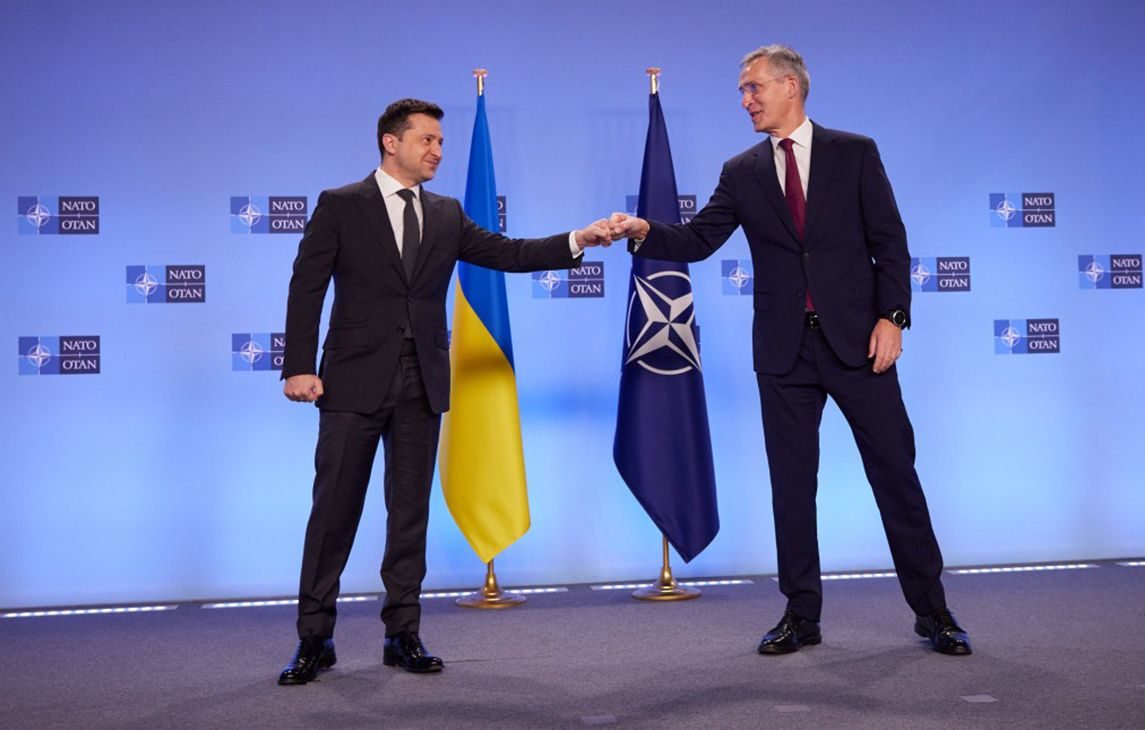
Meanwhile, NATO Secretary General Jens Stoltenberg said at a press conference with Ukrainian President Volodymyr Zelensky in Brussels that NATO sees no signs of Russia slowing its military build-up near Ukraine's borders.
Jens Stoltenberg
NATO Secretary GeneralWe discussed the significant Russian build-up around Ukraine. Tens of thousands of troops, artillery, tanks, etc. We do not see any signs that the build-up is slowing or decreasing. This build-up has no justification, it leads to destabilization and undermines security in Europe.
He called on Russia to return to diplomacy and de-escalation, and to respect Ukraine's sovereignty and territorial integrity.
Stoltenberg noted: "Any further aggression will have consequences and will come at a high price. NATO supports Ukraine, all Allies support Ukraine's sovereignty and territorial integrity, and we do not recognize the illegal annexation of Crimea."
According to him, Ukraine has the right to defend itself, and NATO's support for Ukraine is not a threat to Russia.
The NATO Secretary General said that Ukraine has the right to choose its security arrangements, which is a fundamental principle of European security.
President Volodymyr Zelensky stressed that in the event of a full-scale war with Russia, NATO owes Ukraine nothing, but at the same time Ukraine is a outpost even though it is not a member of the Alliance.
Volodymyr Zelensky
President of UkraineWe understand that if there is a full-scale war, we understand the numbers: thousands, hundreds of thousands, millions of victims, so we do not want this, like any civilized person. If the escalation that everyone talks about, and sometimes neighbors (RF — ed.) intimidate the states of the European Union and Ukraine, it looks provocative and dangerous. What does NATO owe us? NATO owes Ukraine nothing. NATO will owe all its countries, if our army does not hold out, because NATO protects precisely its member states. And the outpost is Ukraine. Ukraine, which is not a member of NATO.
Ukrainian Foreign Minister Dmytro Kuleba said that at the meeting between Zelensky and Stoltenberg, the Ukrainian side raised the question of a timeframe for Ukraine's accession to the Alliance.
The minister noted: "Everything there was very good, positive. The only shortcoming, I'll be honest: they did not tell us the year Ukraine will become a NATO member. Although we asked."
However, according to him, NATO categorically rejects Russia's interference in negotiations on this issue.
Dmytro Kuleba
Foreign Minister of UkraineIt was absolutely clearly confirmed that the discussion of when Ukraine will become a NATO member is exclusively a discussion that should and will take place between Ukraine and NATO. This is the answer to all the Russian accusations and absurd demands they are now making. Once again we have seen that the NATO Secretary General takes a very principled position on this issue.
To recall, Russian President Vladimir Putin, in talks with NATO leaders, demands legally binding guarantees excluding any further eastward expansion of the Alliance and the deployment in Ukraine of weapons allegedly threatening Russia. The NATO Secretary General has already rejected this demand.

Russian Attacks in Dnipropetrovsk Region: Two Killed, Seven Injured

Defense Forces Strike Four Russian Drone Control Points in Past Day, Including in Berdiansk

Britain Threatens Sanctions on Kremlin-Linked People; Poland Ready to Hand Ukraine Ammunition

Russia says it has completed "planned exercises" in the Black Sea

MVD: Fake Riots With Prop Blood Were Being Prepared Near Presidential Office

Law Enforcers Name Another Klitschko Deputy as Suspect

Berlin Holds Protest Against War in Ukraine; EU Prepares for Possible Russian Halt of Gas Supplies
North Korea Fires Ballistic Missile Over Record Distance in Five Years
Irish Fishermen Force Russia to Postpone Naval Drills

US sanctions in case of invasion of Ukraine could completely destroy Russia's economy, NYT reports
