
Occupiers in ORDLO have lost control of chemicals being delivered, Ukrainian military intelligence says
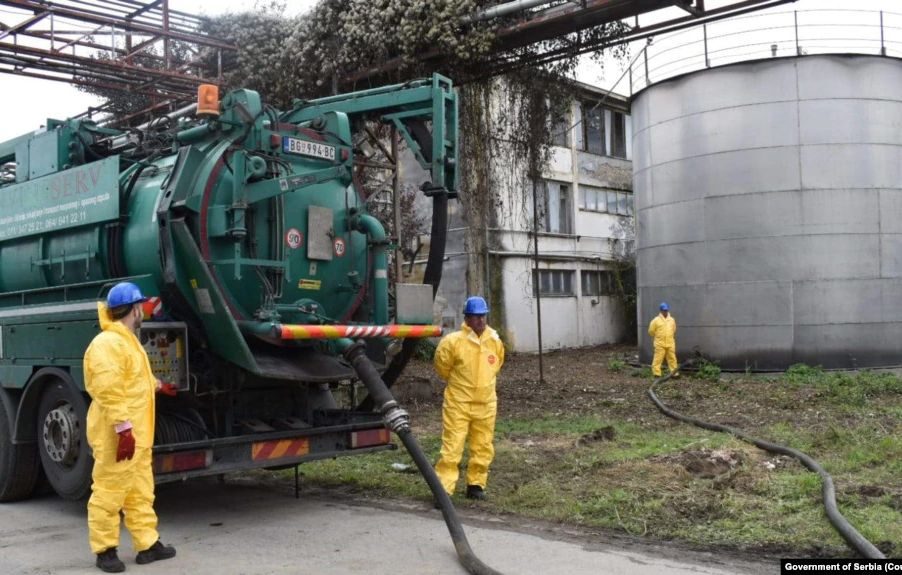
The occupiers plan to blame Ukraine for a possible environmental catastrophe, the intelligence agency says.
Ukraine's Main Directorate of Intelligence (HUR) of the Ministry of Defence said that the Russian occupation administration has lost control of chemical substances delivered to the temporarily occupied territories of Ukraine. The HUR press service reported this on Facebook.
Thus, on January 14, containers of ammonia were delivered to the Horlivka plant Stirol Concern, which is occupied by Russian forces.
"According to Ukraine's military intelligence, on January 14, containers of ammonia were delivered to the Stirol Concern plant in Horlivka, occupied by Russian forces, and due to a loss of tightness, poisonous substances are leaking into the air," the statement said.
The chemical contamination could lead to an environmental catastrophe in eastern Ukraine.
"The man-made disaster caused by Russian occupiers could be used to blame Ukraine for using toxic chemicals and as a pretext for expanding the armed aggression against our state," the HUR of the Ministry of Defence noted.
So far, few details are available. As Radio Svoboda reports, the plant has practically not operated throughout the war, and only recently has the occupation administration announced the resumption of some workshops.
With the start of shelling, the plant was completely emptied of ammonia for safety reasons, as the company Ostchem stated. But HUR reports that the terrorist groups controlled by Russia supplied the plant with this chemical.
Why ammonia is dangerous
Ammonia is highly toxic to humans. It causes burns to the respiratory tract and affects the nervous system. A leak can be detected by the smell of ammonia.
The largest chemical accident in Ukraine's industrial history involved this same substance at the same Stirol plant. In 2013, 600 kg of ammonia were released into the atmosphere when an ammonia pipeline burst.
Six people died at the plant, and 25 were hospitalized. The cloud dispersed over the city. But there may have been more minor accidents.
According to information from the Public Health Center (PHC), ammonia is especially dangerous for the eyes.
Signs of ammonia poisoning:
- Severe cough;
- Eye irritation;
- Irregular pulse;
- Skin redness;
- Irritation of mucous membranes and skin;
For ammonia poisoning, the PHC recommends:
- Move the victim to fresh air;
- Let them breathe humidified air (warm water vapor with a 10% menthol solution in chloroform);
- Rinse the skin, mucous membranes and eyes with water or a 2% boric acid solution for at least 15 minutes;
- Instill 2-3 drops of 30% albucid into the eyes;
- Apply olive or petroleum jelly to the nose;
- Give the victim warm milk with Borjomi or baking soda;
- If there is a spasm of the vocal folds, warm the neck area and take warm baths and inhalations;
- Wash affected skin with clean water and apply compresses of 5% acetic, citric or hydrochloric acid solution.
If you smell ammonia:
- Protect your respiratory organs with a gas mask or a gauze bandage, towel or silk fabric (folded in several layers, first moistened with a 2% citric or acetic acid solution, or water;
- Close windows and doors tightly, preferably covering window and door openings with fabric moistened in citric acid or a weak vinegar solution;
- Drink more milk or tea.
Slavyansk again
Three days before the ammonia leak in Horlivka, public figure Dmitry Snegirev stated that he had information about possible chemical provocations near Slavyansk, in territory controlled by Ukraine.
"Sabotage acts using chemical weapons are now possible in territory controlled by the Ukrainian Armed Forces. In particular, near the city of Slavyansk," Dmitry Snegirev, co-chairman of the public initiative "Rights on the Right," said on the air of Channel 4.
Incidentally, Russian Defence Minister Sergei Shoigu had already mentioned "tanks with unidentified chemical components" in the city of Lyman, which is located near Slavyansk.
Halyna Pryshchepa, spokesperson for the SBU main directorate in Donetsk and Luhansk regions, noted that the security service is studying the information. However, the SBU cannot state with one hundred percent certainty that it is true. The SBU promised to provide an official comment later.

Russian Attacks in Dnipropetrovsk Region: Two Killed, Seven Injured

Defense Forces Strike Four Russian Drone Control Points in Past Day, Including in Berdiansk

Britain Threatens Sanctions on Kremlin-Linked People; Poland Ready to Hand Ukraine Ammunition

Russia says it has completed "planned exercises" in the Black Sea

MVD: Fake Riots With Prop Blood Were Being Prepared Near Presidential Office

Law Enforcers Name Another Klitschko Deputy as Suspect

Berlin Holds Protest Against War in Ukraine; EU Prepares for Possible Russian Halt of Gas Supplies
North Korea Fires Ballistic Missile Over Record Distance in Five Years
Irish Fishermen Force Russia to Postpone Naval Drills

US sanctions in case of invasion of Ukraine could completely destroy Russia's economy, NYT reports
