
Russia Keeps Building Up Troops at Ukraine Border After Putin-Biden Call, Voice of America Reports
The outlet notes that the West still lacks unity over Putin's possible intentions.
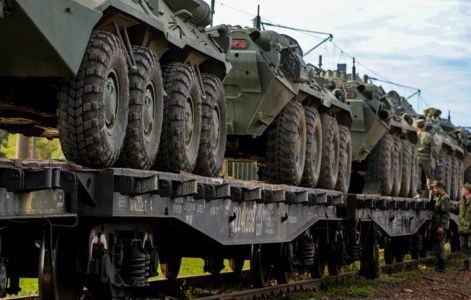
Russia continues to build up troops near Ukraine even after the two-hour call between the presidents of Russia and the United States, Voice of America reports, citing Western sources.
Joe Biden then warned that Russia would pay a "terrible price" in the event of an invasion of Ukraine.
Two days after their video conference in early December, motorized infantry units were moved from St. Petersburg to a camp east of Kursk, which is 100 kilometers from Ukraine, Janes intelligence company reported.
A day after the conversation, videos were posted on social media showing Buk missile systems and armored vehicles arriving at the railway station in Voronezh.
Russia has concentrated forces near Yelnya, Voronezh and Persianovka, which are 100-300 kilometers from Ukraine.
Also, units of the 49th and 58th armies have still not returned from occupied Crimea to their bases in the Caucasus.
According to the outlet, American and European intelligence and security officials say they do not believe an invasion is inevitable.
There is still no key logistical support, in particular sufficient stocks of fuel and ammunition.
According to their data, 70,000-100,000 military personnel have been deployed near Ukraine's borders.
At the same time, officials believe that Russia would need about 175,000 for a possible invasion.
"We must use every opportunity to stop the escalation," said Germany's new Defense Minister Christine Lambrecht on Sunday.
In particular, this refers to warnings of harsh sanctions.
Meanwhile, Ukrainian President Volodymyr Zelensky repeated his call on Western countries to impose preventive sanctions.
VOA notes that the West still lacks unity over Putin's possible intentions.
Last week, Italian Prime Minister Mario Draghi noted that the video call between Putin and Biden shows that the Kremlin is using diplomacy and is not preparing for action.
Italian officials believe that new Russian draft defense agreements also indicate that Russia wants further negotiations.
"Some commentators are skeptical that Putin plans to abandon his maximalist demands, and suspect that he will continue what they consider 'coercive diplomacy,' using the threat of war to keep the West and Ukraine on edge," the article says.
The author quotes former US Ambassador to Russia Michael McFaul, who believes that Putin has "reinvented the so-called threat" from NATO to justify these diplomatic methods and a likely intensified invasion of Ukraine.
Detmer also quotes Russian foreign policy expert and Kremlin adviser Fyodor Lukyanov.
He notes that the Kremlin has reached a "point where the long-standing dispute over NATO expansion needs to be resolved somehow," and is ready to raise geopolitical stakes.

Russian Attacks in Dnipropetrovsk Region: Two Killed, Seven Injured

Defense Forces Strike Four Russian Drone Control Points in Past Day, Including in Berdiansk

Britain Threatens Sanctions on Kremlin-Linked People; Poland Ready to Hand Ukraine Ammunition

Russia says it has completed "planned exercises" in the Black Sea

MVD: Fake Riots With Prop Blood Were Being Prepared Near Presidential Office

Law Enforcers Name Another Klitschko Deputy as Suspect

Berlin Holds Protest Against War in Ukraine; EU Prepares for Possible Russian Halt of Gas Supplies
North Korea Fires Ballistic Missile Over Record Distance in Five Years
Irish Fishermen Force Russia to Postpone Naval Drills

US sanctions in case of invasion of Ukraine could completely destroy Russia's economy, NYT reports
