
Russia Can't Carry Out a Rapid Invasion of Ukraine Due to Truck Shortage, Forbes Reports
US and Ukrainian military intelligence report that Russia is preparing provocative special operations.
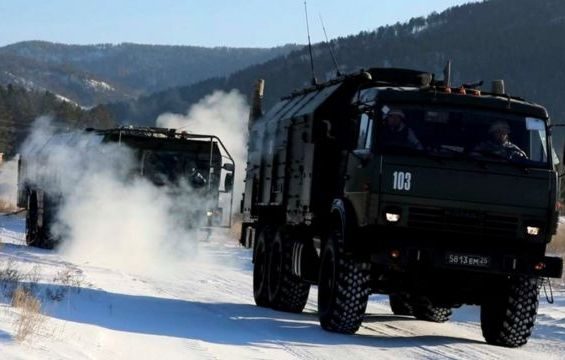
Russia's army lacks the trucks needed to quickly transport equipment in the event of a full-scale invasion of Ukraine. This is reported by the American publication Forbes, citing Lt. Col. Alex Vershinin of the US Army.
Vershinin said the Russian army lacks the trucks needed to meet logistical demands for transporting equipment about 145 km from its ammunition depots.
According to him, the Russian army has 10 logistics brigades. Each controls about 400 trucks. Even if it is assumed that the Russians mobilize every brigade and all trucks remain serviceable throughout the entire military campaign, the available trucks will not be enough.
Although each army has its differences, usually one army (as a military formation – ed.) has between 56 and 90 multiple rocket launchers.
To load just one launcher for a salvo, the ammunition fills the entire truck bed. That means that if one army plans to fire one salvo, between 56 and 90 trucks must be used simultaneously.
To replenish the launchers for a single salvo, half of one logistics brigade's ammunition delivery capacity would have to be diverted.
However, (also deployed near Ukraine's borders – ed.) 6 to 9 field artillery battalions, 9 air defense battalions, 12 mechanized infantry and reconnaissance battalions, 3 to 5 tank battalions, mortars, anti-tank grenade launchers, a heap of small arms, and supplies of food, medicine and engineering equipment must also be delivered».
Experts in the article argue that the Russian military leadership depends on the serviceability of its railways and transport wagons. Equipment and personnel were mainly delivered to Ukraine's borders by rail.
However, Russian trains cannot approach the front line on Ukrainian territory. To carry out the Russian army's combat tasks promptly and without interruption, it will have to use trucks.
Experts suggest that the Russian military command may decide to deliver ammunition and munitions by helicopter or civilian vehicles, but in their view this would also be insufficient.
The authors of the article stress that the Ukrainian army should take this logistical weakness of the Russian army into account. In the event of a full-scale Russian invasion, they advise Ukrainian command to also consider 'boring,' as they put it, targets, including Russian trucks.
US and Ukrainian military intelligence: Russia plans a provocative special operation
The US has received information that Russia is preparing a special operation in eastern Ukraine, aimed at staging a fake attack on Russian troops, blaming Ukraine for it and responding with an invasion of the neighboring state, reports CNN , citing US officials.
According to one official, Russia has trained a whole group of operatives for this purpose. They completed a special course in urban combat and the use of explosives for sabotage.
US National Security Adviser Jake Sullivan promised that within the next 24 hours his agency would have more details on Russia's insidious plans and that he would share them with the press.
The official said Russian military plans to launch this operation several weeks before the invasion, which could take place between mid-January and mid-February.
According to him, the US has also noticed that Russian 'influence agents' have recently begun promoting among Russians, particularly on social media, the topic of an invasion of Ukraine due to the alleged 'deterioration of the human rights situation in the country' and 'rising militancy among Ukrainian leaders.'
Ukraine's Defence Ministry Main Intelligence Directorate also reports in its report that Russian special services are preparing provocations against Russian Armed Forces personnel stationed in occupied Moldovan territory, in order to blame Ukraine.
«According to Ukrainian military intelligence, on January 13 a service meeting was held in the 3rd Separate Motor Rifle Brigade of the Russian Armed Forces in the Transnistrian region of the Republic of Moldova, during which personnel were informed that provocations from Ukraine are expected in the area of the village of Kolbasnaya (artillery depots of the Russian operational group of troops)», the Main Intelligence Directorate of the Ministry of Defence reports.
It is noted that orders to bring the brigade to the highest levels of combat readiness were not announced, but personnel were required to be ready to carry out assigned tasks 'on the first command.'
It is also reported that as of today, leave and discharges of personnel have not been cancelled, but commanders have been ordered to inform subordinates that they must report to their unit upon a specific signal.

Russian Attacks in Dnipropetrovsk Region: Two Killed, Seven Injured

Defense Forces Strike Four Russian Drone Control Points in Past Day, Including in Berdiansk

Britain Threatens Sanctions on Kremlin-Linked People; Poland Ready to Hand Ukraine Ammunition

Russia says it has completed "planned exercises" in the Black Sea

MVD: Fake Riots With Prop Blood Were Being Prepared Near Presidential Office

Law Enforcers Name Another Klitschko Deputy as Suspect

Berlin Holds Protest Against War in Ukraine; EU Prepares for Possible Russian Halt of Gas Supplies
North Korea Fires Ballistic Missile Over Record Distance in Five Years
Irish Fishermen Force Russia to Postpone Naval Drills

US sanctions in case of invasion of Ukraine could completely destroy Russia's economy, NYT reports
