
The Prosecutor General Messaged Me, but I'm Not Sure. How to Spot a Prankster?

A selection of simple tips for Servant of the People (and not only).
What happened?
An anonymous prankster calling himself “Joker” is terrorizing Ukrainian politicians. The victims of the pranks may have included People's Deputies Bohdan Yaremenko, Mykhailo Radutskyi and Mykola Tyshchenko — all of them deputies from the political force Servant of the People. All of these people's elected representatives were messaged by a contact posing as Ukraine's Prosecutor General Ruslan Riaboshapka.
“A Traitor Among Traitors”: Tyshchenko Complained to Fake Riaboshapka About the Situation in Servant of the People
However, the fact of the correspondence was confirmed only by Mykhailo Radutskyi, who said that this contact had been saved in his address book as “Dunno,” and that he kept up a dialogue with the prankster in order to remember who his interlocutor was. People's Deputies Bohdan Yaremenko and Mykola Tyshchenko did not comment on the publications, and the only source of information about the correspondence is an anonymous Telegram channel, which means a low-reliability source of information.
At the same time, the threat of becoming a victim of a prank is very real. In previous years, various officials and politicians fell for prankster tricks, among them Ihor Kolomoisky and even Petro Poroshenko himself. Ordinary Ukrainians, clients of banks or mobile operators, can also become victims of fraudsters.
We spoke with media expert and information security specialist Volodymyr Koval and prepared a list of recommendations worth remembering before sharing secrets with unknown contacts who have added you on a messenger.
What should you remember when communicating with strangers on messengers?
- Check the phone number. Is your contact's phone number the real phone number of the person they claim to be? Pranksters often limit themselves to duplicating the name and photo of their target, faking the visual appearance of the account. Duplicating a phone number to make it more convincing is possible, but it requires extra effort and risks for the perpetrators. “Ordinary pranksters” often do not bother with this, preferring to look for easier victims who do not pay attention to details.
- Check the name, avatar and username of the user and compare them with the original contact. Look into your history of communication with the contact, if there was any. Fraudsters often have a cover story. If your interlocutor has two accounts and the cover story is “Hi! This is my second number, it's more reliable from this one” — ask again and confirm this information with the contact you communicated with before.
- Call them. Hear your interlocutor's voice and hold a short conversation, trying to verify their identity “by ear.” However, a phone conversation is not always a 100% guarantee. Modern technology makes it possible to fake a person's voice, but such technology is far from available to everyone. If your prankster has such technology, it means they are not an ordinary fraudster and you have fallen into the work of a serious specialist. If your interlocutor is a fraudster and has no way to copy the voice of the person they are pretending to be, the prankster will most likely try to avoid the call by citing being busy, a meeting, or being in a public place. This will be an important warning sign that the dialogue should be paused.
- Stop and think about whether what is happening is normal behavior for your interlocutor. Has the prosecutor general, for example, ever written to you before? Do you know him personally, and what is your relationship? Do you have common topics to talk about? If the communication is friendly, shapeless and lacking any constructive content, think again.
- Ask a question that only you and your interlocutor could know the answer to. Where and under what circumstances did you meet? What joke did he tell at a feast with your participation? The question should be one whose answer is hard to find in public sources: the names of a wife and children are not suitable.
- Ask your interlocutor's colleagues and mutual acquaintances. Does he really use this number or messenger account? Can you conduct a dialogue with him through this channel? When asking, mentally assess the literacy level of your colleague; perhaps they are also communicating with the prankster.
- If you still doubt your interlocutor's identity, it is better not to continue the communication and wait for identity confirmation in a face-to-face meeting. At the meeting, be sure to agree with your colleague on how you plan to stay in touch going forward (for example, through a specific account on a specific messenger) and stick to that plan. If, after agreeing on a specific communication channel, an unfamiliar contact claiming to be your interlocutor writes to you, do not continue the conversation without waiting for exact confirmation.
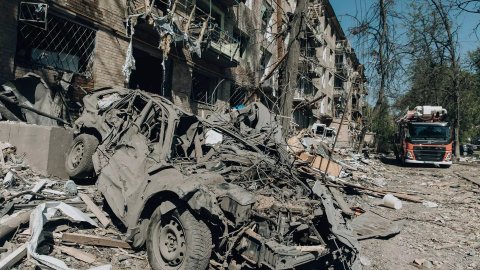
Zelensky: Russia Used 115 Missiles, Nearly 1,900 Guided Bombs and Over 3,000 Drones in a Week
Attack on Major DTEK Energy Facility in Northern Odesa Region Leaves Some Families Without Power

Britain Threatens Sanctions on Kremlin-Linked People; Poland Ready to Hand Ukraine Ammunition

Russia says it has completed "planned exercises" in the Black Sea

MVD: Fake Riots With Prop Blood Were Being Prepared Near Presidential Office

Law Enforcers Name Another Klitschko Deputy as Suspect

Berlin Holds Protest Against War in Ukraine; EU Prepares for Possible Russian Halt of Gas Supplies
North Korea Fires Ballistic Missile Over Record Distance in Five Years
Irish Fishermen Force Russia to Postpone Naval Drills

US sanctions in case of invasion of Ukraine could completely destroy Russia's economy, NYT reports
