
Bild: Kremlin's maximum plan to seize two-thirds of Ukraine, including Kyiv
Erdogan is ready to host a dialogue between Putin and Zelensky.
According to the German publication Bild, Russia is considering a plan to seize two-thirds of Ukraine, including Kyiv.
The information about a possible Russian invasion is based on assessments by several people from NATO and security services who were able to see some of Russia's possible attack plans.
A senior officer said that the plan to seize Ukraine is being considered by Putin, but a final decision has not yet been made.
It is noted that if Putin orders it, the Russian army will carry out a “simultaneous attack from northern Crimea and through separatist territories in the east and from the north.” The attack could allegedly take place “in late January or early February” if Ukraine and NATO do not respond to Putin's demands.
Other sources in NATO consider the attack to be in three phases. Each phase could become the last in the operation, depending on the West's reaction to the invasion.
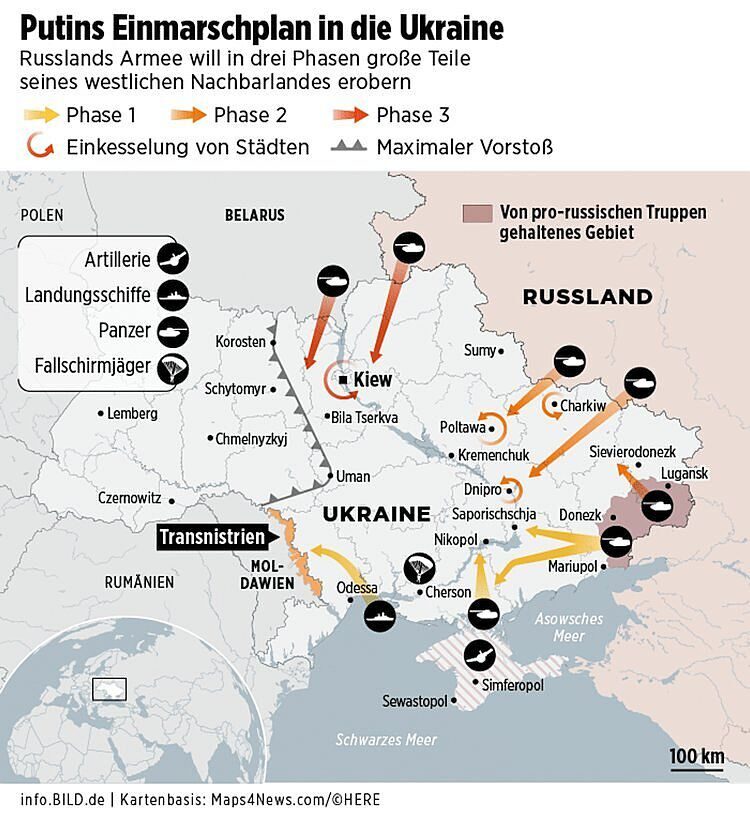
Phase 1: South. A security service officer said that in the first stage Russia plans to conquer southern Ukraine “to secure supplies to Crimea and also to cut Ukraine off from the sea and, consequently, from supplies.”
According to a senior Western intelligence officer, the Russian Federation plans to use landing ships transferred from the Baltic Sea “to transport tanks and troops from Crimea to the Odesa area.”
Another senior military official said that Russian plans envision a landing operation “east of Odesa, between the towns of Fontanka and Koblevo.” Troops “will advance to the northeast of the city, then turn left and advance toward Transnistria.” This would encircle Odesa.
In the Kherson region, along the Dnipro River, “special forces air assault operations” will be carried out at the same time, which will block the bridges over the country's most important river and cut off supplies. Artillery fire will be directed from Crimea at strong Ukrainian positions, which is meant to tie down Ukrainian forces.
Russian tank units will simultaneously advance west from occupied Donbas, then split and advance, on one side toward Zaporizhzhia and toward Crimea. If this succeeds, all of southern Ukraine will come under Russian control, and Putin will create a corridor from Russia to the NATO border with Romania.
Phase 2: Northeast. In parallel with the first phase, aviation and ballistic missiles plan to weaken Ukraine's military potential across the country.
If the Kremlin decides that the conditions for this have been met, Russian tank units could cross the border in the Luhansk and Kharkiv regions and advance toward the major cities of Dnipro and Poltava.
One of the officers said: “First of all, they will surround the cities and cut off electricity, gas and food. Within a few weeks, the Russians may present themselves as saviors of civilians, enter the capitulating cities and save the Ukrainian population from hunger or death.”
Phase 3: Kyiv. At this stage, the army will advance on Kyiv from the north. According to the publication's sources, this could happen at the beginning of the war if circumstances require it.
Sources in NATO are not sure whether Lukashenko's regime will take part in combat operations from Belarus. If Belarus joins the attack, Russia will be able to encircle Kyiv from the northeast and northwest.
Russian troops would then advance “roughly to the Korosten–Uman line to cut off supplies from western Ukraine. Then one could expect the capitulation of Kyiv, and therefore of Ukraine, under Western pressure.” As a result of this maximum plan, Russia could occupy about two-thirds of Ukraine's territory.
Another source said: “If Russia enters, sanctions will happen anyway. Then there is no point in stopping halfway.” A senior official noted that “Ukrainians will fight, but they will not be able to withstand a large Russian attack.” According to him, Kyiv's armed forces will withdraw to the west of the country “unless they are completely destroyed.”
Another officer said that American Javelin anti-tank missiles would not be enough for all Russian tanks, and Turkish Bayraktar drones would become easy prey for Russian combat aircraft. According to him, Ukraine will need modern Western air defense missiles such as Patriot and anti-ship missiles such as Harpoon to defend itself.
An officer of a Western security service said: “Allies are currently rethinking arms supplies to Ukraine. But this decision cannot come from NATO, only from its sovereign members.”
Erdogan is ready to host a dialogue between Putin and Zelensky
The press secretary of the Turkish president said that Ankara opposes any new escalation of tensions between Russia and Ukraine, and is therefore ready to provide a venue for dialogue and help promote it.
The spokesman for Recep Erdogan noted that the confrontation between Russia and Ukraine does not serve the interests of the whole region, including Turkey. Therefore, Ankara is ready to do everything within its power to prevent a new round of escalation in the region.
According to the spokesman, Turkey has good relations with both Moscow and Kyiv, so it can become a venue for dialogue between Vladimir Putin and Volodymyr Zelensky.
Ibrahim Kalin
press secretary of the Turkish presidentOf course, the best outcome would be for the issue to be resolved by the parties themselves, namely Russia and Ukraine; that would be the ideal option. However, if this does not work out, Turkey can play a role and make a constructive contribution to reducing tensions. Ankara is ready to create a venue for dialogue and, thanks to positive relations with both Moscow and Kyiv, take steps to prevent escalation. Many Western countries do not have such constructive ties with Russia, and in this sense Turkey stands out favorably. The final word, of course, rests with the parties themselves. The president of Turkey can take a constructive step and organize a dialogue between Putin and Zelensky, which will help reduce tensions.
Biden–Putin call
On December 7, a video call will take place between US President Joe Biden and Russian President Vladimir Putin, which will in particular address Russia's military activity on the border with Ukraine.
Jen Psaki
White House press secretaryThe leaders will discuss a number of topics in US-Russia relations, including strategic stability, cybersecurity and regional issues. President Biden will stress US concern over Russia's military activity on the border with Ukraine and confirm US support for Ukraine's sovereignty and territorial integrity.
Pentagon confirms US readiness to help Ukraine
The US is ready to provide Ukraine with everything it needs so that the country can defend its territory.
US Secretary of Defense Lloyd Austin once again expressed Washington's concern that Russia is massing troops near the border with Ukraine. According to him, the US is ready to “help Ukraine defend its sovereign territory.”
Austin said the US is ready to provide Kyiv with what it needs for defense. He noted that the United States will look for various forms of support for this, stressing that in the current situation “there is room for diplomacy and leaders’ work.”

Russian Attacks in Dnipropetrovsk Region: Two Killed, Seven Injured

Defense Forces Strike Four Russian Drone Control Points in Past Day, Including in Berdiansk

Britain Threatens Sanctions on Kremlin-Linked People; Poland Ready to Hand Ukraine Ammunition

Russia says it has completed "planned exercises" in the Black Sea

MVD: Fake Riots With Prop Blood Were Being Prepared Near Presidential Office

Law Enforcers Name Another Klitschko Deputy as Suspect

Berlin Holds Protest Against War in Ukraine; EU Prepares for Possible Russian Halt of Gas Supplies
North Korea Fires Ballistic Missile Over Record Distance in Five Years
Irish Fishermen Force Russia to Postpone Naval Drills

US sanctions in case of invasion of Ukraine could completely destroy Russia's economy, NYT reports
