
Nobel Prize in Medicine Awarded for Discovery of Temperature and Touch Receptors

This discovery could potentially be used in medicine, as well as in robotics and virtual reality.
The Nobel Committee in Stockholm named the laureates of the Prize in Physiology or Medicine: David Julius and Ardem Patapoutian, who discovered how temperature or, for example, touch are turned into human sensations.
In particular, the scientists discovered receptors that respond to mechanical stimuli on the skin and internal organs.
The ceremony was held remotely because of the coronavirus pandemic and was broadcast on the Nobel Committee’s website.
This discovery could potentially be applied in various fields, from medicine to virtual reality and robotics.
“The level of the discovery must be very high. It cannot be an invention or an improvement of something existing. It must be a genuine discovery,” the Nobel Committee said before the prize was presented.
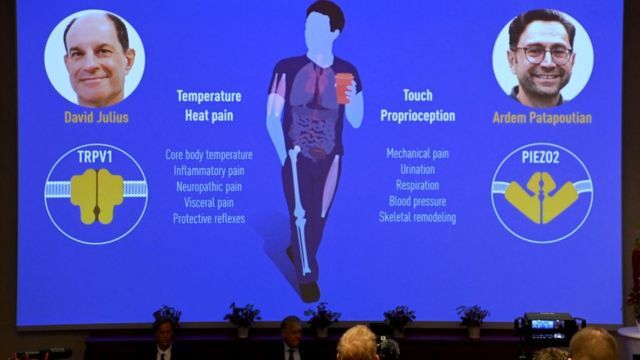
Born in 1955, Julius works at the University of California, San Francisco, and in recent decades has been studying the molecular mechanisms that help people sense touch and pain.
A group of scientists led by him identified a whole family of temperature-sensitive receptors that allow nerve fibers to detect high and low temperatures, using the properties of natural products, in particular hot chili pepper.
This is how Julius discovered the capsaicin receptor, which was later named TRPV1. This led the researcher to other discoveries as well.
When Julius was studying the ability of a protein to respond to heat, he realized that he had discovered a heat-sensitive receptor that is activated at temperatures the body perceives as painful.
Julius then identified the TRPM8 receptor, which is activated by cold.
David Julius and Ardem Patapoutian independently used menthol to identify this receptor.
The scientists identified ion channels associated with TRPV1 and TRPM8, which were activated by different temperatures.
“David Julius’s discovery of TRPV1 was a breakthrough that allowed us to understand how temperature changes can trigger signals in the nervous system,” the Nobel Committee said.
In addition to the mechanisms of temperature perception, scientists were interested in the still not fully understood mechanisms of touch.
Ardem Patapoutian began work on identifying receptors activated by mechanical stimuli.
Patapoutian and his colleagues managed to discover a single gene that makes cells sensitive to touch. A new ion channel was discovered, named Piezo1 (from the Greek “piezein,” meaning pressure). Later, a second gene, named Piezo2, was discovered.
The scientists established that Piezo1 and Piezo2 are sensitive ion channels that are activated when pressure is applied to cell membranes.
Patapoutian’s scientific breakthrough helped establish that Piezo2 is necessary for tactile sensitivity.
In addition, it plays a key role in the critically important sense of body position and movement.
Furthermore, the Piezo1 and Piezo2 channels regulate important physiological processes, including blood pressure, breathing and bladder control.
“The discovery of the TRPV1, TRPM8 and Piezo channels by the Nobel laureates has allowed us to understand how heat, cold and mechanical force can trigger nerve impulses that enable us to perceive the surrounding world and adapt to it,” the Nobel Prize website states.
This knowledge is used in medicine to treat many diseases, in particular chronic pain.
“This reveals one of nature’s secrets. It is truly what plays an important role in our survival,” said Thomas Perlmann, Secretary General of the Nobel Committee.
This week the Nobel Committee will announce the winners in five more fields. On Tuesday, the physics laureate will be announced, on Wednesday, chemistry, and on Thursday, literature. On Friday, the Nobel Peace Prize laureate will be announced in the Norwegian capital, for which 329 candidates are vying. The economics laureates will be announced on October 11.

Russian Attacks in Dnipropetrovsk Region: Two Killed, Seven Injured

Defense Forces Strike Four Russian Drone Control Points in Past Day, Including in Berdiansk

Britain Threatens Sanctions on Kremlin-Linked People; Poland Ready to Hand Ukraine Ammunition

Russia says it has completed "planned exercises" in the Black Sea

MVD: Fake Riots With Prop Blood Were Being Prepared Near Presidential Office

Law Enforcers Name Another Klitschko Deputy as Suspect

Berlin Holds Protest Against War in Ukraine; EU Prepares for Possible Russian Halt of Gas Supplies
North Korea Fires Ballistic Missile Over Record Distance in Five Years
Irish Fishermen Force Russia to Postpone Naval Drills

US sanctions in case of invasion of Ukraine could completely destroy Russia's economy, NYT reports
