
“False Information”. Facebook Starts Flagging Posts with “Unreliable Information” in Ukraine. And There Are Questions About It

Verification is carried out by “independent fact-checking companies”.
Facebook has started labelling posts with “unreliable information” from Ukrainian users. This was noted by blogger Oleksandr Gots — the social network flagged his post about Greta Thunberg's trip on German trains as false.
What does it look like?
Facebook darkens the photo and covers it with a large label reading “False information. Reviewed by independent fact-checkers”.
The label catches the eye before the user has time to read the post, so the reader forms an opinion in advance that the information is unreliable.
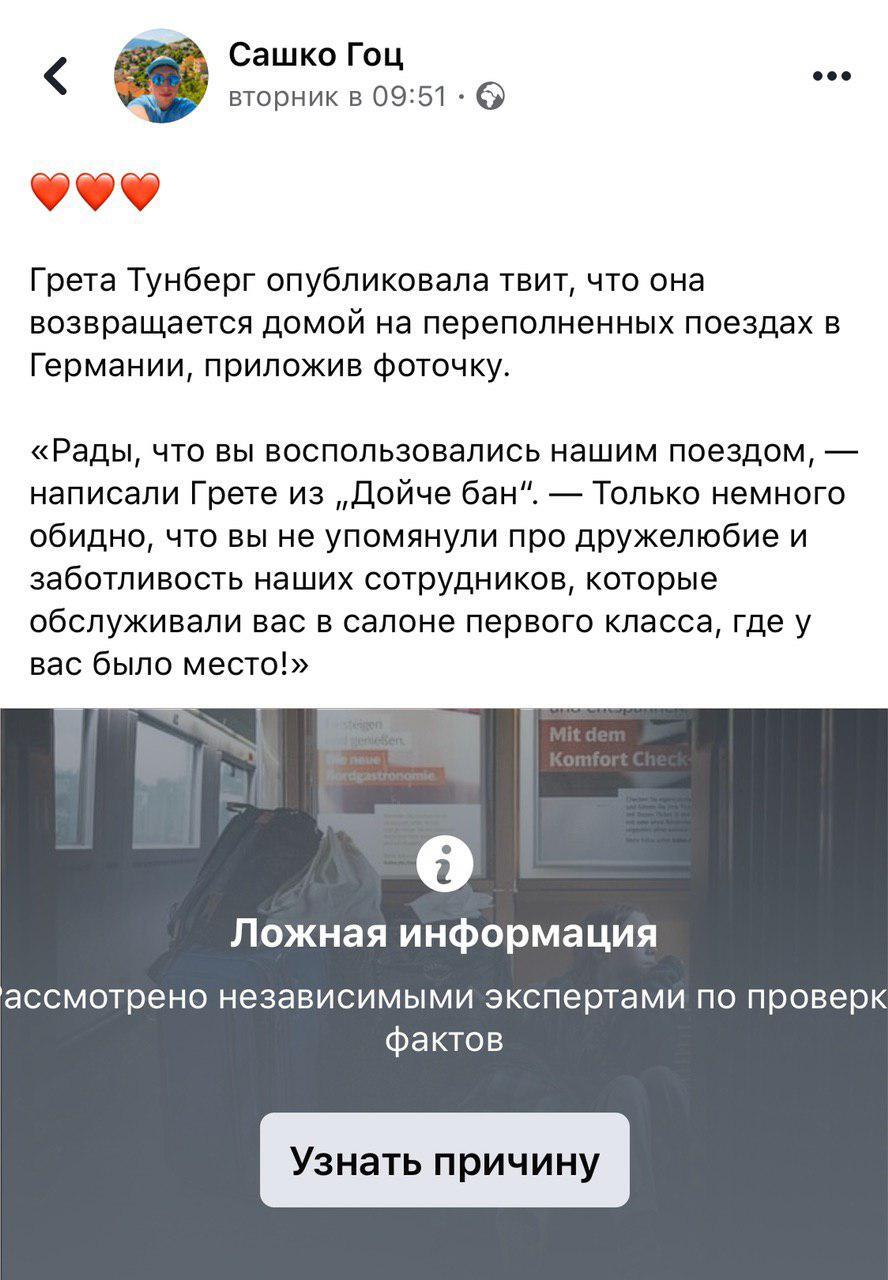
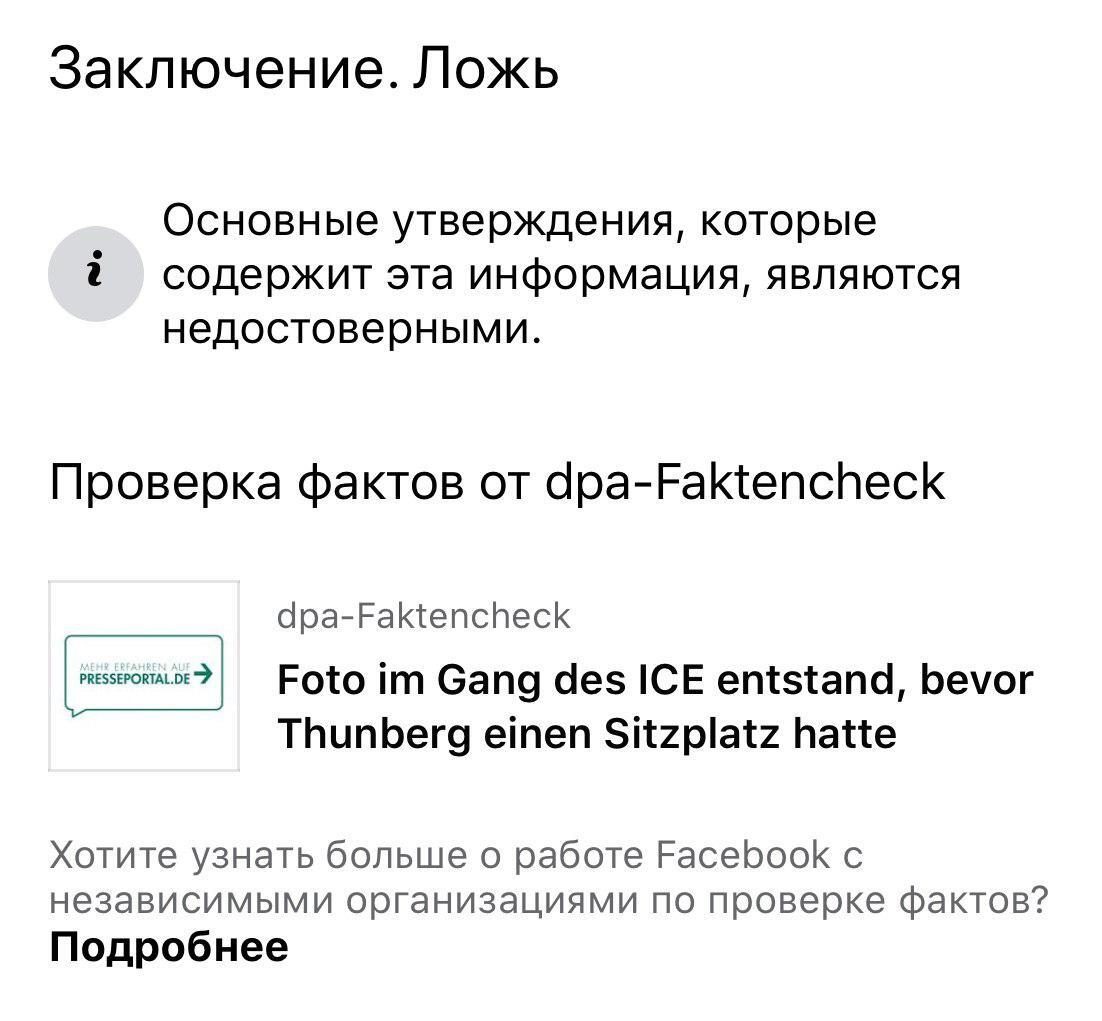
The social network also offers a way to find out the reason for the decision: when the button is clicked, Facebook shows which organisation reached this conclusion. Visiting the organisation's website allows one to read the findings. Users can also hide the label by clicking the “See Photo” button.
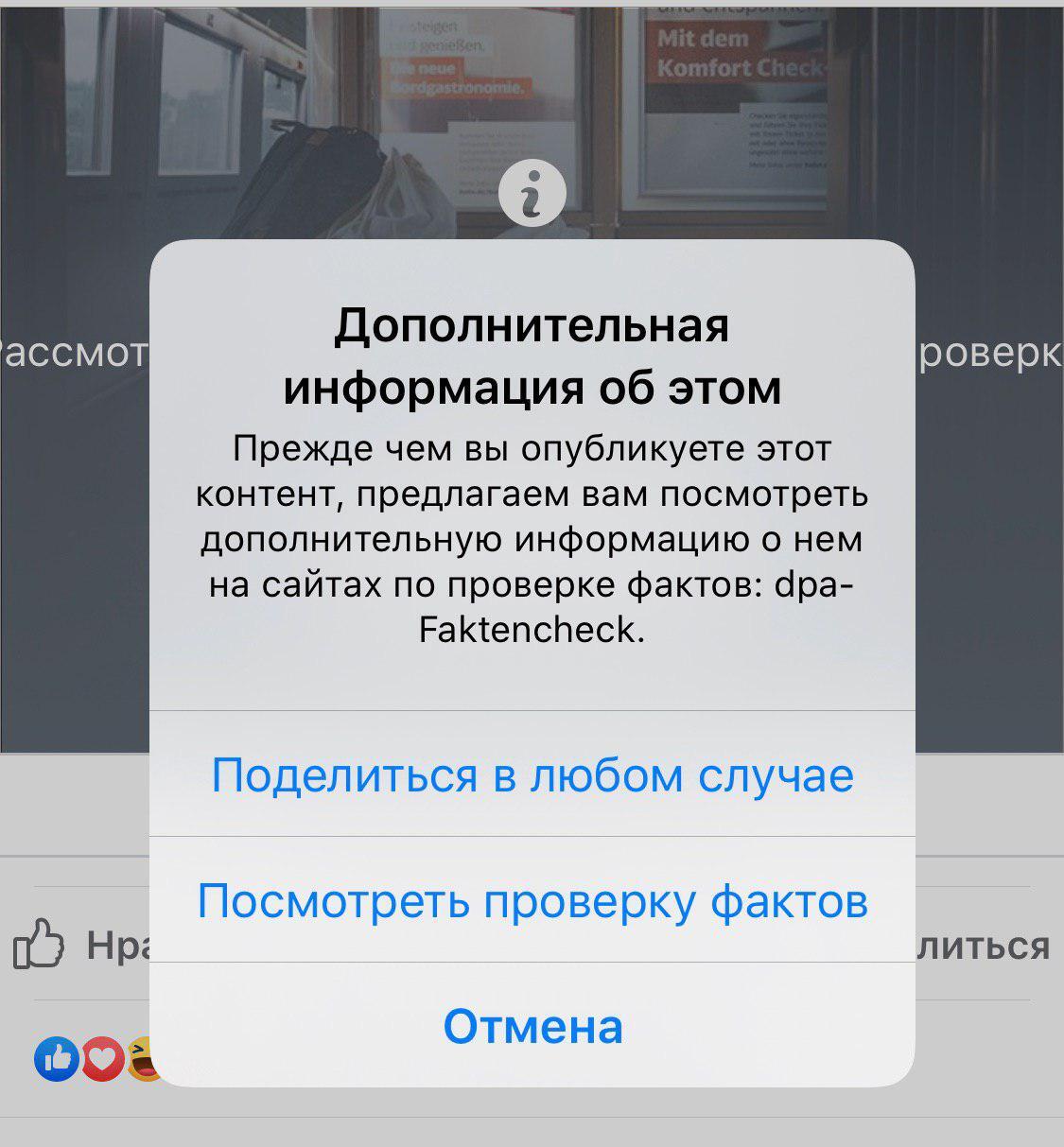
In addition, Facebook issues an extra warning when a user tries to share the post, asking them to confirm their choice and review the fact-check report on the post.
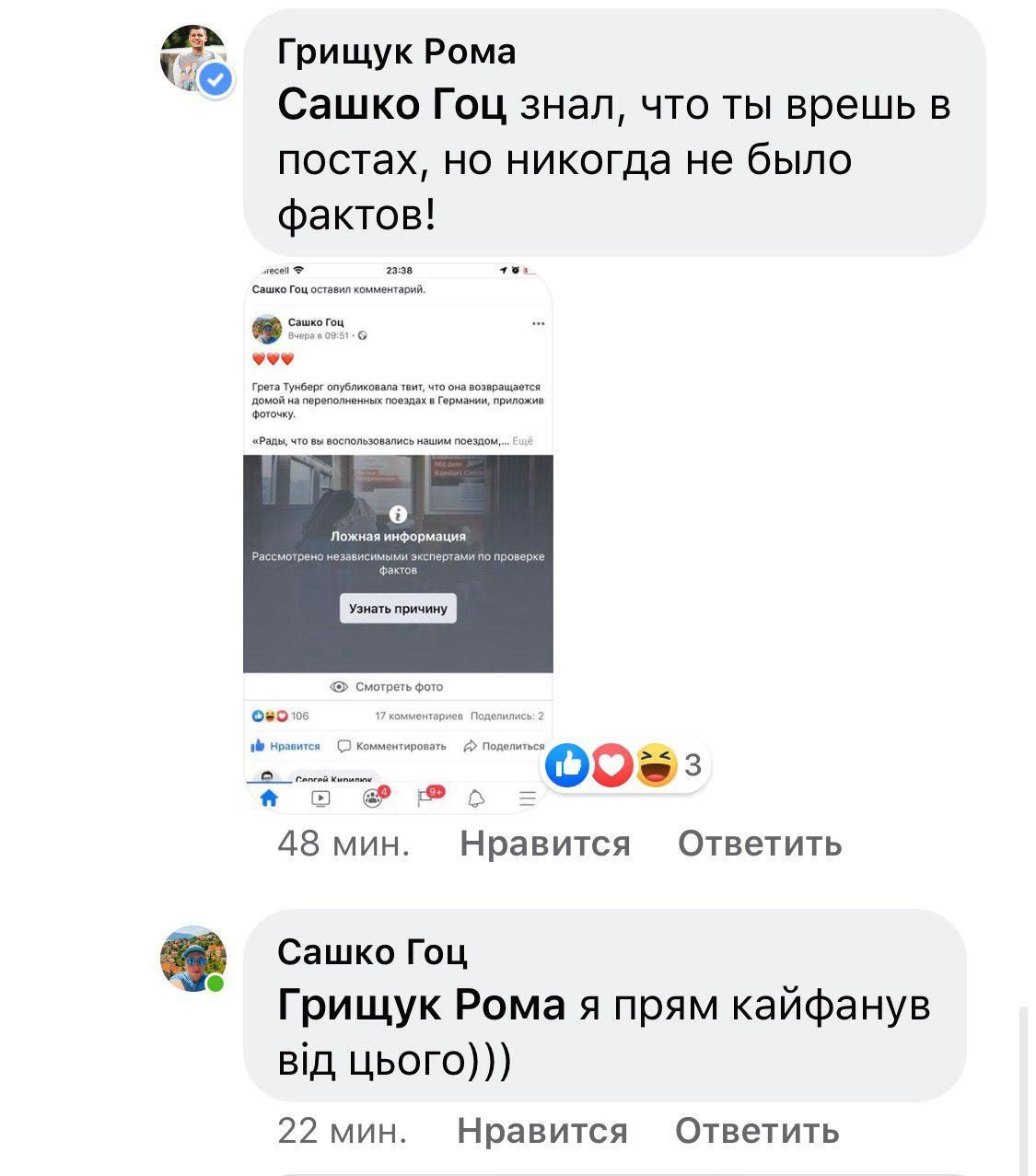
Users reacted to the change with humour. “I knew you were lying in your posts, but I never had the facts,” MP Roman Hryshchuk wrote in the comments.
What is wrong with this change?
Facebook selectively assesses users' posts, and its actions may look like an attempt to establish a “monopoly on truth”. The post by Oleksandr Gots was checked by the German company “dpa-Faktencheck”. In the organisation's report, the user is attributed statements he did not make.
From the fact-checking company’s report
...“The Facebook message claims the photo is “a fake” and “an outright lie” because, according to the railway company, Thunberg had a seat in first class.
Facts: Greta Thunberg travelled with Deutsche Bahn from Basel to Kiel on 14 December 2019. Late in the evening she posted the photo on the Twitter microblogging service. The next day, the press service of Deutsche Bahn thanked the climate activist on Twitter for travelling on ICE 74. The company added: “It would have been even nicer if you had also mentioned how friendly and competent our team looked after you in your seat in first class.” Thunberg responded. Her train from Basel broke down, so she had to ride on the floor of two different trains, Thunberg wrote on Twitter on Sunday...”
In his post, Gots cites a reliable source: the official Twitter account of the German railway company. In turn, the claims of Facebook and the fact-checking organisation “dpa-Faktencheck” boil down to the user not including in his post the railway company's response from Greta Thunberg, which can hardly be called “false information”.
Greta Thunberg Called for Politicians to Be “Put Against the Wall”. Then She Apologised
As actor Yevgeny Yanovich noted in the comments to Oleksandr Gots's post, Facebook also flagged Greta Thunberg's own post as containing “unreliable information”. The Thunberg and Gots posts contain the same photo: the eco-activist sitting on the floor of a German train. From this one can conclude that Facebook labels as “unreliable information” posts that contain this photo. However, the posts by Greta Thunberg and Oleksandr Gots have diametrically opposite meanings: in the first case the eco-activist points to the problem of overcrowded trains, while in the second Oleksandr Gots quotes the railway company, which states that Thunberg was travelling in first class.
On 2 December, Facebook first marked a user's post as unreliable. Earlier, Facebook's public policy manager in Ukraine Yekaterina Kruk , speaking at the forum “Key Challenges to Freedom of Speech on the Internet: The Ukrainian and Global Context”, said that the company would begin a campaign to counter disinformation in Ukraine as early as 2020.
Yekaterina Kruk
Public Policy Manager, Facebook in UkraineWe are now preparing to expand the global programme to counter disinformation in Ukraine. We have a system that has been tested around the world — a programme called “Third-party fact-checker”. We work with local fact-checking organisations that help us verify content. This works on several principles — of course, we use machine learning and ask fact-checkers to verify our internal predictions about which information or which websites may be manipulative. They can also monitor and send information to us themselves

Zelensky: Russia Used 115 Missiles, Nearly 1,900 Guided Bombs and Over 3,000 Drones in a Week
Attack on Major DTEK Energy Facility in Northern Odesa Region Leaves Some Families Without Power

Britain Threatens Sanctions on Kremlin-Linked People; Poland Ready to Hand Ukraine Ammunition

Russia says it has completed "planned exercises" in the Black Sea

MVD: Fake Riots With Prop Blood Were Being Prepared Near Presidential Office

Law Enforcers Name Another Klitschko Deputy as Suspect

Berlin Holds Protest Against War in Ukraine; EU Prepares for Possible Russian Halt of Gas Supplies
North Korea Fires Ballistic Missile Over Record Distance in Five Years
Irish Fishermen Force Russia to Postpone Naval Drills

US sanctions in case of invasion of Ukraine could completely destroy Russia's economy, NYT reports
