
Reconstruction of Kyiv's Khrushchyovkas: The Price Tag Is $2.7 Billion
Material by Big Kyiv.
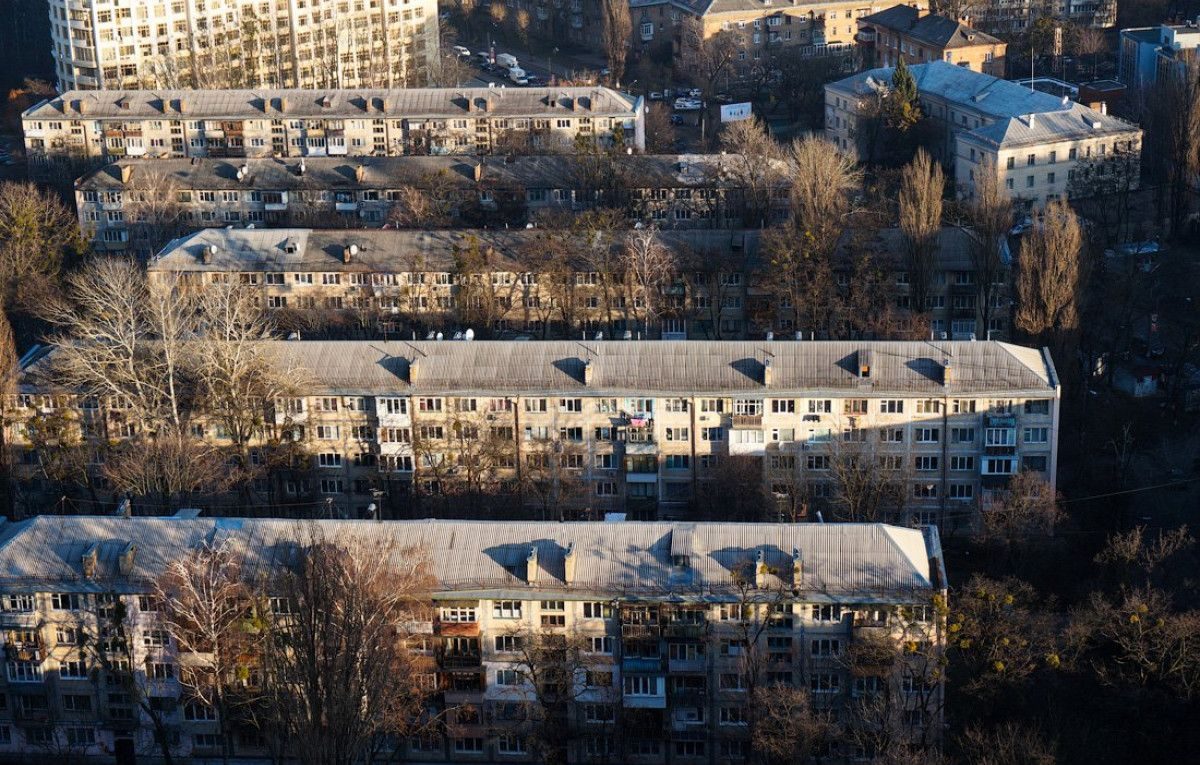
The first Khrushchyovka was built in 1957. It was then considered a temporary solution for 25 years, one generation. Now the adult grandchildren of the original owners live in these "temporary homes," and the problem of outdated buildings deepens every year.
Andrey Pereguda, an experienced builder and head of a company, has comprehensively studied the history of the issue, the depth of the problem and ways to solve it. Although official estimates by the Kyiv City State Administration put the cost of reconstructing the city's Khrushchyovkas today at $2.7 billion (or €2.5 billion), he insists the sum will be even larger tomorrow.
Options for solving the problem
In fact, there are only two such options: renovation and reconstruction.
Quarter-by-quarter renovation
This is the comprehensive demolition and renovation of entire quarters. It means that not individual buildings but a whole quarter is torn down. Then everything is rebuilt on the "clean site": houses, courtyards, road infrastructure (roads, inter-yard passages, parking), public spaces (for example, a kindergarten and a square), commercial space (offices, shops), utilities (heating networks, water and sewage pipes, power grids), and so on.
Problems of the concept:
- high cost;
- duration (at least one year),
- the question of temporary housing for residents of the quarter and the related logistics.
Advantages of the concept:
- a comprehensive solution to all problems, both of the buildings and of the quarter's infrastructure;
- a longer service life of the new buildings (compared with reconstruction).
Reconstruction of buildings
Existing housing can be reconstructed, even each building separately. The main question is how dilapidated the current condition is. To determine this, a building audit is needed, which will show whether it makes sense at all: sometimes it is cheaper to demolish and build "from scratch." The audit will also provide an idea of the list of necessary works, a plan for carrying them out, and an estimate.
Problems of the concept:
- not suitable for all buildings;
- residents must live for several years in a situation of periodic repairs with all the consequences, for example, shutdown of utilities for relaying, dust, noise, etc.;
- a shorter service life of a reconstructed building compared with a new one.
Advantages of the concept:
- lower cost compared with renovation;
- residents do not have to move anywhere.
Foreign experience
Europe has many countries and cities that were once built up with Khrushchyovkas: eastern Germany, Poland, the Baltic states and others. The "problematic" nature of these quarters, built in the 1950s and 1960s and designed for one generation, began to be discussed in these countries on the eve of the collapse of the Soviet system.
In Germany, for example, reconstruction of buildings began as early as 1989 and continued until roughly the early 2000s. According to calculations, this path was 30% cheaper than demolition: the cost of work per apartment in a building averaged 20,000 euros. These funds were allocated from the budget, and money from the residents themselves was also attracted.
However, German cities now mainly undertake quarter-by-quarter renovation. First, three decades have passed since the start of the campaign in 1989. Accordingly, the Khrushchyovka's lifespan has already been exceeded twofold (instead of 25-30 years it has become 50-60). The technical condition of the buildings deteriorated simply from aging, and the Germans decided that modernizing this housing made no sense: it is better to build new than to pour money into something that will fall apart completely in 10-15 years.
Poland and the Baltic states, trying to economize, mostly reconstruct Khrushchyovkas rather than demolishing them. They conduct an audit, draw up a work plan and implement it step by step.
The financing scheme for reconstruction involves attracting funds from the European Union, the state budget, local budgets, the residents' own funds, and donor money from European structures. The condition and stage of its modernization (what has been done, what needs to be done, how long it will continue and how much it will cost the owner) are all one of the significant factors and affect the value of the housing.
There are no other successful cases of solving the Khrushchyovka problem.
Ukrainian "uniqueness"
Foreign experience is good, but one should always make allowances for Ukrainian realities.
Technical differences between buildings. The problem with Kyiv's Khrushchyovkas is their design differences despite formal similarity. Under identical conditions, their current state depends on a host of factors, some of them non-obvious. For example, panel Khrushchyovkas of the 1970s are generally in worse condition than buildings from the late 1950s, which are 15-20 years older. And even buildings commissioned in the same year in the same district can differ! One may be built of concrete blocks, another with the same layout of brick, and a third of brick blocks. The worst among them will be precisely the "panel" type. Therefore, it is quite possible that some buildings make sense to reconstruct, while others should only be demolished.
Poverty. Objectively, our compatriots have fewer resources than Germans or Estonians. And the money people do have, they are not willing to invest in comfort unless it concerns their own square meters. Because everyone reasons this way: if I give money and my neighbor does not (it is understood that there are many residents of Khrushchyovkas who really have no money, and there are quite a few of them), then he will use the benefits paid for by me. And our "conditionally solvent" resident does not pay.
Distrust as a basic national trait. Ukrainian citizens initially distrust any initiative, whether state, municipal or private. This is a problem of mentality, where there is much knowledge and bitter experience of "schemes," "scams" and ways to "cheat fate"; yet there is no notion of mutually beneficial partnership even as a theoretical option. Simply put, Ukrainians always look for where the deception is. And if they do not see it right away, they become even more convinced that it is there, just not obvious.
Paternalism. People say: we do not agree to anything at all, first build new housing at the expense of the budget, offer it to us, and then we will think about whether it is profitable for us or not. If yes, maybe we will move, and if not, we will live in a dilapidated building. Because "it can't get any worse." And they are mistaken. First, unfortunately, an effective system does not work: there are only two paths, described in foreign experience. And second, it will get worse, and much worse. The question is how quickly it will get worse and what exactly will happen to the building: the roof will collapse or gas will explode. And the further it goes, the more often we will hear about such cases.
Experience of solving the issue in Ukraine. Spoiler: unsuccessful.
The domestic experience of reconstructing Khrushchyovkas is only piecemeal, for individual buildings. It is, in fact, divided into "private" and "state."
Private experience. There are isolated examples when a specific developer is interested in building on a certain plot of the city and negotiates with all the residents of a separate building. In such a case the following algorithm applies: resettlement and provision of new housing, larger in area, in a new building constructed by the developer. But even in these cases a mass of problems arises. It may be the disagreement of a couple of residents who, for personal reasons, do not allow the initiative to be put into practice. It may be the "lulling" of questions by local authorities, where there are always lovers of manipulation as well. If these factors combine, the problem "hangs in the air" for years, and people, also for years, do not carry out repairs and curse the "criminal authorities."
State experience. It too is piecemeal, and it too has been unsuccessful. An experimental project of this kind was, for example, the Khrushchyovka on Hryhorenko Avenue in Kyiv. In the early 2000s it was fully reconstructed, with an additional floor added. But the project turned out to be unprofitable: the money received from selling the apartments on the top floor did not even cover the costs of modernizing the building. Architects calculated that the project cost the state as much as building a nine-story building from scratch would have! On the other hand, six floors remained, of which only one was sold. Perhaps if the building had been demolished and a high-rise erected, it would have made financial sense. But no one dared to check this, and the problem was simply mothballed.
Legislative framework: the current law vs a new draft law
Currently, all these isolated examples are carried out on the basis of the 2006 law, developed on the initiative of the Tymoshenko government. At the time, this document was announced and publicized with great fanfare. It can be applied if all residents and the developer manage to reach agreement. But in the 14 years the law has been in force, the real cases of its application can be counted on one hand, and these examples, as we have seen, were unsuccessful. This means the law exists, but it does not work.
In 2019, the Ministry of Regional Development, Construction and Housing and Communal Services tried to launch a process of renovating housing built 50 years ago. Specialists of the agency developed a draft law "On the comprehensive reconstruction of quarters of outdated housing stock." It is somewhat different and more "viable" at least on paper.
Difference: the percentage matters. The current 2006 law provides for the process of demolition and construction of a new building in place of a Khrushchyovka only with the consent of 100% of all residents. The new draft law proposes lowering the "bar" to 75% of those in agreement. After these signatures are obtained, the following algorithm should apply:
- the city must announce a tender for construction;
- residents must be relocated to temporary housing for the duration of construction;
- after completion of works and commissioning of the new building, ownership of the new apartments is transferred to the residents of the demolished Khrushchyovka.
Difference: the area coefficient matters. The current 2006 law provides that in newly built houses people must receive apartments 1.5 times larger in area than their previous ones. Therefore, if a resident owned 40 square meters, after resettlement they must receive no less than 60 "square meters." The new draft law, however, provides that the compensation coefficient for owners of outdated housing will be determined by local authorities.
Restrictions for local authorities
It is clear that the path from draft law to law is long, and from law to its implementation, into practice, is even longer. But until this draft law is adopted, local authorities cannot:
- determine the compensation coefficient;
- properly work with the city plan;
- conduct explanatory work with residents of Khrushchyovkas;
- organize tenders.
What the capital's authorities can do now is keep records of Khrushchyovkas, create estimates that will lose relevance tomorrow, and also... eliminate the consequences of accidents, which are happening more and more often.
Inventory data: quantity and cost in numbers
Last year the Kyiv City Council took a decisive step and decided to conduct an inventory of outdated housing stock.
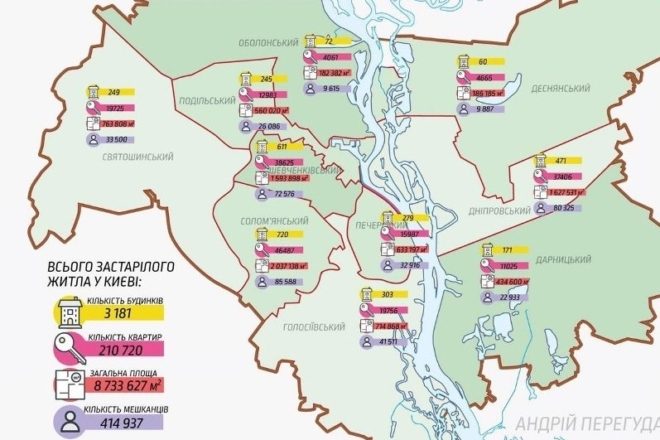
The inventory results showed that in Kyiv:
- Khrushchyovkas: 3,181;
- Khrushchyovka apartments: 210,720 apartments;
- total area of these premises: 8,733,627 square meters;
- 414,937 Kyiv residents live in them.
This means that almost every sixth residential building in Kyiv is unfit for habitation. Nearly 9,000,000 square meters of residential space in the city are either emergency or require urgent major repairs, and almost half a million Kyiv residents live in them.
The largest number of such Khrushchyovkas is in Solomianskyi District, up to 720. Another 611 are in Shevchenkivskyi District, 471 in Dniprovskyi. About 300 each in Holosiivskyi, Pechersk, Podilskyi and Sviatoshynskyi. 171 in Darnytskyi. Fewer than 100 in Obolonskyi and Desnianskyi.
In Solomianskyi District, the most saturated with these buildings, 85,588 people live in such conditions. This is 46,487 apartments with an area of 2,037,138 square meters, a quarter of the capital's "Khrushchyovka housing stock."
According to the already developed renovation projects for the capital's Khrushchyovkas, the cost of work is more than 280 euros per square meter of total area. Accordingly, renovating all these buildings in Kyiv alone requires a minimum of 2.5 billion euros. In principle, in practice in the capital's development, the cost of renovation is comparable to the cost price of cheap housing construction.
Plans
Nevertheless, according to current projects and plans of the city authorities, the entire outdated housing stock of Kyiv is not subject to demolition or dismantling. It is planned to develop a plan for renovating Khrushchyovkas.
This means that residents will not be forcibly evicted, as, for example, was done in Moscow. But is this good or bad? There is no unambiguous answer.
There is an information resource where you can check the current status of a specific building in Kyiv: its parameters, current status, degree of dilapidation, planned repairs and the like.
Summary
For now it is clear that demolishing and building up the same Solomianka is not a solution. This is not Pozniaky with private development; this is an old district inside the city that cannot be "cut to the living."
It is obvious that political will is needed: to finally choose renovation, modernization or a combination of them for Khrushchyovkas. Political agreement and consensus are also needed, which would allow the global problem to be addressed lawfully through specific pilot projects. As soon as people see how the living conditions of their neighbors, the appearance of the city and the quality of the housing stock improve, they will stop resisting.
The task of central authorities. It is obvious that adopting a new law, whatever mechanism for solving the problem it proposes, would at least open a window of opportunity for both authorities and residents of Khrushchyovkas. The absence of a law or its "non-viability" only fixes the status quo, driving the problem into a dead end. After all, all Kyiv's Khrushchyovkas will simply collapse, this year or in the next decade. Understanding this, people simply will not invest even in current repairs! It is clear that without an effective algorithm for solving the issue that is acceptable to most residents, the matter will, after the next accidents and, God forbid, victims, be decided by local authorities. And this will be done at the expense of the city budget, which means at the expense of all Kyiv residents.
The task for the capital (local) authorities. With a law in place and proper management, the Kyiv authorities could easily attract investors. Developers are more than interested in areas in the city center, in old districts such as Solomianka. Therefore, local authorities, on the basis of the current law and the general mechanism, should have proposed clear and transparent rules for each side, understandable to all: residents of Khrushchyovkas and developers. And then they should have monitored compliance with these rules by all participants in the deal, acting as an intermediary and protecting the rights of both sides. Over ten years, having accumulated and adapted models, it would have been possible to move on to the problematic nine-story panel buildings, of which there are also many.
Material Big Kyiv
Zelensky: Russia Used 115 Missiles, Nearly 1,900 Guided Bombs and Over 3,000 Drones in a Week
Attack on Major DTEK Energy Facility in Northern Odesa Region Leaves Some Families Without Power

Britain Threatens Sanctions on Kremlin-Linked People; Poland Ready to Hand Ukraine Ammunition

Russia says it has completed "planned exercises" in the Black Sea

MVD: Fake Riots With Prop Blood Were Being Prepared Near Presidential Office

Law Enforcers Name Another Klitschko Deputy as Suspect

Berlin Holds Protest Against War in Ukraine; EU Prepares for Possible Russian Halt of Gas Supplies
North Korea Fires Ballistic Missile Over Record Distance in Five Years
Irish Fishermen Force Russia to Postpone Naval Drills

US sanctions in case of invasion of Ukraine could completely destroy Russia's economy, NYT reports
