
Things to Do During Quarantine: 6 Wins, 2 Draws and 2 Losses Worth Revisiting
An option for sports pastime at home.
Dynamo — Atletico 3:0 (Cup Winners' Cup final, 1985/1986)
Valeriy Lobanovskyi on the bench, nimble technician Oleksandr Zavarov, explosive Ihor Belanov and the already fading but still skillful Oleh Blokhin on the pitch. That team was special, and it is no surprise it was able to lift a European trophy for the second time in the club's history.
That match at Lyon's Gerland Stadium is a great way to understand what speeds football was played at almost 35 years ago, where Blokhin's arrogance came from, why Belanov was given the Ballon d'Or, and why Zavarov was invited to Juventus.
Vasyl Ivanchuk — Garry Kasparov (Linares, 1991)
Ivanchuk approached the match against the great Garry Kasparov, then world champion, as a young star who had led the USSR national team at the World Olympiad in Novi Sad the previous year. But in Linares, where Anatoly Karpov also took part, he was certainly not the favorite.
That, however, was only a matter of time: the first chess game against Kasparov at that tournament in Spain confirmed it. As did his game against Karpov there, which also ended in victory for the Ukrainian.
Serhiy Bubka (Sestriere, 1994)
There is no point listing all of Serhiy Bubka's achievements in pole vault. He was the dominant figure in the event throughout his career and retired undefeated. His record jump in Sestriere, Italy (6.15 m), was beaten only in 2014 by Frenchman Renaud Lavillenie, but the 56-year-old from Luhansk still remains the best outdoor pole vaulter.
Oksana Baiul (Olympic Games, 1994)
At the 1994 Games in Lillehammer, no one expected gold from the 16-year-old Ukrainian figure skater, even though she arrived at the Olympics as world champion, while her main rival Nancy Kerrigan had been attacked two months earlier by associates of another well-known figure skater, Tonya Harding.
Baiul, who competed while receiving injections (she had problems with her back and shoulder), ultimately managed to leave behind both Kerrigan, who had recovered in time for the Olympics, and Harding, about whom a biographical film with Margot Robbie would later be made. The young Ukrainian's success was so unexpected that the ceremony organizers spent a full hour searching for the anthem recording of the country making its Olympic debut.
Barcelona — Dynamo 0:4 (Champions League group stage, 1997/1998)
Even though Barcelona's European campaign in the 1997/1998 season clearly did not go well (finishing last in the Champions League group with 5 points), that performance by the Kyiv side at the legendary Camp Nou was certainly one of the most memorable in the history of Ukrainian football.
Two weeks earlier, having shocked Louis van Gaal's team in Kyiv (3:0), Dynamo put Barca to shame, with Luís Figo, Luis Enrique and Rivaldo in the lineup, in front of 52,000 home fans. Unfortunately, such resounding victories over the giants of world football are now out of reach.
Dynamo — Bayern 3:3 (1st leg of the Champions League semi-final, 1998/1999)
Although Dynamo had won twice in Europe by 1999, the Champions League is, as legendary Volodymyr Bessonov said years later, “a completely different tournament”. And in the 1998/1999 season the Kyiv side came very close to winning it.
The Kyiv side left London's Arsenal, with Dennis Bergkamp, Marc Overmars and Nicolas Anelka, out of the race already in the group stage, knocked out defending champions Real Madrid in the quarterfinal, and even Bayern was close to giving up, trailing 1:3 in the 78th minute of the first match in Kyiv. Had things gone slightly differently, Valeriy Lobanovskyi's team could have played Manchester United at Camp Nou.
Andre Agassi — Andriy Medvedev (French Open final, 1999)
By the age of 25, Elina Svitolina had already surpassed Andriy Medvedev both in the number of career titles and in highest world ranking, but in one respect Elina still falls short of Medvedev. Yes, the Kyiv native never managed to conquer any Grand Slam tournament, but he does have one final: at the French Open the Ukrainian stopped just one step short of victory.
The 1999 French Open final was an event for Ukrainian tennis, which by then had not known the taste of truly big victories. Along the way, Medvedev knocked out world No. 1 Pete Sampras, and in the quarterfinal he eliminated future world No. 1 Gustavo Kuerten. Andriy came closest to success in the final too: he won the first set against Andre Agassi in 19 minutes and took the second as well, but the Ukrainian could not manage more.
Russia — Ukraine 1:1 (Euro 2000 qualifiers)
Heading into the final, 10th match of the Euro 2000 qualifying group stage, the Russian national team had a streak of six consecutive wins, including a triumph over reigning world champions France. A win in Moscow would have sent them directly to the final tournament, but Ukraine, in front of a crowd of nearly 80,000, managed to draw and left Oleg Romantsev's team out.
Yes, the Ukrainians ultimately did not reach the European Championship either, receiving a painfully harsh blow from Slovenia in the play-offs, but that 1:1 draw with the Shevchenko-Filimonov goal in the last official match between these teams will be remembered for a long time.
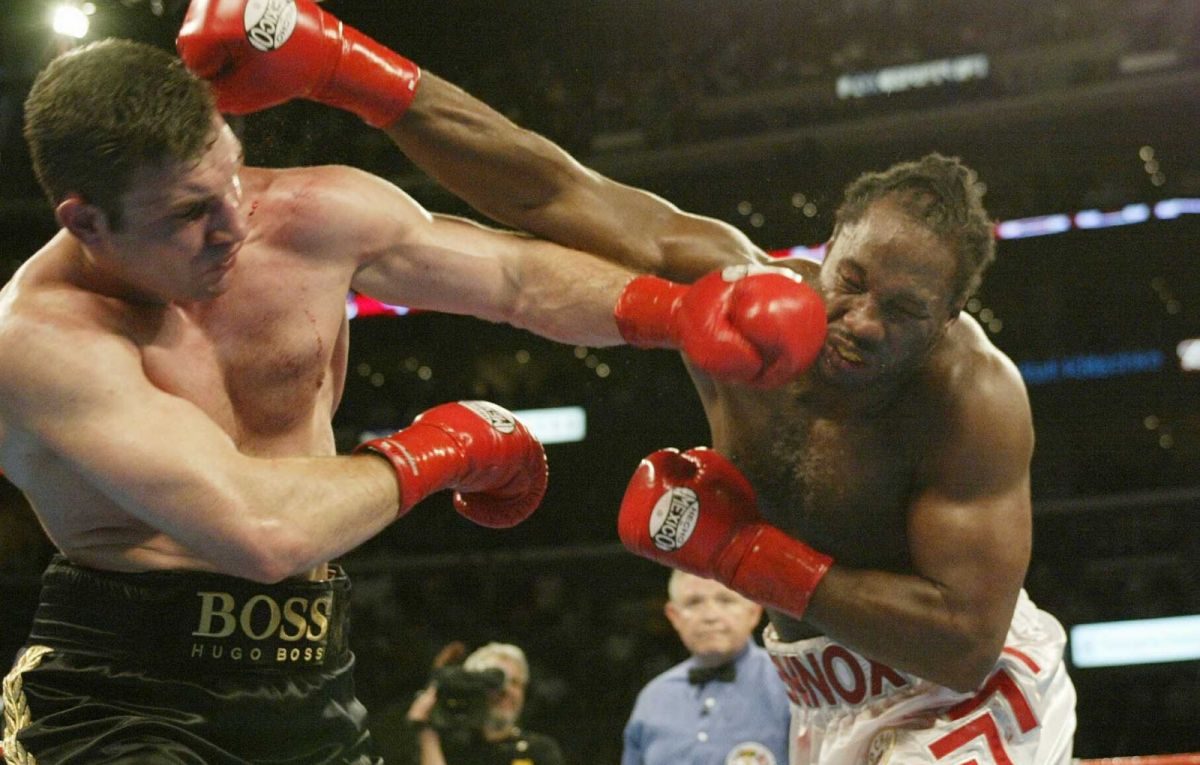
Vitali Klitschko — Lennox Lewis (fight for the world championship under the WBC, IBO, The Ring and Lineal versions, 2003)
The Battle of the Titans at the Staples Center in Los Angeles in June 2003 forever entered the history of Ukrainian boxing, when Vitali Klitschko, as WBC world champion, came face to face with Lennox Lewis, who had previously knocked out Mike Tyson.
The fight's legendary status is also boosted by the fact that Klitschko, despite the final defeat by technical knockout in round 6, led on the scorecards at the moment the fight was stopped. It is no surprise that Kyiv's current mayor wanted a rematch, and no surprise that Lennox ultimately decided to end his career, although he had initially been ready to fight the Ukrainian champion once more.
Shakhtar — Werder 2:1 (UEFA Cup final, 2008/2009)
If Shakhtar had already begun to dominate in the domestic Ukrainian arena (3 championship titles in four years), then in Europe the Miners, unlike Dynamo, could not yet boast of their moment of glory. The 08/09 season became a turning point for the Donetsk club in this regard.
In that UEFA Cup competition, the last before the tournament was transformed into the Europa League, Shakhtar not only handled the tough Werder Bremen (whose squad included such masters as Mesut Özil, Torsten Frings, Claudio Pizarro and Naldo), but also advanced to the semi-final... over Kyiv's Dynamo.
Vasyl Obaraz, TK Media

Russian Attacks in Dnipropetrovsk Region: Two Killed, Seven Injured

Defense Forces Strike Four Russian Drone Control Points in Past Day, Including in Berdiansk

Britain Threatens Sanctions on Kremlin-Linked People; Poland Ready to Hand Ukraine Ammunition

Russia says it has completed "planned exercises" in the Black Sea

MVD: Fake Riots With Prop Blood Were Being Prepared Near Presidential Office

Law Enforcers Name Another Klitschko Deputy as Suspect

Berlin Holds Protest Against War in Ukraine; EU Prepares for Possible Russian Halt of Gas Supplies
North Korea Fires Ballistic Missile Over Record Distance in Five Years
Irish Fishermen Force Russia to Postpone Naval Drills

US sanctions in case of invasion of Ukraine could completely destroy Russia's economy, NYT reports
