
How Modern Technologies Are Developing Ukraine's Agricultural Sector
A huge field for growth after the moratorium on the sale of farmland is lifted.
The company InVenture claims that only 10% of Ukrainian agricultural enterprises are implementing new technologies. According to experts' estimates, elements of precision farming technology cover just 20-30% of land in Ukraine. This suggests that the industry has enormous development potential, which will grow even further once the moratorium on the sale of agricultural land is lifted. And the lifting of this moratorium is very close — after yesterday's vote in the Verkhovna Rada, the land market is due to open in October 2020.
According to the most radical model, lifting the moratorium will accelerate Ukraine's economic growth by 3% per year, while under the least radical scenario, by 0.5%. It is logical that the more money there is in the industry, the faster it will develop and adopt modern technologies. We explain which technologies are already being used in Ukraine.
Drones
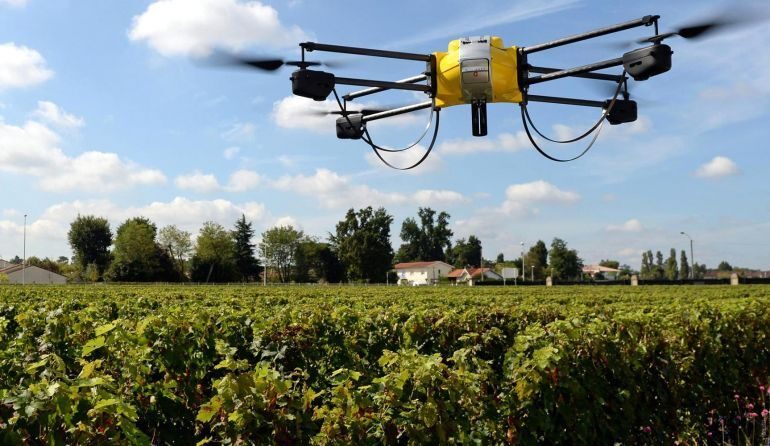
The number of drones is growing not only in the military sphere, but also in agriculture. In particular, they carry out primary diagnostics of problems in the field. After this, an agronomist is sent there to select samples for laboratory analysis. In the future, this scheme is planned to be improved. For example, work is already underway to make it possible to determine the problem and its source without the involvement of an agronomist.
In addition to video monitoring, drones take overview images with high detail and GPS tagging, create mapping in various spectral ranges, and can carry out 3D modeling.
Moreover, large breeding companies use drones. Their task is to obtain comparative data on plant height, density, the area of bare patches, etc. from a large number of small plots.
Smart farm
IT tools help control farms and manage communication among farmers, and developers are already offering mobile apps for farm management.
For example, the Soft.Farm Eye mobile app allows crop condition inspection. With it, farmers can take photos of plants with a smartphone, which are automatically assigned GPS coordinates. Another cloud application, Field Journal, provides GPS-based field boundary determination and tracking of the condition of treated areas.
The Fish Buoy device measures water temperature and its chemical indicators to determine the optimal time for feeding fish. It can also be remotely controlled via a mobile app.
Soil moisture sensors are also already in use. They are installed in greenhouses, on vegetable crops and in other cases where drip irrigation systems are operated. They can be combined into a system with a mini weather station. The development of this technology has led to sensors for soil electrical conductivity, temperature and density.
Digital terrain models
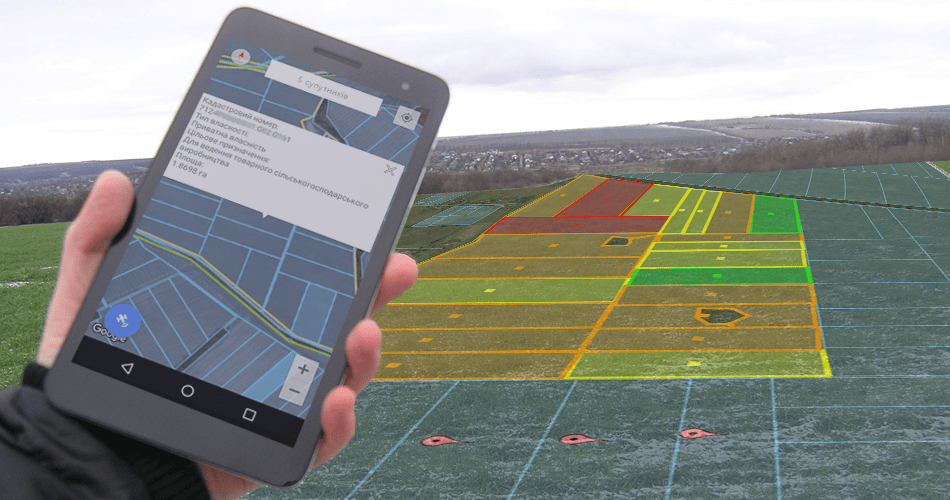
More and more online maps are appearing, to which accompanying electronic documentation is attached: object passports, protocols, photos, etc.
As a result, it becomes possible to visualize soil analysis dynamics; analyze satellite images; create crop yield maps; identify the most productive and high-yield plots; track crop development dynamics; monitor field conditions; forecast yields.
Thus, a farmer gains the ability to obtain information in various spectral ranges for calculating vegetation indices or compiling soil distribution maps. All data is provided with precise coordinates, with the possibility of detailed study and laboratory analysis.
Soil analysis
Last year, the Ukrainian startup Soil Lines created a soil analyzer based on a microlaser. It can be used in field conditions. The development provides qualitative and quantitative information about the chemical composition of soil and allows fertilizing soil only with the elements that are needed. This device gives farmers the opportunity to significantly reduce fertilizer costs while simultaneously increasing yields, the authors say.
Software for farmers
Technologies that are not directly related to growing and harvesting crops are already operating in the agricultural sector. Technologies responsible for planning, business process management, crop sales, and communication with potential buyers through various channels are emerging.
For example, the bpm'online platform includes tools for customer relationship management and business process management. It is available both as a web format and as a mobile app for popular operating systems. Farmers can plan and record external meetings in the app, show available agricultural products to a buyer and place an order instantly. The mobile app also provides field engineers working with agricultural machinery, who record malfunction data and provide service maintenance.
Aleksey Simonchuk

Russian Attacks in Dnipropetrovsk Region: Two Killed, Seven Injured

Defense Forces Strike Four Russian Drone Control Points in Past Day, Including in Berdiansk

Britain Threatens Sanctions on Kremlin-Linked People; Poland Ready to Hand Ukraine Ammunition

Russia says it has completed "planned exercises" in the Black Sea

MVD: Fake Riots With Prop Blood Were Being Prepared Near Presidential Office

Law Enforcers Name Another Klitschko Deputy as Suspect

Berlin Holds Protest Against War in Ukraine; EU Prepares for Possible Russian Halt of Gas Supplies
North Korea Fires Ballistic Missile Over Record Distance in Five Years
Irish Fishermen Force Russia to Postpone Naval Drills

US sanctions in case of invasion of Ukraine could completely destroy Russia's economy, NYT reports
