
Explosions in Kalynivka in 2017: Investigation Confirms Sabotage
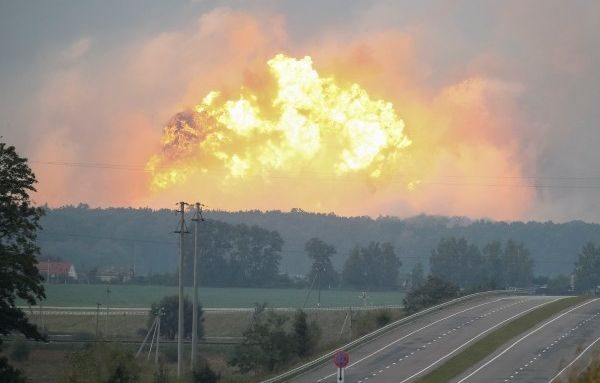
Several people have been held accountable for negligence.
Sabotage caused the fire and ammunition explosions at Arsenal 48 in Kalynivka, Vinnytsia Oblast, in 2017. Ukraine's Prosecutor General Iryna Venediktova said so on Facebook.
Iryna Venediktova
Prosecutor General of UkraineFour years ago, ammunition exploded at the storage facilities and open-air storage sites of Arsenal 48 in Kalynivka, Vinnytsia Oblast. Losses amount to more than UAH 5.9 billion from the destruction of ammunition, and damage was also caused: military unit facilities and local residents' buildings were damaged.
The Prosecutor General said that the explosion at Arsenal 48 was carried out by an outsider entering the unit's territory and placing an explosive device. This is confirmed by the evidence obtained, forensic examinations already received and attached to the case materials, protocols of covert investigative actions, interviews with witnesses and inspections.
It is reported that, given the "special period in Ukraine" and combat operations in the temporarily occupied territories of Ukraine, особое внимание is paid to collecting evidence of arson and explosions at Ukrainian warehouses carried out by Russian sabotage and reconnaissance groups or the terrorist organizations "DPR" and "LPR".
To this end, prosecutors and investigators also use international cooperation measures provided for by the criminal procedural law. A response is now expected from the competent authorities of the Czech Republic regarding the explosions at ammunition warehouses that occurred in October and December 2014 in the village of Vrbětice.
The investigation into the causes of fires and ammunition explosions during 2015-2018 at other military ammunition storage sites also continues, in particular, the missile and artillery weapons compound of Sector "A" in the city of Svatove, Arsenal 65 in the city of Balakliia, and Arsenal 6 in the city of Nizhyn.
Among the investigative versions in all these proceedings, besides the main ones:
- sabotage and a terrorist act are being checked, as well as the involvement of military officials in committing the crime in order to conceal shortages;
- negligent attitude of military officials toward performing their official duties;
- fires and ammunition explosions caused by spontaneous combustion or other natural factors.
There are already several servicemen held accountable in connection with the explosions at the arsenals. It is noted that law enforcement suspects these individuals not of involvement in the causes of the emergencies, but of official negligence and inaction, which led to more serious consequences of the warehouse fires.
The most likely cause of the fire at the missile and artillery weapons warehouse in Sector "A" in Svatove is a terrorist act.
However, the spread of the fire and the damage to military unit facilities and local residents' buildings were caused by military officials violating the requirements of methodological recommendations, instructions, guidelines and regulatory documents of the Ministry of Defense of Ukraine, and by their failure to carry out orders from superiors.
Precisely for failing to carry out leadership orders on ensuring the unit's operations, the head of the missile and artillery weapons warehouse in Sector "A" was held criminally liable; a court convicted him in 2016 and sentenced him to confinement in a disciplinary battalion.
In addition, two commanders of Ukrainian Armed Forces artillery units were notified of suspicion for negligent attitude toward military service during the special period. Due to violations of regulatory documents, they positioned the units and military equipment entrusted to them in close proximity within the missile and artillery weapons compound of Sector "A" in Svatove.
In addition, they failed to ensure that each unit of military equipment was placed at the standard distances from one another and did not arrange revetments and trenches for the safe storage of weapons and protection from damage.
As a result, the military equipment entrusted to them was destroyed during the fire on the territory of the missile and artillery weapons warehouse, leading to the detonation of ammunition. The state suffered more than UAH 18 million in property damage.
Across all these proceedings, to establish the causes of fires and ammunition explosions at warehouses over these years, more than 3,500 witnesses and victims have been interviewed, including with the use of polygraph testing, more than 1,700 inspections have been conducted, more than 50 temporary accesses to documents have been obtained, and about 650 examinations have been ordered, most of which have already been completed.

Russian Attacks in Dnipropetrovsk Region: Two Killed, Seven Injured

Defense Forces Strike Four Russian Drone Control Points in Past Day, Including in Berdiansk

Britain Threatens Sanctions on Kremlin-Linked People; Poland Ready to Hand Ukraine Ammunition

Russia says it has completed "planned exercises" in the Black Sea

MVD: Fake Riots With Prop Blood Were Being Prepared Near Presidential Office

Law Enforcers Name Another Klitschko Deputy as Suspect

Berlin Holds Protest Against War in Ukraine; EU Prepares for Possible Russian Halt of Gas Supplies
North Korea Fires Ballistic Missile Over Record Distance in Five Years
Irish Fishermen Force Russia to Postpone Naval Drills

US sanctions in case of invasion of Ukraine could completely destroy Russia's economy, NYT reports
