
Russia Began Moving Helicopters Toward Ukrainian Border. Possible Invasion Postponed Until Closer to Spring, NYT Reports
For now, the obstacle to an attack is weather that is not cold enough, the publication notes.
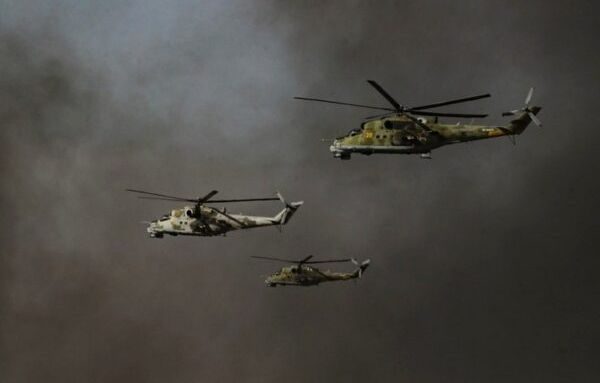
Russia has begun moving military helicopters toward Ukraine's borders, which may be a sign that preparations for a potential attack are continuing, American government sources told New York Times.
The publication's sources, whose comments formed the basis of the material, agreed to speak on condition of anonymity, given the sensitivity of the topic.
American officials had previously assumed that Russia would move new troops to the Ukrainian border between late December and early January, raising the total number to 175,000.
Although the redeployment of troops has slowed, around 100,000 military personnel still remain near the border, and attack helicopters have now been moved there as well.
"Combat and transport helicopters, as well as fighter jets, would give Russia a critical advantage if Putin decided to launch a large-scale invasion of Ukraine," the publication reports.
The publication's sources believe that if Vladimir Putin decides to attack, he has a limited window of time given the weather conditions: while the frost holds, heavy equipment can move quickly, whereas the arrival of the spring thaw traditionally brings impassable mud.
However, due to the relatively mild winter this year, the soil has not yet frozen sufficiently, so the "favorable time" for a potential attack has shifted again closer to spring, to February at the earliest.
Officials who spoke with journalists say the Biden administration has instructed officials to closely monitor the expected weather in Ukraine in the coming weeks in order to understand what conditions will be.
Since December 27, American RC-135 Rivet Joint reconnaissance aircraft have been flying over Ukrainian territory, enabling the interception of communications of Russian unit commanders.
E-8 JSTARS reconnaissance aircraft are also flying, tracking the movement of Russian troops near the Ukrainian border.
The US is particularly interested in indications of whether Russia will move part of its tactical nuclear weapons to the border; signals about such possible steps have come from Russia.
Intelligence reported to the White House that although Russia continues what appears to be planning for an invasion, they do not think Putin has yet made a decision.
Ongoing active diplomatic engagement also points in this direction: a meeting of US and Russian delegations in Geneva and further meetings in the following days.
However, US Secretary of State Antony Blinken remarked ahead of this important week that making progress will be very difficult, if not impossible, while Russia continues its escalation.
After the January 10 meeting, the head of the US delegation, Deputy Secretary of State Wendy Sherman, noted that no de-escalation had occurred and that the talks had mainly come down to a discussion aimed at better understanding each side's positions.
Although American officials publicly say they are not sure of Putin's intentions, they believe he is unlikely to retreat from his maximalist positions.
Russian military strength is currently estimated at 60 battalion tactical groups, or 85,000 to 100,000 troops. They have conducted drills and maneuvers, demonstrating a high level of readiness. In addition to the redeployment of air forces, units responsible for logistics have also begun to be moved in.
The Biden administration does not yet have a consensus on how to support Ukraine if Russia launches a full-scale invasion, a major escalation in Donbas, or escalation in another form. The White House continues intensive discussions on possible courses of action for various scenarios.

Russian Attacks in Dnipropetrovsk Region: Two Killed, Seven Injured

Defense Forces Strike Four Russian Drone Control Points in Past Day, Including in Berdiansk

Britain Threatens Sanctions on Kremlin-Linked People; Poland Ready to Hand Ukraine Ammunition

Russia says it has completed "planned exercises" in the Black Sea

MVD: Fake Riots With Prop Blood Were Being Prepared Near Presidential Office

Law Enforcers Name Another Klitschko Deputy as Suspect

Berlin Holds Protest Against War in Ukraine; EU Prepares for Possible Russian Halt of Gas Supplies
North Korea Fires Ballistic Missile Over Record Distance in Five Years
Irish Fishermen Force Russia to Postpone Naval Drills

US sanctions in case of invasion of Ukraine could completely destroy Russia's economy, NYT reports
