
Online Education Is More Effective Than Classroom Learning. In Many Cases

A wide selection, concise presentation and more.
The Office of the President on Friday published statistics showing that over three weeks of the “All-Ukrainian Online School” program, 545 lessons on YouTube and Ukrainian TV channels were watched by 19.6 million people. If the Presidential Office expects the million-plus figures to impress, it is trying to manipulate. Ukraine has approximately 3.5 million schoolchildren, which means each of them watched an average of 5-6 lessons during quarantine. One day's school norm.
These sad statistics once again highlighted the state of Ukrainian (read: post-Soviet) education: only repressive methods make children go to school. The system itself is hopelessly outdated and incapable of making knowledge interesting for a child, and the quarantine distance learning program brings nothing new, despite the word “online” in its name. It is merely a video copy of boring rote-learning lessons, rather than the new and long-overdue format of delivery.
Most likely, this is a problem not only of Ukraine and the post-Soviet space, but of much of the world. Secondary and higher education systems are obviously facing colossal changes in the coming years (some have already taken place, and in our country too, shifts are underway at the primary school level, but they run into a lack of understanding from teachers accustomed to the old model), yet for several years, several effective forms of education that are fully accessible to everyone via the internet have been operating around the world.
These are online courses with simple but nonetheless new approaches. They cannot replace secondary education and only partially can substitute for universities, so for now they can be discussed only as a form of supplementary education, though their success should be analyzed during reforms of familiar forms.
So what makes them effective?
The world’s best teachers are at your service
Anyone can become a lecturer on paid platforms such as Coursera or Udemy, but the rating system will bring only the best to the top of search results.
A single course can earn a lecturer several million dollars. On Udemy, prices start at 11 dollars, and the company pays lecturers at least half of the revenue from each user, while the best courses attract audiences of several hundred thousand.
The profit for the best is obvious.
A huge selection of narrow specializations
Already earning money but want to deepen your knowledge? No problem: the best online platforms offer you the widest choice — from baking a pie to writing unit tests for programmers.
Essentially, Udemy operates on the principle of a social network, where any specialist can share their knowledge, and from there, the demand for and quality of their course will determine whether they earn even 100 dollars or several million dollars. A pure market.
Short lessons help absorb information better
Remember school and those 45 minutes of boredom and monotony. Remember university — an hour and a half of dreary note-taking. After a short break, everything repeats. But the best teachers figured it out and — most importantly — got the opportunity to implement a different approach online: short lessons of 2 to 15 minutes.
A short but meticulous presentation of individual micro-topics is far more effective for learning than 45-90 minutes of information without pauses. Check it yourself to be convinced.
By the way, this point was missed by Ukrainian Prometheus, which posted high-quality information with good teachers, but the long videos in some courses reduced effectiveness.
It’s cheap
A Coursera subscription costs 50 dollars a month. Expensive? Perhaps. Moreover, a subscription to everything at once motivates learning more of what is unlikely to be useful.
Then there is the alternative of Udemy — 11 to 19 dollars for a one-time payment per specific course. And although this platform’s marketing tries to create the impression of a promotion, crossing out a price of 200 dollars, in fact nothing there can be bought for more than 19 dollars. Even the highest-quality course.
But all of this will work only under two conditions. If you:
- can quickly apply the acquired knowledge in practice;
- have paid money for it.
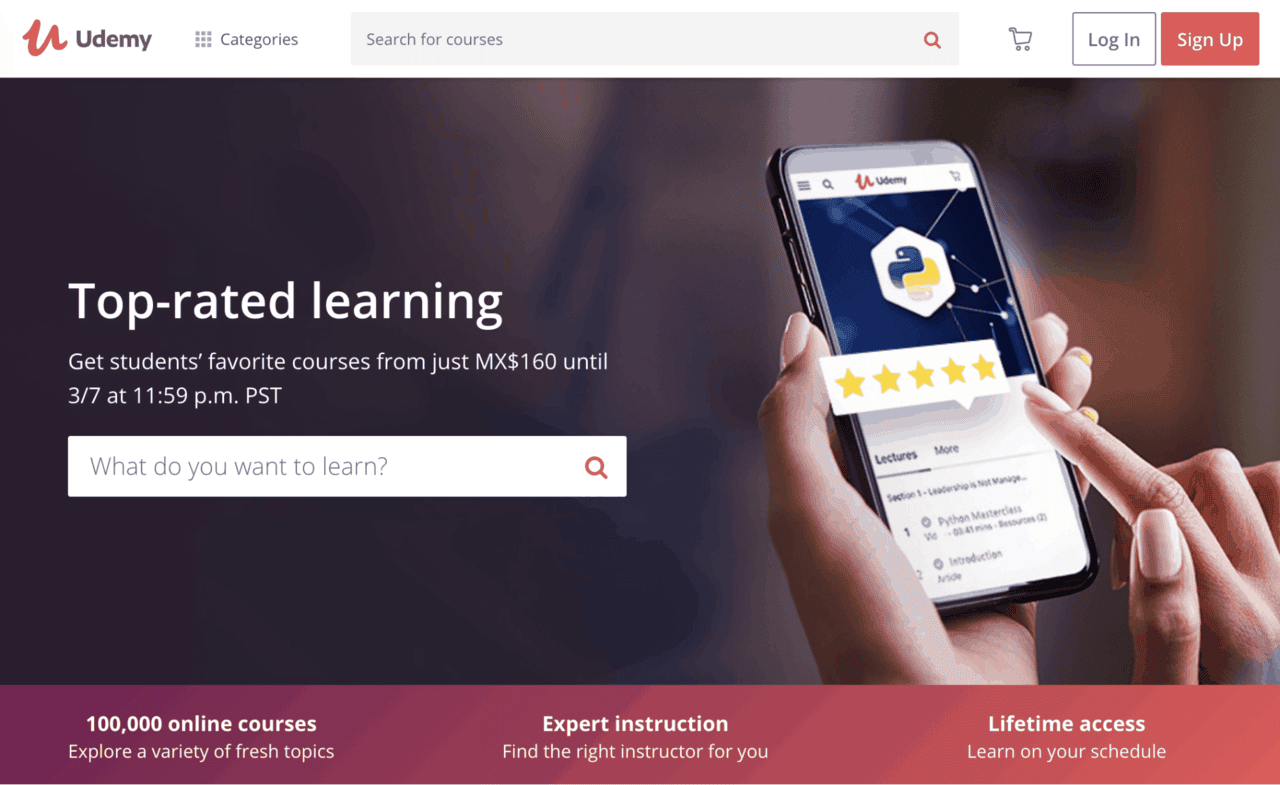
Udemy, Coursera, their analogues, including Ukrainian Prometheus, and even YouTube in part, have put a mass of the coolest knowledge online with easy access to it. At the same time, the free cluster — first of all, take the same Prometheus — with noble intentions can do more harm than good, creating a new type of procrastination out of the thirst for knowledge.
If you cannot apply the information you receive in practice constantly, you will very soon forget it, and no one will return the time spent.
Most people value money more than their time. The free format of Prometheus and YouTube looks very tempting, but only the need to pay creates the right threshold that makes you think carefully: do I really need this course at all?
If the answer is yes and the person has paid for the course, then the psychological factor comes into play: paid is more valuable than free and therefore provides motivation. If you bought a Netflix subscription for 10 dollars, you will surely try to watch more, right?
Are there downsides? Of course.
The best is only available in English
The English-speaking audience is the largest in the world, so the best teachers, even if they are not native speakers, bet precisely on it. And they get the opportunity to earn more money.
But the drive to reach a wider audience also motivates them to present in plain English, so it may be enough for you to raise your level to B1 or B2. English subtitles are usually available.
Ways to test knowledge are still in their infancy
Udemy — for now, most likely the best platform for online education — offers completing tasks and taking tests. But you will have to evaluate the results of the tasks yourself, and the tests may create a false impression of mastery.
* * *
Schools and universities undoubtedly play a crucial role in a person’s life through socialization and live communication, which online courses will never provide, but nevertheless, when it comes to acquiring specialized narrow knowledge, online courses in most cases can be far more effective.
Evgeny Blazhko, TK Media

Russian Attacks in Dnipropetrovsk Region: Two Killed, Seven Injured

Defense Forces Strike Four Russian Drone Control Points in Past Day, Including in Berdiansk

Britain Threatens Sanctions on Kremlin-Linked People; Poland Ready to Hand Ukraine Ammunition

Russia says it has completed "planned exercises" in the Black Sea

MVD: Fake Riots With Prop Blood Were Being Prepared Near Presidential Office

Law Enforcers Name Another Klitschko Deputy as Suspect

Berlin Holds Protest Against War in Ukraine; EU Prepares for Possible Russian Halt of Gas Supplies
North Korea Fires Ballistic Missile Over Record Distance in Five Years
Irish Fishermen Force Russia to Postpone Naval Drills

US sanctions in case of invasion of Ukraine could completely destroy Russia's economy, NYT reports
