
Apple TV+: good content, bad service

Apple impressed, but failed on the technical side.
On November 1, the Apple TV+ streaming service launched in more than 100 countries, including Ukraine. Four shows were widely announced, but in fact nine were released at once, though so far all attention is focused on the main hits.
And they did not let people down.
"The Morning Show" with Jennifer Aniston and Reese Witherspoon was met by viewers with a rating of 8.2 on IMDb and 91% approval on Rotten Tomatoes. The series, which brought Aniston back to small screens (now the notion of a small screen has become even smaller, because Apple TV+ will most likely be watched on iPhones more than anything else), not only shows the rich and stressful lives of television stars, but also raises the still-relevant topic of harassment and #MeToo. So far, Apple has released three episodes of the first season — seven more are ahead, which will be released one per week.
"See" brought Jason Momoa back in a role resembling Khal Drogo from "Game of Thrones", but the events take place in the distant future, where a deadly virus left only 2 million people alive and all of them — blind. It scores 7.8 on IMDb and 76% audience approval on Rotten Tomatoes (though critics rated the series down to 39%).
"For All Mankind" shows an alternative history in which, in 1969, the USSR manages to beat the US and be the first to send a man to the moon. On IMDb the first episodes score from 8.1 to 8.5, and 95% audience approval on RT.
The debut season of the series "Dickinson" about poet Emily Dickinson was released by Apple all at once, and so far it also receives mostly positive reviews — from 8.3 to 9.4 per episode on IMDb and 87% on RT.
As can be seen, Apple intends to use different release models for episodes — like Netflix's, when all episodes are released at once, and a hybrid one, with the first three released at once and then one each following week.
But what about the technical side of the service?
At first glance, Apple TV+ is very likable — a wide choice of audio tracks (though without Ukrainian and Russian) and an even wider choice of subtitles (with both Ukrainian and Russian). But that is where the pluses end and the problems begin.
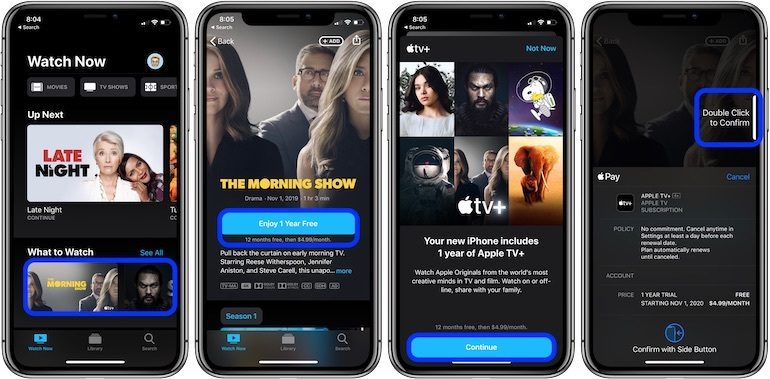
1. The interface is oddly arranged and hard to navigate
Apple's original shows, which are available by subscription (the first week is free for everyone, a full year is free for those who bought new Apple devices, and then 5 dollars per month), are mixed with other content that must be paid for separately — this is inconvenient. There is no recommendation system — this feels outdated.
2. It does not always remember where the viewer stopped watching a show
Sometimes it remembers, sometimes it does not. When it does not, to continue watching you have to scrub forward manually.
3. Inconvenient control buttons
They are at the bottom of the screen, they are small, so they are hard to tap and easy to press the wrong one — for example, rewinding 15 seconds instead of pausing/playing. Netflix does this much more conveniently — pause/play and rewind controls are right in the middle of the screen.
Of course, if you watch through the Apple TV set-top box on a TV and control it with the remote, there is no such problem. On iPhones and iPads — it is very relevant.
Apple has trained people to pay attention to details, so the release of a raw service looks very unusual. On the creative side, the company has managed to do much better this time than on the technical side.
Evgeny Blazhko

Russian Attacks in Dnipropetrovsk Region: Two Killed, Seven Injured

Defense Forces Strike Four Russian Drone Control Points in Past Day, Including in Berdiansk

Britain Threatens Sanctions on Kremlin-Linked People; Poland Ready to Hand Ukraine Ammunition

Russia says it has completed "planned exercises" in the Black Sea

MVD: Fake Riots With Prop Blood Were Being Prepared Near Presidential Office

Law Enforcers Name Another Klitschko Deputy as Suspect

Berlin Holds Protest Against War in Ukraine; EU Prepares for Possible Russian Halt of Gas Supplies
North Korea Fires Ballistic Missile Over Record Distance in Five Years
Irish Fishermen Force Russia to Postpone Naval Drills

US sanctions in case of invasion of Ukraine could completely destroy Russia's economy, NYT reports
