
Takeaways from the Year's Rematch: Joshua Gets an A, Ruiz Fails
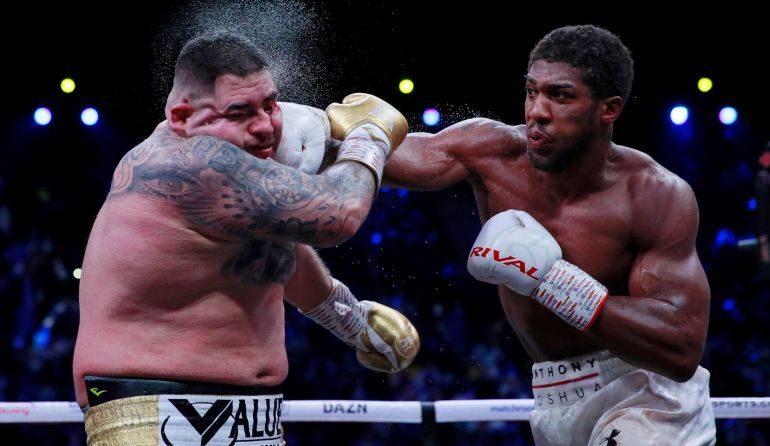
A professional analysis of the Briton's win yesterday.
On the night of Saturday to Sunday, December 7 to 8, a rematch for the WBA, WBO and IBF titles took place in Saudi Arabia between American Andy Ruiz Jr. (33-2, 22 KO) and Briton Anthony Joshua (23-1, 21 KO).
The 12-round fight ended with Joshua's unanimous decision victory on the judges' scorecards (118:110, 118:110, 119:109) and became the biggest rematch of 2019.
Why the Rematch Was So Important
On June 1, Anthony Joshua was supposed to make a loud statement in the US, debuting against the huge former kickboxer Jarrell Miller. But a month and a half before the fight, Miller was caught using banned substances, so the Briton's management began looking for a replacement. The choice fell on Andy Ruiz, seemingly harmless but a very underrated boxer.
The reason for Joshua's first defeat was either underestimating his opponent, a desire to perform brilliantly and knock out quickly, or a lack of time for full preparation for this particular boxer. Either way, the Briton lost fair and square the first time: he constantly engaged in exchanges at mid-range, where the very fast opponent had the advantage.
In round 3, Joshua sent his opponent to the canvas, but apparently rashly decided that was it, and as a result his attempts to finish the job ended in two knockdowns of his own. Anthony did not have time to recover while the American calmly kept firing lightning-fast combinations at him. He did not hunt for the head but skillfully battered the opponent body by body. Ultimately, in round 7, the exhausted Briton hit the canvas twice more, and the referee stopped the beating.
Andy Ruiz achieved his goal, becoming the first Mexican-born fighter to win a heavyweight title. Although Anthony Joshua had irrevocably lost the zero in the losses column, he remained a big star, but with very uncertain prospects. There could be no talk of a unification megafight with Deontay Wilder or a British derby with Tyson Fury while the chapter on Andy Ruiz remained an ellipsis. It is no surprise that the second fight was organized as quickly as possible.
Only One Did the Homework
Both fighters had something to prove. For the Briton, reputation and status beyond his country were at stake. In the case of a second defeat, AJ would have continued to fill arenas on Albion's shores, but would have dropped out of the race for leadership in the division for a long time.
Andy Ruiz wanted to wipe the smirks off the skeptics' faces and prove that his victory was not accidental, to present solid arguments that June's sensation was not the result of a wild combination of circumstances, and that the expression “caliph for a day” (a person endowed with or who seized power for a short time — ed.) has nothing to do with him.
Judging by the result, Joshua's motivation proved stronger, which could be guessed already at the weigh-in, where Ruiz had gained 7 kg before the fight. The Briton drew conclusions from the first meeting and decided to sacrifice muscle for speed, mobility and physics. He shed 5 kg of muscle mass, which allowed him to be lighter on his feet and stay mobile longer than usual.
Ruiz's conclusions remain a puzzle; he showed his heaviest weight in 10 years. The fighter of Mexican descent explained this by a desire to be physically stronger so that this time too the fight would not go to the judges' scorecards. But it can be explained more simply: having made his dream come true, earned piles of money and tasted world fame, Andy did not find in himself the motivation to kill himself in the gym to exhaustion.
American boxer Oscar De La Hoya once said: “It's hard to get up for a 5 a.m. run when you're sleeping on silk sheets.” Apparently, the first victory ruined Ruiz.
The Briton and trainer Rob McCracken chose a winning strategy of careful, light boxing: Joshua circled the massive opponent, worked the jab and periodically brought in power punches. At the right moments he was not shy about finding protection in clinches, and the referee, fortunately for the Briton, did not let Ruiz get carried away with tussling at close range, separating the fighters.
Ruiz, meanwhile, unhurriedly pressed his opponent and waited for his mistakes. Several times Joshua did get carried away in attacks and immediately took punches, but he timely returned to the original game plan and leaned on his legs.
The fight was boring, but too much was at stake for Joshua to think about how it looked from the outside. Ruiz could not influence the course of events, since he entered the ring with a simple calculation that somehow it would work out. The Briton's team developed the only right strategy, and AJ himself ideally put it into practice.
Anthony Joshua perfectly did his homework, came up to the board himself and performed, while Andy Ruiz came to class unprepared, counting on copying or simply sitting in the back row, hoping he would not be called to the board, as last time. They called him up and asked, but got no answers.
What Next
Right after the fight, both fighters agreed to organize a trilogy. But now the question of interest arises, because a third fight, though it would bring a lot of money, has little sporting sense after what was seen in the second. At least not with the same mindset and weight.
Regardless of whether a third fight is arranged, Ruiz needs to return to the gym and work until he sweats buckets, since 130 kg for his build is an unhealthy excess, with which there are no prospects at championship level. Joshua has regained the lost belts, but may soon lose one of them, as two mandatory IBF and WBO defenses are coming up. If his management does not secure another postponement, one of these titles will become vacant.
The mandatory challenger for the WBO is Ukrainian Oleksandr Usyk, who is in line for a fight with Derek Chisora in late February. In the IBF's ranking, Bulgarian Kubrat Pulev has long been a contender, and AJ is expected to choose him as his defense. Thus, the WBO title may become vacant and possibly be at stake in the Usyk–Chisora bout.

Russian Attacks in Dnipropetrovsk Region: Two Killed, Seven Injured

Defense Forces Strike Four Russian Drone Control Points in Past Day, Including in Berdiansk

Britain Threatens Sanctions on Kremlin-Linked People; Poland Ready to Hand Ukraine Ammunition

Russia says it has completed "planned exercises" in the Black Sea

MVD: Fake Riots With Prop Blood Were Being Prepared Near Presidential Office

Law Enforcers Name Another Klitschko Deputy as Suspect

Berlin Holds Protest Against War in Ukraine; EU Prepares for Possible Russian Halt of Gas Supplies
North Korea Fires Ballistic Missile Over Record Distance in Five Years
Irish Fishermen Force Russia to Postpone Naval Drills

US sanctions in case of invasion of Ukraine could completely destroy Russia's economy, NYT reports
