
What is happening on the Spanish island of La Palma after the volcanic eruption
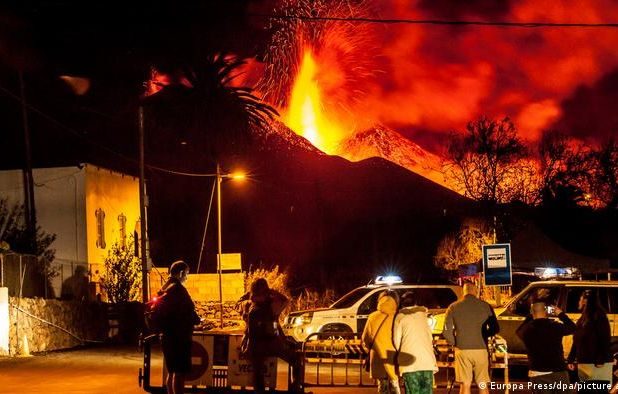
Those affected by the volcanic eruption are trying, with the help of authorities and the military, to restore daily life and their farms.
For two months, since September 19, the eruption of the volcano on the island of La Palma, part of the Canary Islands archipelago, has not stopped. Many of its farmer residents have lost their homes and agricultural machinery.
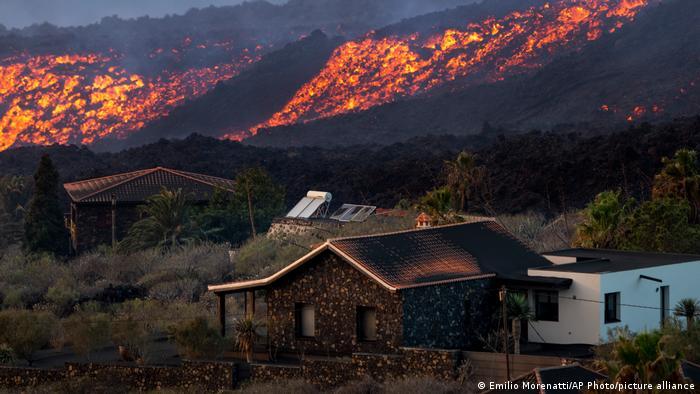
Their farms have been destroyed by lava or covered by a layer of ash. Finding themselves in a difficult situation, people are trying, first and foremost, to save the source of their livelihood: banana plantations, which in some cases have been cut off from their owners by lava flows.
Islanders are counting on help from the state, without which it is impossible to quickly restore normal life on La Palma, reports DW.
Working on a landing craft
Shortly before dawn, several hundred people gather daily at the small port of Tazacorte, on the west coast of the island. Some arrive on a tractor that survived the volcanic eruption, others bring a pair of donkeys, which are indispensable for work on the plantations.
On the horizon looms the silhouette of the large Spanish Navy landing ship Castilla. It operates four landing craft which, making several trips a day over a distance of five nautical miles, transport farmers, their equipment and animals to the plantations. After all, the plantations cannot be reached by land, as the lava has destroyed the roads.
"We are grateful to the military," says 40-year-old Vicente Gutiérrez, a resident of the village of Los Llanos, who was reached by phone by the publication. He owns a banana plantation in an area called Puerto Naos, covering 5 hectares.
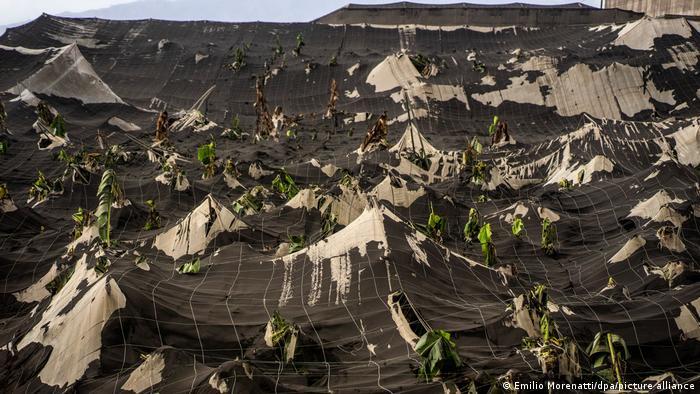
The lava spared it, but the ash damaged the trees and destroyed the harvest. "The bananas have lost their marketable appearance, so they are not fit for sale," the farmer laments. According to him, the plantation will have to be cleared of ash and its irrigation system restored.
Life on the volcano
The farmer said he lost his house and almost all his property, including his car and agricultural machinery. Only the hens, a dog and a cat were saved. Vicente has settled with his wife and two children in a neighboring village, in his father-in-law's house.
He works on the plantation for 12 hours a day, as everything has to be done by hand. People from the unaffected areas of the island help with food and clothing. True, there are occasionally interruptions in the delivery of fresh produce.
As for those who have no relatives, they have to live wherever they can. Some have been fortunate: municipalities have housed them in hotels, while others, waiting for new housing, spend nights in cars, tents or even caves in the mountains.
Vicente does not know when the state will pay compensation for the damage caused by the disaster. But money is needed urgently, as the farm cannot be revived without it. After all, the farmer intends to stay on the island in any case and work the land he inherited from his parents.
Those in the worst position are those whose lava destroyed not only their homes but also their plantations. "Some are waiting impatiently for the compensation money so they can move to other places," the farmer summed up.
Scale of the disaster
In total, 7,000 people had to be evacuated from the eruption zone. More than 2,000 of them were left homeless, as their houses were completely destroyed. One resident died while trying to save his property.
The villages of Los Llanos and El Paso and the municipality of Tazacorte were particularly affected. Damage to the island's main source of income, the plantations, which before the eruption produced 350 tonnes of bananas daily, is estimated at €100 million. In addition, 158 hectares were burned by lava and 300 were affected by ash.
"The financial capacity of the archipelago is limited," says a document from the regional government of the Canary Islands. Tourism, another lucrative sector of the region, "due to the pandemic, brings practically no revenue to the budget."
So money can only be spent on urgent tasks: desalination plants to restore the plantations' irrigation system, paying for hotels, and buying prefabricated houses for those affected. As for financial aid from the central government of Spain, it "has not yet arrived."
Millions in aid, but so far only on paper
Meanwhile, official reports published on the Spanish government's website show that the Special Recovery Plan for La Palma, adopted back in October, provides for €225 million to be allocated from the state budget.
The funds will go toward housing construction, infrastructure repairs and subsidies for non-agricultural businesses. At the same time, €19 million is allocated to aid farms and €5 million to social services. In addition, individuals and businesses receiving state aid are exempt from paying taxes.
The situation was explained by Antonio Heras Gil, professor at the Faculty of Economics of Madrid University. In his view, aid from the state, in line with established practice in Spain, "can arrive only about six months after the end of the natural disaster and the identification of the full extent of the damage."
Meanwhile, the volcanic eruption on La Palma is still ongoing, so it is too early to name a timeframe for aid, the professor noted.
Hoping for Brussels
As local press reports, given the situation, a delegation of the Canary Islands Banana Producers' Association was forced to travel to Brussels in these days, to the headquarters of the European Union.
The aim of the trip was "to secure swift help from this organization to save the industry." And judging by the reactions of delegation members, this goal was achieved.
La Palma will be allocated funds from several EU funds at once. True, the amount of aid and the timeline for its provision have not yet been announced.

Russian Attacks in Dnipropetrovsk Region: Two Killed, Seven Injured

Defense Forces Strike Four Russian Drone Control Points in Past Day, Including in Berdiansk

Britain Threatens Sanctions on Kremlin-Linked People; Poland Ready to Hand Ukraine Ammunition

Russia says it has completed "planned exercises" in the Black Sea

MVD: Fake Riots With Prop Blood Were Being Prepared Near Presidential Office

Law Enforcers Name Another Klitschko Deputy as Suspect

Berlin Holds Protest Against War in Ukraine; EU Prepares for Possible Russian Halt of Gas Supplies
North Korea Fires Ballistic Missile Over Record Distance in Five Years
Irish Fishermen Force Russia to Postpone Naval Drills

US sanctions in case of invasion of Ukraine could completely destroy Russia's economy, NYT reports
