
NASA launches first mission to destroy an asteroid
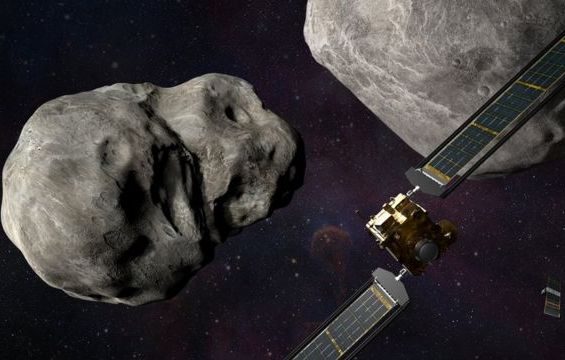
Also during the mission, a new ion engine will be tested.
NASA's DART space mission, which launched on the morning of November 24, will test humanity's ability to change an asteroid's orbit by literally crashing into it.
The spacecraft will also test a new type of propulsion system for the agency.
Project details
DART was launched from Vandenberg Space Base in California aboard a SpaceX Falcon 9 rocket on Wednesday, November 24. The vehicle lifted off at 8:21 a.m. Kyiv time.
The spacecraft is designed to collide with the asteroid while traveling at roughly 24,000 km/h. Its target is the asteroid moon Dimorphos (Greek for 'two forms'), which orbits a larger asteroid named Didymos (Greek for 'twin').
In autumn 2022, DART will collide with Dimorphos to change its orbit in the binary asteroid system.
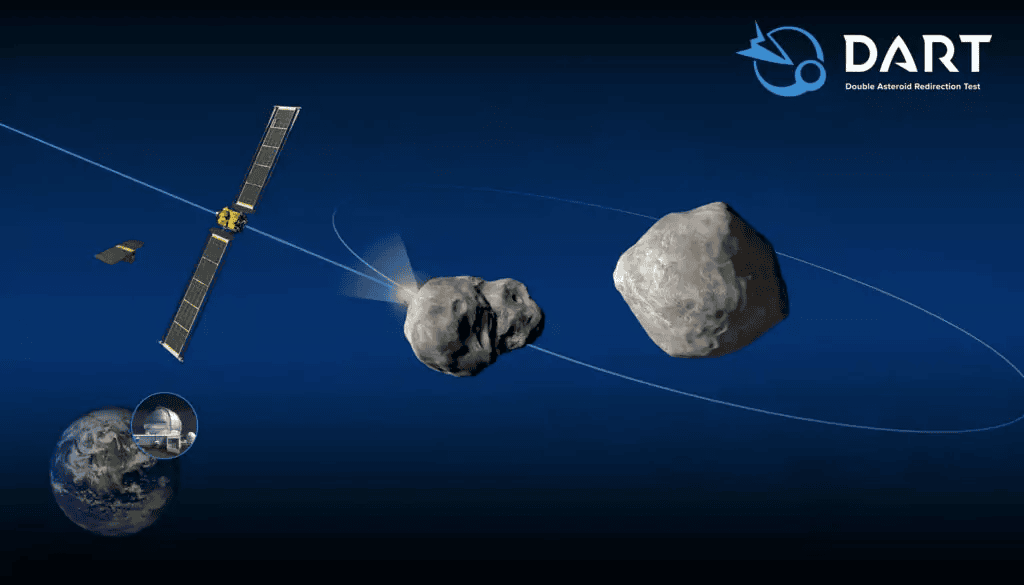
The DART mission, which NASA is carrying out jointly with the European Space Agency, is part of a program to protect Earth from collisions with space objects.
Scientists are testing whether it is possible at all to deflect an asteroid heading toward Earth, as in the film 'Armageddon' (1998) starring Bruce Willis.
The collision will be recorded by the DRACO camera mounted on the spacecraft's impactor. Images of the collision will be transmitted to Earth in real time.
Also, from outside the collision, a 14-kilogram Italian-made CubeSat, LICIACube, will record it; it will separate from the DART spacecraft 10 days before impact. The CubeSat's two optical cameras will photograph the moment of collision and several minutes after.
Four years later, the European Space Agency will begin studying the collision with the Hera space probe.
Although there is no real threat at present, NASA considers it advisable to practice planetary defense mechanisms. Especially since there is still no technology that would allow changing the trajectory of a celestial body six months before a collision.
New engine
However, before the dramatic conclusion of the DART mission, NASA will test the revolutionary Evolutionary Xenon Thruster (NEXT-C) ion engine.
The ion engine was previously used on NASA's Deep Space 1 and Dawn spacecraft, launched in 1998 and 2007, but according to NASA, NEXT-C will be three times more powerful.
'It's a little bittersweet knowing that we'll only be able to operate for a short period of time before we hit the asteroid,' said Jeremy Jon, DART lead power engineer and engineer at the Johns Hopkins University Applied Physics Laboratory.
NEXT-C will not be the main force pushing DART along its path; that role falls to 12 conventional engines on board the spacecraft, which will be responsible for most of the vehicle's movements, including during the final stage of its journey.
But NEXT-C will fire several times along DART's path. According to the NEXT-C creators, the purpose of the maneuvers is to test the ion engine. Its engineers will switch on the system to show that the ion engine can operate in the harsh conditions of space.
Threat of chaos
Earlier, an international team of astronomers warned that such a collision could 'create chaos' in Dimorphos's motion.
A research team led by Harrison Agrusa of the University of Maryland simulated the collision of the spacecraft and the asteroid, and it turned out this could lead to unpredictable consequences.
When DART hits Dimorphos, the impact energy will be comparable to the explosion of three tons of TNT, throwing thousands of fragments into space, which could even cause the first artificial meteor shower in history. The asteroid itself will initially show no reaction to the impact, but over time everything will begin to change dramatically.
In a few days Dimorphos will start to wobble. Over time, the amplitude of its oscillations will grow larger and larger, since the asteroid will be surrounded by the vacuum of space, which cannot slow this wobbling.
After weeks, Dimorphos may enter a 'state of chaos', rotating uncontrollably around its axis.

Russian Attacks in Dnipropetrovsk Region: Two Killed, Seven Injured

Defense Forces Strike Four Russian Drone Control Points in Past Day, Including in Berdiansk

Britain Threatens Sanctions on Kremlin-Linked People; Poland Ready to Hand Ukraine Ammunition

Russia says it has completed "planned exercises" in the Black Sea

MVD: Fake Riots With Prop Blood Were Being Prepared Near Presidential Office

Law Enforcers Name Another Klitschko Deputy as Suspect

Berlin Holds Protest Against War in Ukraine; EU Prepares for Possible Russian Halt of Gas Supplies
North Korea Fires Ballistic Missile Over Record Distance in Five Years
Irish Fishermen Force Russia to Postpone Naval Drills

US sanctions in case of invasion of Ukraine could completely destroy Russia's economy, NYT reports
