
Usyk Confidently Bursts Into Heavyweight, But Questions Remain
Alexander Medvedev breaks down the Ukrainian's start in the heavyweight division.
The Debut Finally Took Place, Though Barely
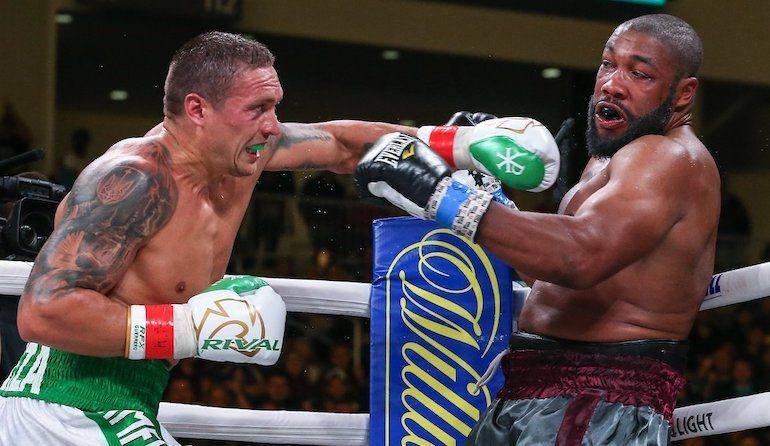
The long-awaited debut of Oleksandr Usyk in a new division has finally taken place, despite unfavorable circumstances that repeatedly forced adjustments to the plans of the former heavyweight ruler. This morning he confidently dealt with American veteran Chazz Witherspoon, forcing the opponent's team to surrender during the break between the 7th and 8th rounds.
Had the Ukrainian's camp been superstitious people looking for signs and following them, the move to heavyweight might never have happened. Circumstances were not the best. The brilliant win over Tony Bellew last November drew a line under Usyk's outstanding cruiserweight period. The Crimean made the decision to give up all four heavyweight belts and move up. The debut was scheduled for May 25 against Carlos Takam, but a couple of weeks before the fight Alexander injured his biceps and the bout was postponed to the autumn.
For a long time it was assumed the opponent would remain the same, but in the end the Cameroonian changed promoters, and the new broom swept differently. A contract for the October 12 fight was signed with unbeaten former kickboxer Tyrone Spong, but a few days before the bout it became known that the Surinamese fighter had failed a doping test.
Either the debut had to be postponed again or a replacement had to be found quickly. Nobody wanted to delay Usyk's return to the ring: he had already been inactive for a record 11 months, and it was important to shake off the accumulated ring rust, not letting it “seep deeper”. Those around Alexander say they learned of the possible force majeure several days before the official notice from VADA, so they began working on finding a replacement in advance.
As a result, 38-year-old Philadelphian Chazz Witherspoon was signed. Given the circumstances, the option is not bad. It would have been foolish to hope that in such a situation someone of higher standing than Spong, who was chosen for lack of better options, would agree to face Usyk.
The Fight Went Without Surprises, but Gave No Answers
Oleksandr Usyk weighed in at 97.5 kg, which allowed him to keep his strong qualities: speed, mobility, body work. Here everything is logical. Even David Haye, to preserve his explosiveness when moving up to heavyweight, weighed the same, then played with his weight depending on which qualities were needed against a given opponent.
“I think we'll add a bit more weight, 100 kg or maybe even more,” — the former heavyweight champion said after the fight.
Perhaps there is sense in this and it is worth trying, but one must keep in mind that with weight gain his signature qualities may also disappear. Haye himself, after crossing the 100 kg mark, never looked as dangerous again as in his natural 95–97 kg form.
The start of the bout was cautious on both sides. Usyk did not force the action, and Witherspoon even less so. Alexander has never been inclined to start at a sprint. So a brisk beginning in his first fight in the heavyweight division, and against an opponent he could not prepare for properly, was utopian.
The Crimean circled the slower opponent, worked the jab, and occasionally exploded in flurries. From the third round their number rose sharply, and near the midpoint, when Chazz Witherspoon had practically stopped, there was a clear class gap in the ring.
Chazz, to his credit, did not just go through the motions. He had a simple but workable plan. The American pressed his opponent unhurriedly and, following the classic approach against a southpaw, tried to counter with a right overhand. It worked a few times, though it all looked dangerous for the first 10 minutes or so. As soon as Witherspoon began to tire, the fight took on a one-sided character.
Over seven rounds Witherspoon landed only 21 punches, while Usyk recorded 139 hits. With each minute the ratio became more catastrophic, so the corner's decision not to send the fighter out for the 8th round came as no surprise. On the contrary, this is exactly the case where everything was done correctly and in good time.
Nevertheless, despite the easy win in the long-awaited heavyweight bout, many important questions remain unanswered.
Visually it seemed that most of Usyk's power punches carried little threat. Perhaps this was tied to a plan to take it easy and catch his breath for as many rounds as possible. Perhaps Alexander was simply protecting his hand, understanding that this was only the first fight after the injury. However, sooner or later he will have to fight younger, physically prepared and explosive fighters, and it would be better if they felt danger in the fists of the former cruiserweight.
When will Usyk fight for a title?
To get answers about the Ukrainian's stamina at the new weight, as well as his ability to make bigger opponents respect his punching power, Alexander needs a fight with a higher-level opponent.
The victory over Witherspoon allowed him to keep mandatory challenger status with the WBO, meaning Alexander will have the right to seek a bout with the strongest in the December 7 rematch between Andy Ruiz and Anthony Joshua.
“I am ready, I am ready to fight anyone. If they arrange a championship bout for me, of course I will accept it,” — Usyk said after today's victory.
There is a high chance that Usyk's next fight will not be for a title, but he will get his shot by mid-2020.
The point is that three championship belts will be at stake in the Ruiz-Joshua rematch in Saudi Arabia. The winner will not only be able to pose with the regalia for cameras, but will also be obliged to fulfill championship obligations. So, according to Matchroom Boxing chief Eddie Hearn, the winner will have to choose between a mandatory defense against IBF's Kubrat Pulev and a bout with WBO mandatory challenger Oleksandr Usyk. If officials from these organizations do not make further concessions and grant a postponement, one of these belts will become vacant.
If such a situation arises, the chances are high that the belt bearing the WBO emblem will become vacant. If Joshua wins, that makes sense. Why would Hearn now pit his fighters against each other when both could be champions and fuel interest in unification? If Ruiz wins, it is harder to predict next steps, but they will likely prefer to fight the older and more predictable Bulgarian.
Either way, while all this is being decided, Alexander will have time to step into the ring once more. A fight in January–February is needed not only to stay active and maintain good form. It is needed to get answers to several important questions tied to the new chapter in his sporting career. But for that to happen, he needs a 'live' opponent, preferably from the top 15.
Alexander Medvedev

Russian Attacks in Dnipropetrovsk Region: Two Killed, Seven Injured

Defense Forces Strike Four Russian Drone Control Points in Past Day, Including in Berdiansk

Britain Threatens Sanctions on Kremlin-Linked People; Poland Ready to Hand Ukraine Ammunition

Russia says it has completed "planned exercises" in the Black Sea

MVD: Fake Riots With Prop Blood Were Being Prepared Near Presidential Office

Law Enforcers Name Another Klitschko Deputy as Suspect

Berlin Holds Protest Against War in Ukraine; EU Prepares for Possible Russian Halt of Gas Supplies
North Korea Fires Ballistic Missile Over Record Distance in Five Years
Irish Fishermen Force Russia to Postpone Naval Drills

US sanctions in case of invasion of Ukraine could completely destroy Russia's economy, NYT reports
