
“Covid” Trash: How Medical Waste from the Pandemic Ends Up in Landfills and Forest Belts Instead of Being Disposed Of
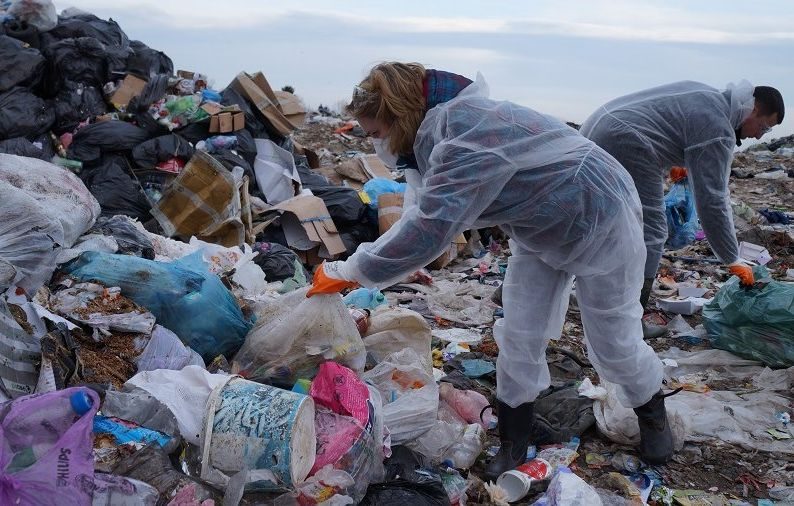
According to official statistics, 94% of such waste was disposed of, while Ukraine does not have sufficient capacity for this.
Why the trash left by the pandemic — syringes, test tubes, disposable clothing — instead of being disposed of ends up in ordinary landfills and forest belts, was investigated by LIGA.net.
95,000 deaths from COVID-19 are not the only black mark the pandemic has left in Ukraine.
Since February 2020, according to the Ministry of Health, 11,135 tons of medical waste have accumulated in the country — syringes, disposable clothing, test tubes, enough to fill about 500 large trucks.
Waste generated after 28 million vaccinations, more than one million hospitalizations and several million PCR tests must be destroyed in a special way — in special furnaces at high temperatures.
If the reports are to be believed, the state has disposed of 94% of the accumulated “Covid” waste in this way. It cost the budget more than UAH 100 million.
In fact, as it turned out, Ukraine does not have the capacity to destroy hazardous medical waste in such quantities .
Another fact: the true volume of “Covid” trash may be three or four times greater than the Ministry of Health's estimate .
The publication's investigators looked into what happens to waste generated as a result of the COVID-19 pandemic.
Volumes of “Covid” trash
In mid-February 2020, several regions of Ukraine were gripped by panic. Authorities were looking for a place to evacuate Ukrainians from Wuhan, China. Fear of the epidemic sparked protests — several towns took up arms against “dangerous” guests.
Eventually, on a winter night, more than fifty evacuees arrived in Novi Sanzhary. Footage of military vehicles, clashes between locals and police, and arrests then spread across the whole country.
What was left off camera was the continuation of the story. When the observation period ended, the question arose of disposing of disposable clothing, masks, test tubes, etc. that remained in Novi Sanzhary. The job was carried out by the company “Ecological Processing Technologies.”
“We were the only ones who responded to the request from the government and the State Emergency Service to organize the removal and disposal of hazardous waste from the medical center in Novi Sanzhary,” says the company's director Dmytro Ageev.
According to him, to avoid stirring up a new wave of protests, the procedure was carried out without publicity and on the basis of an oral agreement, as proposed by representatives of the Ministry of Health. The cargo was sent to Lviv region, where the company's equipment for hazardous waste disposal is located.
This year police have already searched Ageev's company twice. “Now we are accused of not disposing of the cargo from Novi Sanzhary and of dumping it somewhere,” says Ageev, adding that destruction took place in the presence of a Ministry of Health representative, though since then the ministry's leadership has changed and there is no one left to confirm the neutralization of the medical waste.
Over two years of the pandemic, Ukrainians have lost their panic, but everything related to the disposal of “Covid” waste still resembles a “wild field.” The state has only a rough idea of the volumes of such trash and almost no control over the chain of its disposal.
Medical waste left as a result of the pandemic includes damaged or expired vaccines; gloves; gowns; masks; disposable consumables that came into contact with biomaterial — test tubes, syringes, etc.
Such trash belongs to the so-called “B” category — hazardous waste that must be destroyed in special furnaces at temperatures above 800 degrees. They cannot be thrown into ordinary landfills.
Until now this information has not been public. At the publication's request, it was provided by the Ministry of Health, which needed a month and a half to collect this data.
According to the Ministry of Health, the total volume of “Covid” waste accumulated in state medical institutions from March 2020 to October 31, 2021 amounted to 11,135 tons. Of these, 94% was handed over for disposal, while the rest remains in storage at medical facilities.
The ministry clarified that it has no authority or ability to verify data provided by the regions.
As for whether one can rely on hospital reports (spoiler: no), the answer comes from a study conducted in 2018 by the Expert-Analytical Center “Medical Constructor.”
For three months, the center's specialists analyzed the work of one of the regional hospitals (Medical Constructor prefers not to name the hospital). One of the findings: the medical facility generated 90% more waste than it declared.
Is it correct to assume that similar proportions apply to other medical institutions? Alexander Pugach, co-founder of Medical Constructor, answered affirmatively in a comment to the publication — his team visited several dozen hospitals in Ukraine.
In other words, the total volume of “Covid” waste may also be significantly greater than in the Ministry of Health's statistics.
According to calculations by the World Health Organization, one hospital bed generates 0.45 kg of hazardous medical waste per day. According to Pugach, in Ukraine this figure is higher, at 1.5 to 2 kg per day. Or rather, that was the case before the pandemic. With its onset, volumes grew significantly.
Using one of the hospitals in Kyiv region as an example, Pugach's team concluded that hazardous waste had increased three to four times. Thus, a single bed of a COVID-19 patient can “produce” about 5 kg of waste per day. Due to the greater number of used masks, syringes, etc.
Taking this figure into account, as well as data from Ukraine's National Health Service on the number of COVID-19 hospitalizations in 2021 (709,690 patients) and the average length of hospital stay (12 days), it can be calculated that more than 40,000 tons of “Covid” waste accumulated in hospitals in 2021.
Another several thousand tons (the exact amount is hard to calculate) were generated by the country's 10,000 outpatient clinics. This is a completely different volume from what is reported by the Ministry of Health (11,135 tons for the period from March 2020 to the end of October 2021).
Consequently, in Ukraine not 94% of “Covid” waste, but less than a quarter, was actually disposed of.
What happens to the rest of the trash, or uncontrolled waste
The discrepancies in the figures indicate that a significant part of hazardous medical waste is not being destroyed properly.
According to Vitaliy Dankevych, director of the Odesa disposal company “NPK Ukrekoprom,” hospitals send 30% to 40% of waste that should be burned in the furnaces of licensed companies to ordinary landfills. Law enforcement and oversight bodies periodically report on such discoveries.
The explanation is on the surface: getting rid of ordinary medical waste, which can be taken to open landfills, costs a hospital 5–6 hryvnias per kilogram. Destroying hazardous waste in furnaces of licensed disposal companies costs three times as much.
“If you go to a hospital's yard, you will see a lot of medical waste in ordinary garbage bins,” says Kyrylo Kosourov, head of the Association of Enterprises in the Hazardous Waste Management Sector.
In his words, the cause is chronic underfunding of hospitals. Alexander Pugach recalls a hospital near Kyiv where “Covid” trash has been stored in a garage bay for a year, and there are many such examples. There is no money for proper disposal because the relevant expense items are not protected.
The disposal company “Ecological Processing Technologies” lost its license in the summer, but as recently as early 2021 it was serving 280 medical institutions. According to director Dmytro Ageev, it was common practice among medical institutions to allocate meager budgets for hazardous waste disposal, which sometimes barely covered a tenth of the accumulated trash.
“Some of the hospitals' medical waste is sent to ordinary landfills, with the services paid for not from budget funds but from charitable contributions, so as not to draw attention to this fact before oversight bodies,” adds Alexander Pugach for his part.
A top manager of a company engaged in certification of medical products (who asked not to be named) noted in a conversation with the investigators that oversight of private medical facilities is even worse than oversight of state hospitals. Therefore, the question of disposal of “Covid” waste by private clinics and laboratories is more acute and depends above all on the good faith of business.
“They came up with a wonderful business model — a virtual laboratory: they did PCR tests at home. They hired professional medics, rented a small office in the premises of a Diagnostic Center in Kyiv for representative purposes. They sent the accumulated medical waste (masks, disposable clothing, test tubes) to the disposal company via Nova Poshta. So the bags of this trash ended up next to food, children's toys and so on… you can imagine... And the nurse and cleaner of the diagnostic center who had packed all this into garbage bags at the time simultaneously fell ill with COVID-19,” said a source who personally knows both the management of the diagnostic center and the owner of the virtual laboratory.
According to the World Health Organization, the virus that causes COVID-19 can persist on surfaces for several hours or several days, depending on conditions.
Even if a medical institution conscientiously handed over its entire volume of hazardous waste for disposal, there is no guarantee that the waste will be neutralized.
The simple explanation is this: Ukraine does not have sufficient capacity to destroy the entire volume of hazardous medical waste.
Phantom disposal
Two years ago, the State Environmental Inspectorate became the first to try to figure out what happens to medical waste in Ukraine.
Ecologists collected information from local administrations as well as several dozen disposal companies, on the basis of which they obtained the following data. The annual volume of medical waste is 98,700 tons, half of which is hazardous.
At the same time, the amount of hazardous waste that medical facilities handed over for further disposal totaled only 12,500 tons (25%). And only 1,200 tons (less than 3%) were burned in special furnaces.
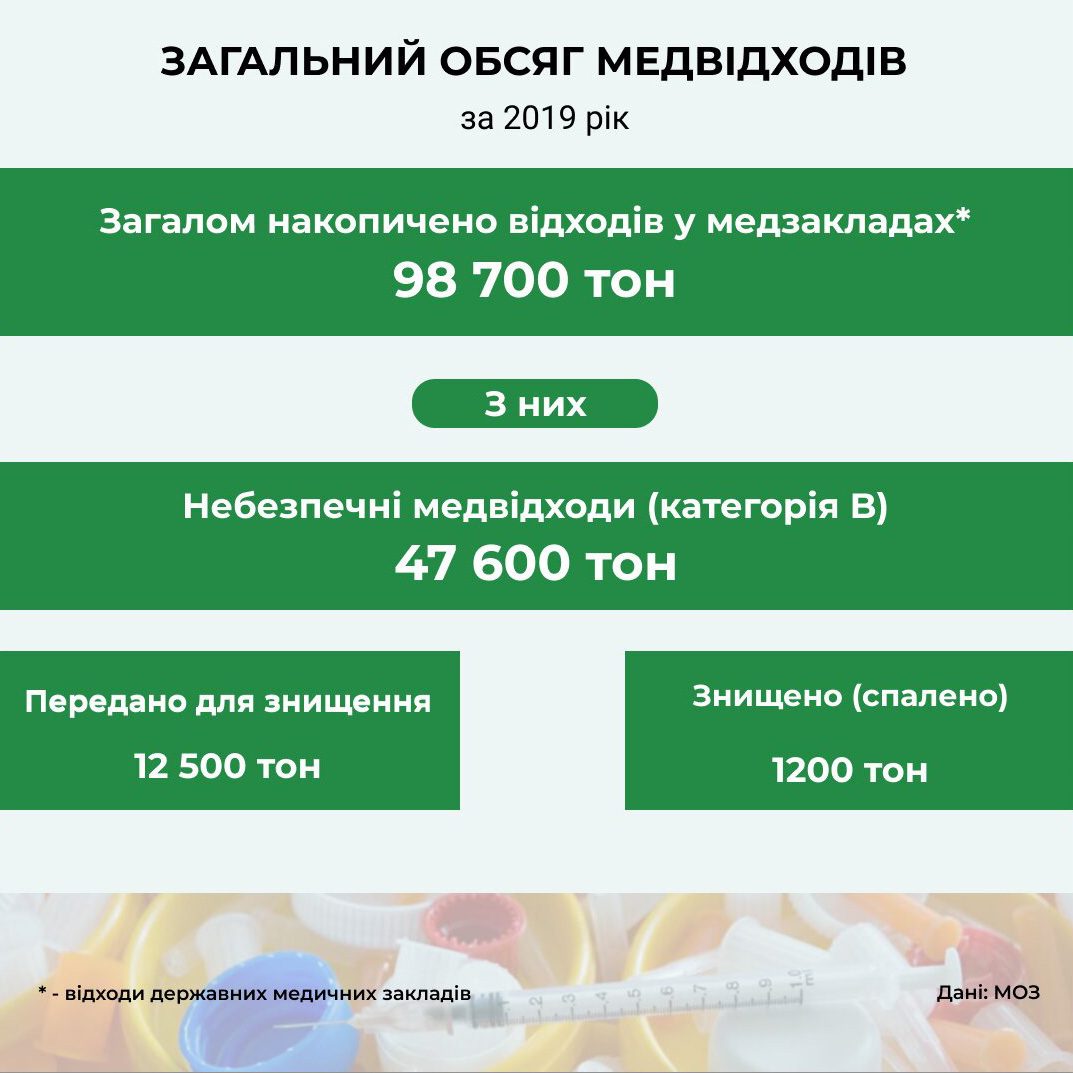
Thus, only a small part of the infected trash is properly destroyed. Estimates of the volume of accumulated medical waste vary widely.
In Ukraine, 61 companies hold licenses for medical waste disposal. Of these, only about two dozen have furnaces for disposal. If their combined production capacity is added up, then with eight hours of daily operation over a year they are able to burn a maximum of 8,000 tons of waste, experts calculated. That means it would not be enough even to destroy “Covid” waste.
However, even this volume is not destroyed properly.
At the end of 2020, on the instructions of Prime Minister Denys Shmyhal, the State Environmental Inspectorate began an unscheduled inspection of business entities handling medical waste. As of late November, 35 of the 61 companies had been inspected. Most of the inspected enterprises do not comply with the temperature regime when incinerating medical waste.
Another result of the inspection: all companies lack emission permits for emissions generated during the incineration of medical waste. According to him, when obtaining permits, the companies provided unreliable data, which allowed them to avoid checks for emissions of two dozen components that form during incineration of medical waste. Especially dangerous emissions — dioxins and furans.

Russian Attacks in Dnipropetrovsk Region: Two Killed, Seven Injured

Defense Forces Strike Four Russian Drone Control Points in Past Day, Including in Berdiansk

Britain Threatens Sanctions on Kremlin-Linked People; Poland Ready to Hand Ukraine Ammunition

Russia says it has completed "planned exercises" in the Black Sea

MVD: Fake Riots With Prop Blood Were Being Prepared Near Presidential Office

Law Enforcers Name Another Klitschko Deputy as Suspect

Berlin Holds Protest Against War in Ukraine; EU Prepares for Possible Russian Halt of Gas Supplies
North Korea Fires Ballistic Missile Over Record Distance in Five Years
Irish Fishermen Force Russia to Postpone Naval Drills

US sanctions in case of invasion of Ukraine could completely destroy Russia's economy, NYT reports
