
“Maidan,” “Donbass” and “Home”: 10 Key Ukrainian Films of the 2010s
A subjective ranking of the best domestic films of the past decade.
Ukrainian cinema has seen a notable rise in recent years. The State Film Agency provides state support for the film industry, which is why the fact that Ukrainian films reach the big screen is no longer seen as a victory. High-quality works keep appearing, so at the start of 2020 we are telling you about the most interesting and important Ukrainian films released over the last ten years.
“The Tribe” (2014)
Director: Myroslav Slaboshpytskyi
Myroslav Slaboshpytskyi’s film tells a brutal love story set in a boarding school for children with hearing impairments. The deaf students also play the lead roles, as they are non-professional actors.
The Tribe was one of the contenders for Ukraine’s submission for the Best Foreign Language Film Oscar nomination in 2015, but lost to The Guide. Some critics believe that had the Ukrainian committee put forward The Tribe, Ukraine would have won its first Oscar in history. In particular, director Myroslav Slaboshpytskyi himself is convinced of this.
The film also won numerous world and European awards. At the Cannes Film Festival, The Tribe won three of the four possible awards in Critics’ Week. As a result, it became the only film to win that many awards in the 53-year history of Critics’ Week. At the Milan International Film Festival, the film was named the best feature film of 2014. It also received the Sutherland Trophy at the BFI London Film Festival as the winner of the First Feature Competition, which honors an original and powerful directorial debut.
On Rotten Tomatoes the film has a rating of 88% based on 109 critics’ reviews, with an average score of 7.6. On Metacritic the film scored 78 out of 100 based on 27 reviews, which is considered “universal acclaim.”
“A radical film that will leave no one indifferent or unimpressed and will stay in your memory forever,” wrote the Spanish outlet El Mundo in its review. “The film has no music and no words, but some moments are so strong and intuitive that I still catch myself covering my ears,” says the author of The New Republic. “The film shows that you don’t need dialogue to communicate,” argues The Sun.
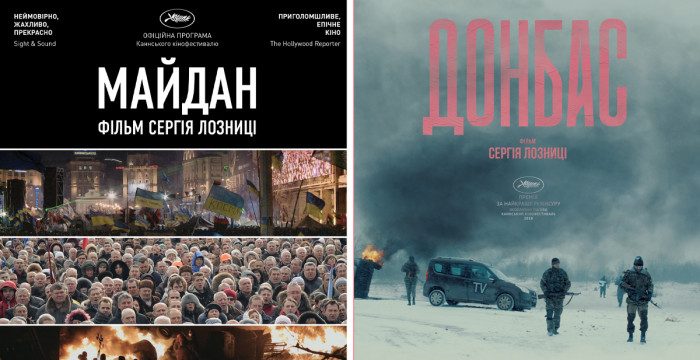
“Maidan” (2014)
Director: Sergei Loznitsa
Loznitsa’s film chronicles the events of the Euromaidan. It begins with peaceful protests in late 2013 and ends with a bloody confrontation between protesters and the militia.
The film won the Grand Prix at the Nuremberg International Human Rights Film Festival. It also received positive reviews and a standing ovation at its premiere at the Cannes Film Festival.
“It is powerfully moving, eerie and at times strangely beautiful,” says the review in the British Times. “Loznitsa offers what is rare and valuable these days: a close look at history as it is being made, without ‘breaking news’ tickers or network logos stuck on it,” wrote another British outlet, The Observer.
The Hollywood Reporter writes that “the film returns to the heroic, journalistic roots of documentary cinema, yet feels incredibly contemporary and formally daring.”
“Ukrainian Sheriffs” (2015)
Director: Roman Bondarchuk
The plot centers on the everyday work of two residents of the village of Stara Zburivka (Kherson region): 50-year-old Viktor Kryvoborodko and 44-year-old Volodymyr Rudkovsky. Law enforcement is almost entirely absent from their village, so they decided to take on the duties of law enforcers themselves.
The film received the Special Jury Prize for the best feature-length documentary at the Amsterdam International Documentary Film Festival. Ukraine also submitted the film for the Best Foreign Language Film Oscar, but it did not make the shortlist.
“Although the title brings to mind the Wild West, Roman Bondarchuk’s village chronicle actually resembles a ‘soft East’ more,” writes The Hollywood Reporter.
“Zhyva Vatra” (2015)
Director: Ostap Kostiuk
This is a story about life on a Carpathian polonyna (high mountain meadow), which the director studied for four years, and in which he brings the conflict between the traditional and the new to the fore. The film’s main themes are the nature of the mountains, human fate, love, family and a place in the sun. All of this unfolds in the mind of a little boy who may become a shepherd.
Three men of different generations live in the Ukrainian Carpathians: 82-year-old Ivan, who lives out his old age alone and has recently buried his wife, and is himself preparing for his own funeral. While 10-year-old Vanya starts life afresh at a boarding school in the district center, 39-year-old Vasyl runs a livestock farm and raises young sheep. When spring comes, all three will climb into the mountains, following the shepherd’s calling, which is becoming ever harder to sustain in the modern world.
The film received the Special Jury Award at the Hot Docs Canadian International Documentary Festival, as well as the cinematography award at Salem Film Fest.
“The Turtledove’s Nest” (2016)
Director: Taras Tkachenko
A story about a woman working in Italy who returns home and faces a difficult life choice. It is about Darina, who lives with an Italian family. Her life would be unbearable if not for the old signora’s son, Alessandro. She has to return home to Ukraine to her husband and daughter, and also make a difficult choice: stay with her family or leave for the man she loves.
The film won six nominations at the Ukrainian Golden Dzyha awards, including Best Film and Best Director. It was also recognized as the best Ukrainian feature film at the Odesa International Film Festival in 2016 and received the Ecumenical Jury Prize at the Mannheim-Heidelberg International Film Festival.
“Black Level” (2017)
Director: Valentyn Vasyanovych
The film shows the routine of 50-year-old wedding photographer Kostia. Everything he loved and was attached to is leaving his life. He examines his past path and his past, when he was young and happy, and at the same time photographs other people’s happiness.
The film is called documentary because the camera plays the role instead of actors. It is an album of a man who is gradually losing the meaning of his existence. The director conveys the heroes’ most subtle emotions without words. Moreover, words and dialogue are almost entirely absent. Even when the characters speak, the viewer still hears extraneous sounds that drown out their voices.
The film received the FIPRESCI Prize at the Odesa International Film Festival, as well as the award for best director at the Golden Dzyha awards.
“Cyborgs” (2017)
Director: Akhtem Seitablaiev
A film about the battles at Donetsk Airport during Russia’s aggression in September 2014. The film received three Golden Dzyha awards: for Best Film, Best Actor and Best Screenplay.
The film tells the story of a two-week combat duty in September 2014. A group of Ukrainian soldiers arrives for the first time at the war-damaged building of the old terminal of Donetsk Airport.
A volunteer with the call sign “Major,” a musician and the son of influential parents, secretly ran off to war. He tries to understand his role in this war, the war itself, and what will come after it. He is joined by six other soldiers, whose prototypes are real Ukrainian servicemen.
“Donbass” (2018)
Director: Sergei Loznitsa
The film consists of 13 episodes that flow one into another. As the basis of the script, Loznitsa used documentary material from amateur videos on YouTube, filmed in the occupied parts of Donetsk and Luhansk regions.
The jury of the second parallel competition of the Cannes Film Festival, Un Certain Regard, awarded director Sergei Loznitsa the prize for best directing, for “a piercing look at war in his homeland, in Ukraine.”
“The story is sometimes bewildering and often depressing, but it is shot through with dark absurdity,” writes the Times. “Brilliant formalist Loznitsa loves to turn his camera on crowds in motion, turning each sequence into a collective indictment,” notes the Los Angeles Times. “Donbass is a flawed but vivid achievement,” writes The Guardian.
“Volcano” (2018)
Director: Roman Bondarchuk
The story of Lukas, an OSCE interpreter who accidentally ends up in Berislav (Kherson region). There he encounters a completely new universe, in which life seems entirely detached from any familiar way of life.
The film received the Grand Prix, the Golden Apricot, at the Yerevan International Film Festival. It was also shown in the main programs of several world festivals, including Karlovy Vary, Munich and Vancouver.
“An impressive drama, with welcome notes of absurd comedy and crooked humor,” writes Variety. “A blend of a road movie in the style of Kafka and a contemporary western, rich in lavish visual effects and lyrical strangeness,” notes The Hollywood Reporter.
“Home” (2019)
Director: Nariman Aliev
The film tells the story of Crimean Tatar Mustafa, who wants to take the body of his late elder son, Nazim, from Kyiv to bury him in Crimea, and bring home his younger son, Alim.
The film was Ukraine’s entry for the Best Foreign Language Film Oscar. It also won the Grand Prix for Best Film at the Bucharest International Film Festival.
“Good work for a limited budget, Aliev works well with limited resources,” notes The Hollywood Reporter. “Nariman Aliev’s debut feature shows a composure and maturity that exceed his age,” writes Screen International.

Russian Attacks in Dnipropetrovsk Region: Two Killed, Seven Injured

Defense Forces Strike Four Russian Drone Control Points in Past Day, Including in Berdiansk

Britain Threatens Sanctions on Kremlin-Linked People; Poland Ready to Hand Ukraine Ammunition

Russia says it has completed "planned exercises" in the Black Sea

MVD: Fake Riots With Prop Blood Were Being Prepared Near Presidential Office

Law Enforcers Name Another Klitschko Deputy as Suspect

Berlin Holds Protest Against War in Ukraine; EU Prepares for Possible Russian Halt of Gas Supplies
North Korea Fires Ballistic Missile Over Record Distance in Five Years
Irish Fishermen Force Russia to Postpone Naval Drills

US sanctions in case of invasion of Ukraine could completely destroy Russia's economy, NYT reports
