
Why Social Distancing Is the Best Way to Fight the Coronavirus
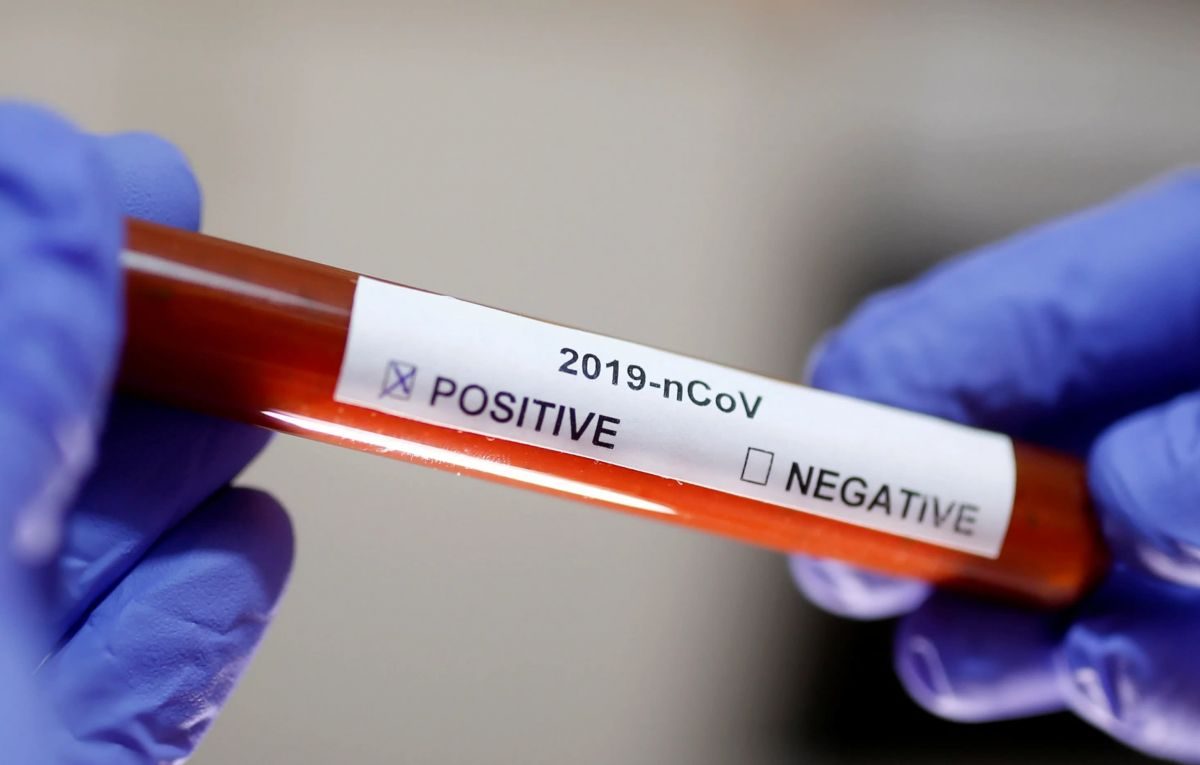
The Washington Post explains why outbreaks like the coronavirus spread exponentially and tend to subside just as quickly.
If in December and January the coronavirus outbreak seemed like something happening far away for most of the planet's population, now the disease is everywhere. The virus has not yet entered every home, but it has reached virtually every country. First the Chinese province of Hubei, then China with Hong Kong, followed by South Korea, the United States, Iran, and then nearly all of Europe — as of March 16, Montenegro remains the only European country where no case of infection has been officially recorded. This virus spreads through society slowly, but over time the number of infections begins to grow steadily.
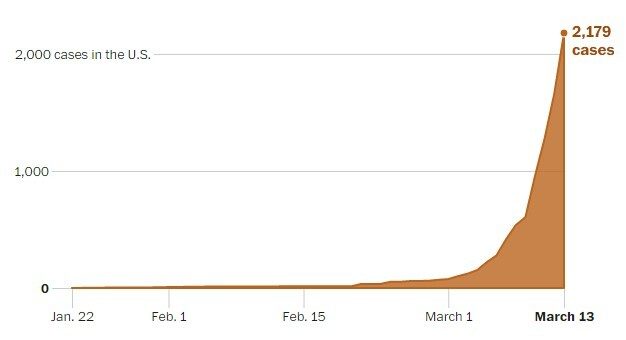
This so-called exponential growth has made experts worried. If the number of recorded infections continues to double every three days, the United States alone will have 100 million sick people by May.
This is mathematics, not prophecy. Health experts argue that the spread of the virus can be slowed if people begin to "socially distance" — avoiding public places and generally limiting their own movement. For now, with no means to slow it, the coronavirus will continue to spread exponentially.
To understand why this will happen, you can simulate the spread of a fake disease through a population. Let's call our disease simulitis. Simulitis spreads even more easily than Covid-19: as soon as a healthy person (blue circle) comes into contact with an infected one, they catch the infection and become a sick person (brown circle).

With a population of 5 people, it takes almost no time for everyone to become infected. In real life, people, of course, recover. A recovered person (purple circle) cannot pass simulitis on to a healthy person, nor become sick again after contact with an infected person.

Now let's see what happens when simulitis enters a city with a population of 200 people. We will place them in random positions, and they will move about chaotically. We will infect one of them.
Notice how the brown curve, which represents the number of sick people, rises sharply as the virus spreads and then falls just as sharply as people begin to recover.
This simulated town is too small — roughly like a long-forgotten village somewhere in Alaska — so simulitis quickly spread through the entire population and just as quickly subsided. In a country like the United States, where about 330 million people live, the curve could remain high for a long time before it begins to fall.
When it comes to the coronavirus, we would prefer to slow its spread and not allow a large number of residents to become infected. To slow simulitis, let's try to create conditions of forced quarantine — like the one the Chinese government imposed at the epicenter of Covid-19, in Hubei province.
Oops! As experts will rightly point out, it is not possible to fully separate the sick from the healthy.
"Many people work in the city but live outside it, and vice versa — explained Lena Wen, former health commissioner of the city of Baltimore, in a recent interview. — Will people be separated from their family members? How do you block all the roads? How will food be delivered?"
Lawrence Gostin, director of the Center for International Law and Health, is unequivocal: "The truth is that such strict isolations are very rare and never effective."
Fortunately, there are other ways to slow the spread. Above all, official health representatives urge people to avoid public places, stay at home more often, and keep their distance from others. The virus has fewer chances to spread if people are less mobile and come into contact with each other less often.
Some will keep moving. Some cannot stay at home because of work or other obligations, and some simply don't care about any warnings. And they are not only more likely to become infected, they are also more likely to spread simulitis.
Let's see what happens when a quarter of our population keeps actively moving around, while three quarters adapt to the social distancing strategy.
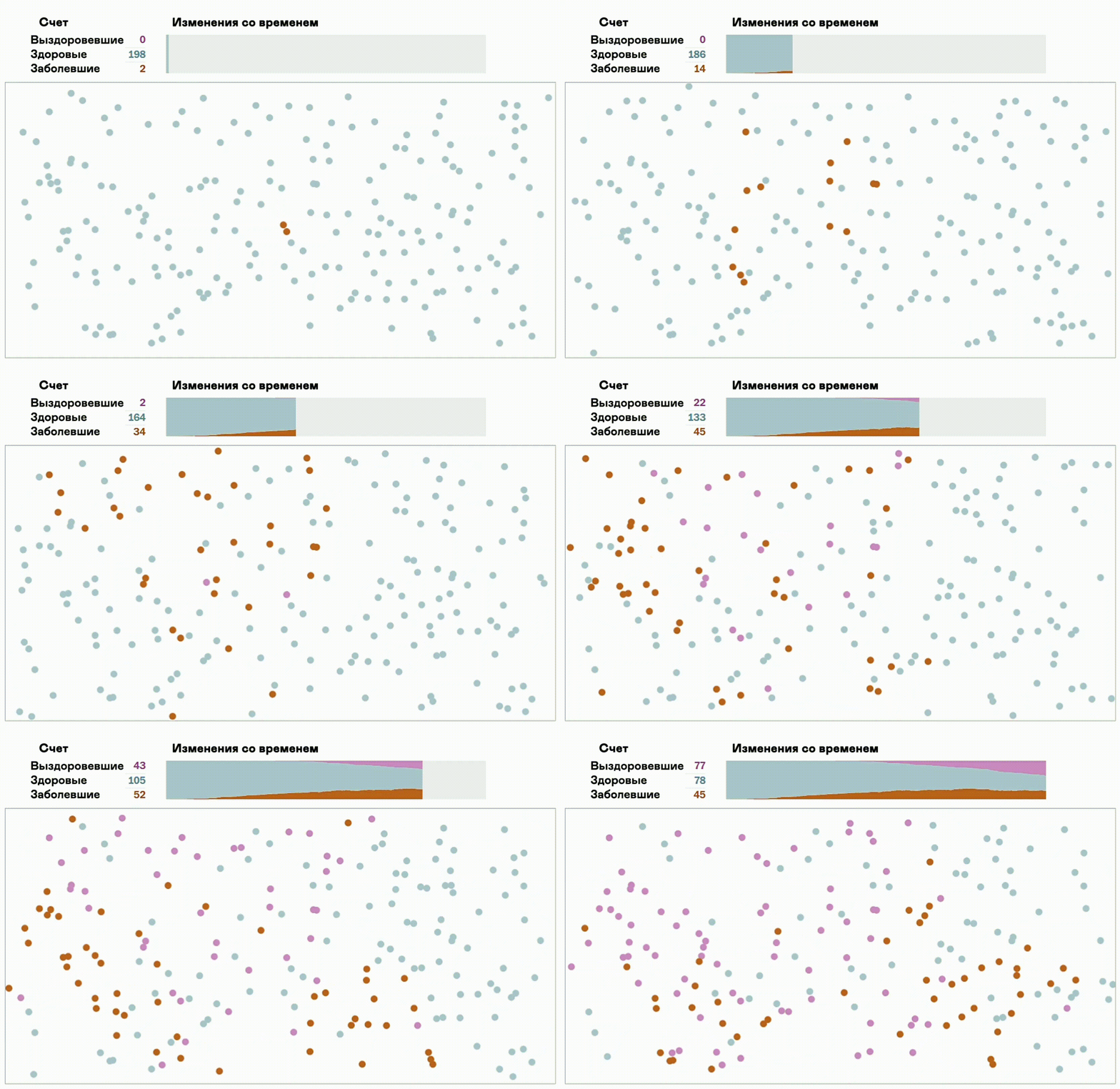
The more people socially distance, the more people remain healthy. And people can be kept away from public places if they are deprived of temptations.
"We control the desire to visit public places by closing those public places — says Drew Harris, researcher and assistant professor at Thomas Jefferson University. — Italy is closing all its restaurants. China is closing everything. Now we are starting to close things too. By reducing the number of opportunities for people to gather, we help them socially distance."
To simulate even greater social distancing, let's allow only one person out of eight to move around in society.
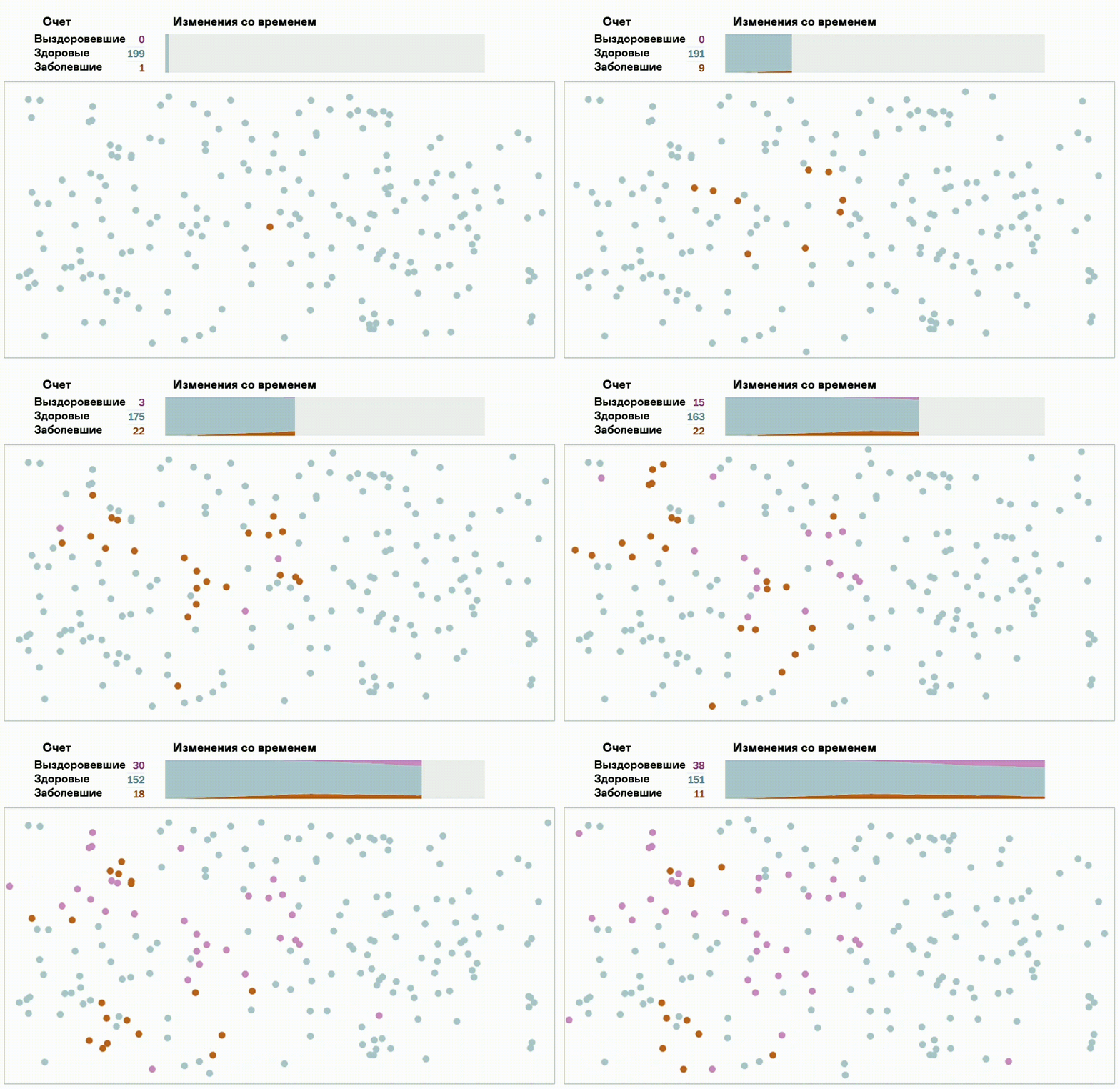
The four simulations you have just watched — free movement, forced quarantine, moderate social distancing, and enhanced social distancing — are completely random. This means that each time you refresh the simulation here, you will see a different result.
And even with different results, moderate social distancing leads to a better outcome than forced quarantine, not to mention enhanced social distancing. Compare the difference.

Simulitis is not the coronavirus, and these simulations greatly simplify the difficulties that arise in real life. But the coronavirus spreads through society just like the network of circles on your screens — it enters countries, cities, your workplaces, your families. And — just like the circle bouncing across the screen — the behavior of one person can have consequences for those who are very far away.
There is one big difference, however. Unlike simulitis, Covid-19 can kill. Although the exact mortality rate is still unknown, it is clear that older members of our society are at the greatest risk.
"If you want it to be more realistic — says Harris, looking over the drafts of this material — some circles should disappear."
Material by Harry Stevens, The Washington Post
Translation and adaptation by Vasily Obaraz, TK Media

Russian Attacks in Dnipropetrovsk Region: Two Killed, Seven Injured

Defense Forces Strike Four Russian Drone Control Points in Past Day, Including in Berdiansk

Britain Threatens Sanctions on Kremlin-Linked People; Poland Ready to Hand Ukraine Ammunition

Russia says it has completed "planned exercises" in the Black Sea

MVD: Fake Riots With Prop Blood Were Being Prepared Near Presidential Office

Law Enforcers Name Another Klitschko Deputy as Suspect

Berlin Holds Protest Against War in Ukraine; EU Prepares for Possible Russian Halt of Gas Supplies
North Korea Fires Ballistic Missile Over Record Distance in Five Years
Irish Fishermen Force Russia to Postpone Naval Drills

US sanctions in case of invasion of Ukraine could completely destroy Russia's economy, NYT reports
