
Zelensky Knew, but Yermak Postponed: Bellingcat Publishes First Part of Investigation into Special Operation Against Wagner Mercenaries
The report reveals that Zelensky knew about the special operation from summer 2020, but it is still unknown who was responsible for its failure.
Report by Bellingcat investigators on an operation by Ukrainian special services that planned to lure more than 30 fighters of the private military company Wagner out of Russia and arrest them.
The investigation found that the operation was postponed by Andriy Yermak, head of the Office of the President, and the reason could have been negotiations with Russia on a ceasefire in Donbas.
Bellingcat revealed details of a large-scale operation by Ukrainian special services to capture 33 fighters of the “Wagner PMC” in a multi-page report, the publication of which was postponed several times.
The report is based on dozens of interviews, in particular with mercenaries who were sure they were flying on a “business trip” to Venezuela, as well as former employees of Ukrainian special services who took part in preparing this operation.
The report also mentions that one of the investigators’ interlocutors was fifth president Petro Poroshenko.
The document, which describes the operation in detail, does not answer the main question that has been one of the decisive factors in Ukrainian political life for more than a year: was the failure of the operation the result of a deliberate “leak” of secret information by the country’s leadership, President Volodymyr Zelensky, or the head of his office, Andriy Yermak.
Ukrainian authorities first denied the very fact that such an operation was being prepared, then called it “not our operation,” hinting at Russia’s involvement in these events.
Official Kyiv’s latest version of this operation was voiced the day before: now they claim that a “special measure” to move 33 “Wagner fighters” into Ukraine was being prepared but did not take place.
The parliamentary investigative commission has still not been able to establish the cause of the failure, according to its interim report of November 15.
How It Began
The operation, now known as “Wagnergate,” dates back to the presidency of Petro Poroshenko, the report says.
At that time, analysts of Ukrainian special services, while conducting operational work on participants in the Donbas conflict who fought on the side of separatists, studied in detail the specifics of how Russian private military companies work.
In particular, the special services found that many mercenaries sit without work in their home towns and villages between rotations, and that the market for private military companies in Russia is heterogeneous and decentralized.
Based on these observations, as early as mid-2019 Ukrainian special services drew up an initial plan under which a small number, from two to five, of Russian mercenaries who had committed serious crimes in Donbas and, after rotation, were looking for side jobs, were to be lured to a third country, arrested there and then handed over to Ukraine.
The pretext for the fighters to travel abroad was to be participation in a training camp supposedly organized in Hungary or one of the Baltic states. After completing a fictitious training course, they could supposedly claim a higher salary during real missions.
Intelligence and SBU
The investigation claims that a successful special operation by Ukrainian military intelligence to seize and transport Vladimir Tsemakh from the so-called “DPR” to territory controlled by the authorities, Tsemakh being accused of involvement in the downing of Malaysia Airlines flight MH17, forced the special services to revise their original plans.
Now Kyiv began to consider capturing dozens, if not hundreds, of PMC fighters involved in combat in Donbas.
To this end, Ukrainian intelligence created a “virtual” fake private military company called “MAR.” This name coincided with that of a PMC that had really existed in the past but later ceased its activities.
Then intelligence officers began recruiting workers on behalf of “MAR” for a “business trip” to Syria. Later the fighters were told that plans had changed and they would have to work in Venezuela.
Details of the deal, code-named “Avenue,” according to the report, were developed in strict secrecy. Six intelligence employees working in isolation were responsible for this.
Informants in Russia
In several places, the Bellingcat report mentions agents of Ukrainian special services working on Russian territory.
One of them is a mid-level GRU officer who was arrested and recruited by Ukrainian military intelligence during the Donbas conflict.
He returned to Russia, retired, and then, at the request of Ukrainian intelligence officers, got a job again in the Russian Ministry of Defense.
This officer could have been useful to Ukrainian special services in confirming the reliability of the company they had created, if such doubts arose among “candidates” for jobs there, the report says.
Elsewhere the document states that immediately before leaving Russia, the fighters who were arrested by Ukrainian special services received travel budgets in cash.
The report says these funds were brought into Russia through a network of Ukrainian intelligence agents, including through citizens of Chechen origin.
The report’s authors claim that hundreds of candidates for places in the invented private military company sent Ukrainian special services a huge amount of information about their activities in Donbas, for example, footage of a downed Ukrainian helicopter filmed on a phone.
Success of the Operation
The Bellingcat report shows that, despite the actual failure of the operation, Ukrainian special services managed to collect a vast array of information about participants in combat in Donbas.
Essentially, they offered idle fighters well-paid work, with a salary of about $3,000 a month. And when they received hundreds of replies from combat veterans in response to this offer, they simply asked them to describe their experience in more detail.
By early July, hundreds of pages of detailed handwritten accounts about the activities of candidates for jobs in eastern Ukraine, the Middle East and Central Africa had arrived at two email addresses controlled by Ukrainian intelligence.
In particular, these included the surnames of their direct supervisors, or, for example, data on how regular units of the Russian army entered Donbas disguised as “militiamen.”
Zelensky Was Aware
As a result, the report indicates that if the Ukrainian special services’ operation had succeeded, it would have increased tensions in relations between Kyiv and Moscow, so the intelligence officers had to obtain approval for it from Ukraine’s top political leadership.
Citing information from conversations with former Ukrainian military intelligence employees, Bellingcat claims that Volodymyr Zelensky was informed about the preparation of the operation on June 15, 2020, during his weekly meeting with the leadership of Ukrainian intelligence.
The report’s authors claim that Ukrainian President Volodymyr Zelensky knew about the planned operation and regularly held meetings on its preparation.
Bellingcat’s interlocutors say that on June 26 Zelensky approved the operation in principle and asked for its specific plan, prepared and approved by then Ukrainian Defense Minister Andriy Taran on July 1 of that year.
Vasyl Burba was dismissed from his post as head of the Main Intelligence Directorate of the Ministry of Defense on August 5, 2020, right after the special operation failed. Ukrainian media wrote that his dismissal followed his demand to get to the bottom of the reasons for the failure of “Wagnergate” and, in particular, to check officials from the President’s Office with a polygraph.
Overheard Conversation
The general outline of the “Avenue” operation was sketched at the initial planning stage: the fighters who were to be captured were to leave Moscow for Minsk and from there fly to Istanbul.
The 28 minutes the plane was to spend in Ukrainian airspace were to be decisive: it was at that time that, according to the special services’ plan, the plane was to be landed at Boryspil airport.
At first, the Bellingcat report claims, two scenarios were developed for forcing the liner to land there. In one, one of the passengers was to feel unwell; in the other, the emergency landing was to be explained by a bomb threat on board.
The report claims that for various reasons Ukrainian special services chose the second scenario: a certain person at Minsk airport was to call the Ukrainian air traffic control center and report a conversation he had overheard between two unknown men hostile to Ukraine, who spoke about a terrorist attack on board the aircraft moving over its territory.
Yermak Postponed the Operation
As the report says, Burba and then deputy head of the SBU Ruslan Baranetsky arrived at the President’s Office on the eve of the operation itself, which was scheduled for July 25, for a final report on it.
Citing Vasyl Burba’s words, the document says the president could not receive representatives of the special services because he was busy.
The person who asked for the operation to be postponed, the report says, was head of the President’s Office Andriy Yermak
Burba also told Bellingcat that Yermak proposed postponing the special operation by a week. The day before, Volodymyr Zelensky had agreed to start a ceasefire in Donbas, which was to begin on July 27. “Detaining the ‘Wagner fighters’ in Kyiv will disrupt the truce before it even begins,” Burba quoted Yermak as saying.
Burba reportedly replied that such a delay would inevitably alert both the “Wagner” fighters and the special services of Russia and Belarus. Then, according to Burba, representatives of the President’s Office who were not named in the report, meeting with the special services officers and trying to meet them halfway, proposed postponing the operation by at least four days so that the ceasefire in Donbas would at least formally begin.
Heads of the special services suggested that finding new tickets from Minsk to Istanbul might be difficult, but promised to look into what could be done, the report says.
The next morning, when the “Wagner” fighters were leaving Moscow, Ukrainian intelligence officers nevertheless managed to book 33 new tickets for July 30, and Vasyl Burba reportedly informed the President’s Office of the progress of the plan, though with a five-day delay.
Detention in Belarus
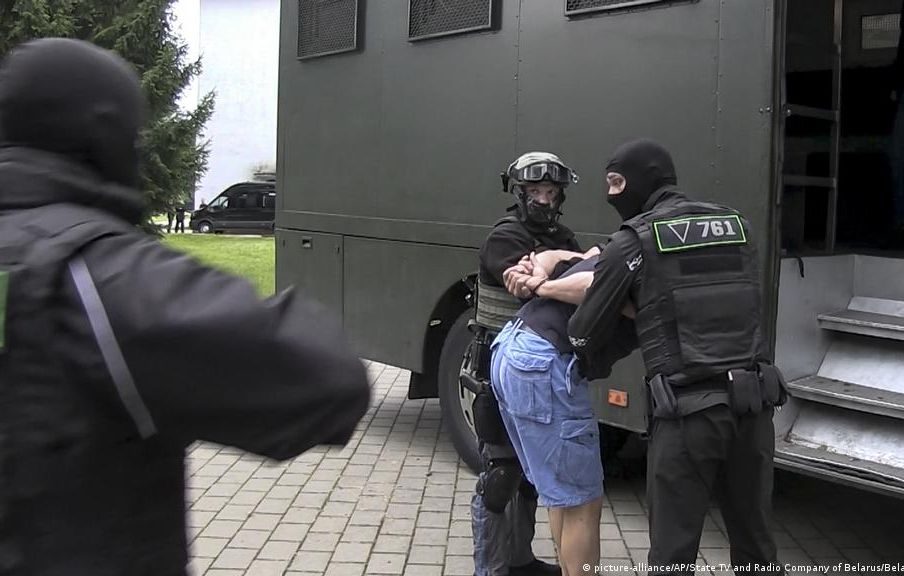
However, as is known, the plan did fail. The Bellingcat report states that on the morning of July 29, 2020, all the “Wagner” fighters waiting for their postponed flight to Venezuela were arrested by Belarusian law enforcement officers.
The document does not say whether the Belarusian security forces’ raid on the “Belorusochka” sanatorium near Minsk was the result of a “leak” of information about the Ukrainian special operation.
This refers to a “preventive action” by Belarusian special services on the eve of the presidential election scheduled for August 5 and the tense atmosphere in society on the eve of that event.
However, the report states that during interrogations the detained “Wagner” fighters were asked whether they knew Sergei Tikhanovsky and Nikolai Statkevich, well-known figures of the Belarusian opposition.
Moreover, the report claims, the security officers conducting the interrogation seemed sincere in their belief that they were dealing with people who had come to Belarus to overthrow Lukashenko.
Statements by Alexander Lukashenko at the time also fit this line: the Belarusian leader seemed convinced that the “Wagner” fighters were not going to Venezuela but had come to overthrow him.
Back to Russia
The report states that Moscow’s first reaction to the detention of the “Wagner” fighters most likely indicated that the Russian capital did not understand what all these people had been doing in Minsk.
It seems, the investigators claim, that Moscow realized it was dealing with a special operation by Kyiv only a week later: that is when Russian special services managed to trace Ukrainian IP addresses from which job ads seeking people to work in a PMC were posted on the Russian website Avito, as well as the Ukrainian travel agency through which tickets from Minsk to Istanbul were bought for the “Wagner” fighters.
Having received Ukrainian and Russian requests for the extradition of the detained “Wagner” fighters, Lukashenko agreed only to Moscow’s request.
For two weeks of quarantine they were regularly interrogated by the FSB, which tried to reconstruct in detail what happened after one of the “Wagner” fighters responded to a job ad he saw on a vacancy website, the report sums up.

Russian Attacks in Dnipropetrovsk Region: Two Killed, Seven Injured

Defense Forces Strike Four Russian Drone Control Points in Past Day, Including in Berdiansk

Britain Threatens Sanctions on Kremlin-Linked People; Poland Ready to Hand Ukraine Ammunition

Russia says it has completed "planned exercises" in the Black Sea

MVD: Fake Riots With Prop Blood Were Being Prepared Near Presidential Office

Law Enforcers Name Another Klitschko Deputy as Suspect

Berlin Holds Protest Against War in Ukraine; EU Prepares for Possible Russian Halt of Gas Supplies
North Korea Fires Ballistic Missile Over Record Distance in Five Years
Irish Fishermen Force Russia to Postpone Naval Drills

US sanctions in case of invasion of Ukraine could completely destroy Russia's economy, NYT reports
