
“Matchmakers” Series, Bogdan vs. Klitschko Conflict, War on the Advertising Mafia, D*ck Instead of Lenin. Sergey Ivanov Interviews Geo Leros – “Antipodes”
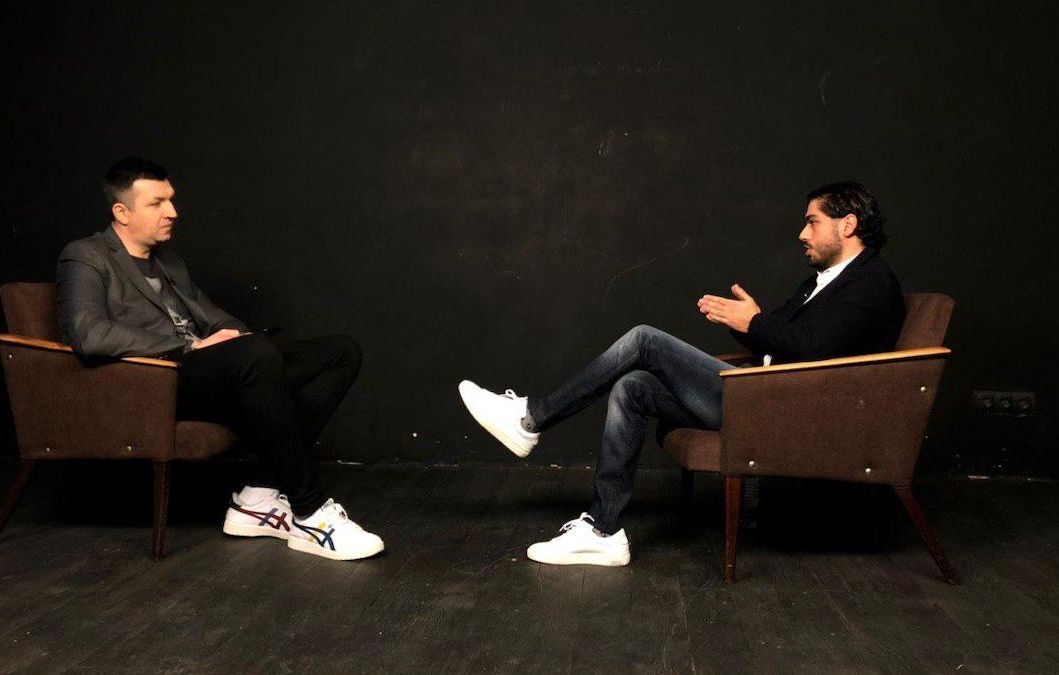
Text version of the new episode of the “Antipodes” program.
The new guest of the “Antipodes” program on the “Iceland” TV channel is a People's Deputy from “Servant of the People,” former adviser to the Mayor of Kyiv, and art curator Geo Leros.
“Antipodes” is the author's program of journalist Sergey Ivanov, former host of the political show “Pravo na Vladu” on the “1+1” channel.
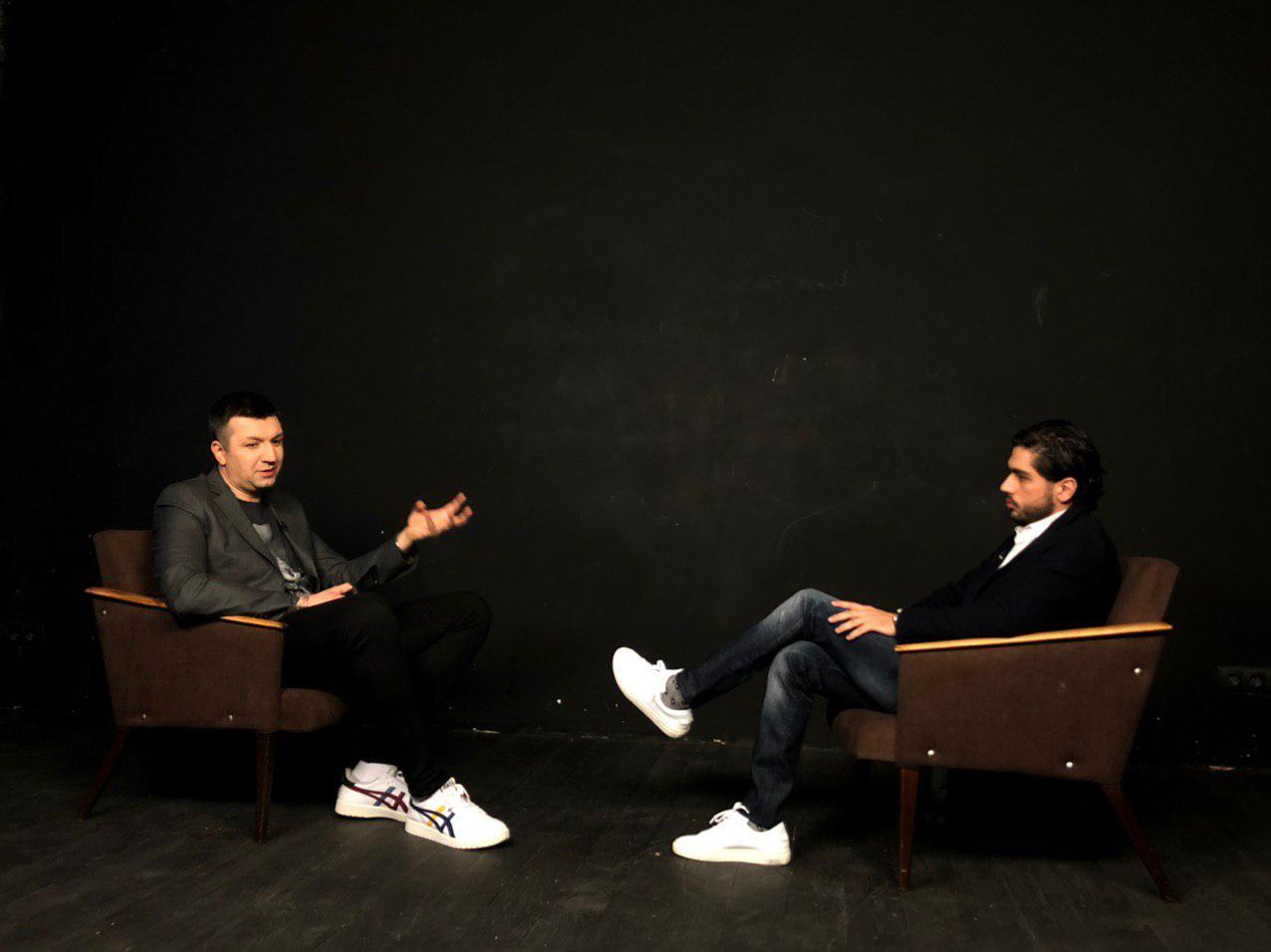
As part of a partner special project of TK Media and the “Iceland” TV channel, we are publishing the text version of the interview between Sergey Ivanov and Geo Leros for those who cannot watch the full show but can read the text version.
— I would not want to turn this interview into a typical interview with a People's Deputy, as often happens. Of course, we won't be able to avoid topics related to your current status, but first and foremost I would like to talk about things I consider very important. So I suggest we don't hold back, be yourself, and behave as you would in a party chat.
— Agreed (laughs). Those who know me don't distinguish between Geo the deputy, the politician, or Geo in normal life.
— You are a culture promoter. Describe in one word the cultural tastes and addictions of Ukrainian society.
— Vinaigrette.
— Can it be said that Ukrainian society is culturally degrading?
— If we don't take the million-plus cities — Kyiv, Lviv, Odesa, Dnipro — then mostly, it seems to me, yes.
— And the reasons?
— Politics, power and priorities have always been placed on certain central regions, and progressiveness and innovation did not reach the other regions. If some cultural hub opened, the priority went to Kyiv, Odesa or the million-plus cities. This is one of the reasons why people began leaving Ukraine. Interest in their own city disappeared. There are no magnets to keep people there.
— To what extent does television contribute to this process?
— It depends on which age group we take. If it's under 30, then TV accounts for 40%. If it's 35+, it's 75%.
— So television is the main factor, right?
— It depends on the age group, I think. Over 30-35, then yes.
— Doesn't it upset you, as a person connected with culture, that the country is ruled by a man who created such an epochal sh*t as the series “Matchmakers”?
— Let's take a broader view. I think TV as a separate entity is pure evil and utter nonsense. If a person has the willpower to get rid of television and the information that television force-feeds… In essence, any show is a sail in the right direction. If you need to push things somewhere, shows and talk shows are directed there, and the population is brainwashed bit by bit. One of the reasons Crimea was occupied and the war is going on in eastern Ukraine is [this one].
— And how could the series “Matchmakers” interfere? Or, on the contrary, help?
— That's not in the context of the series “Matchmakers.”
— All right, humanitarian policy. You are the deputy chair of the committee. The committee is headed by Mr. [Oleksandr] Tkachenko, producer of no less infernal things such as “The Milkmaid from Khatsapetivka,” “Kateryna,” “Ment Wars,” “Vorozheya,” and other trash.
— I haven't watched any of that. Not even the teasers.
— I'm interested in something else. What humanitarian policy do you plan to build with people who produced such things?
— Then they could also ask me why I went into parliament. Under one roof with people…
— You misjudged my question. So a person who creates crap and trash is now envious of humanitarian policy in parliament? Is this person, whose deputy you are, capable of creating something healthy in the humanitarian sense?
— I have a counter-question, but it's rhetorical. Well, you also worked at “1+1,” on the channel where this product aired? Implying that since someone needs this product and people watch it, it gets produced in some quantity. I agree that one can create niche and more intellectually developed content to educate the population.
— The content we produced, in my humble opinion, was intellectually a bit higher (the program “Pravo na Vladu” — note by TK Media).
— I in no way compare one content with another. I came to the committee and parliament with specific goals related to the sphere of culture. We have deputies in our faction and in other factions who came to parliament and floundered about where to go, which committee to choose. In general, I don't support that. You have to understand why you are going there, what for, and where your final “goal” is.
— You are trying to promote modern, relevant culture in our country. I'm curious how much a person who created the series “Vorozheya” can help your ideas?
— It doesn't interfere at all. In this case, our relations are rather partnership-based. When we have working meetings, I don't discuss the series he made. Likewise, he doesn't discuss with me the context of the murals that were made. We discuss some strategy or vision that each person presents in this committee. That's the only thing that concerns me. What we are working toward and in which direction — it's pro-Ukrainian, it's ideological, it's the development of the country, it's museums, galleries, encouraging private initiatives so that they bring exhibitions here. That's what we talk about.
If we sit down to discuss which series you made and which you did not — honestly, I don't care. He could have made 500 series.
— But background matters. Say we have an event dedicated to metamodernism, and it is presented by Shufutinsky, for example. Is that normal or not?
— In this context, no.
— That's exactly what I'm saying. If people don't consume that trash themselves, aren't the target audience for the trash they produce, the question arises: why do they make it and feed people crap?
— You don't know specifically, if we're talking about Tkachenko…
— No, well, I mean “Matchmakers” too — that's already for Zelensky and his team, and Tkachenko. I don't want to specifically jab anyone right now.
— I haven't watched any of the series you mentioned.
— Did you see “Servant of the People”?
— No. I haven't watched a single series. In general I avoid watching television, except for two or three channels that I occasionally leave on in the background. These are National Geographic, Discovery Channel and Travel Channel.
In all other dominant cases, I use Apple TV to turn on exactly those shows that interest me. I'm interested in watching some old shows by Jacques Fresco and other intellectually developing programs, but I choose specifically what interests me. In general, the trash that TV forces on me — it doesn't matter, series, non-series, news — doesn't interest me at all. I prefer to filter the information that gets into my head.
— Can it be said that you feel some synergy working with these people?
— I don't feel it at all. In the context of the committee it is not felt at all and does not affect performance.
— Parliament. Who is the most unpleasant person in parliament?
— It depends on the context.
— Who makes you sick? Number one.
— If you're asking who makes me sick in parliament, that implies this person should somehow get to me, and I walk in and realize I feel really unpleasant. That means losing. Freud put it well: “The scale of your personality is determined by the scale of the problem that can drive you out of your mind.” If I walk into parliament and some person drives me out of my mind — I have lost. I can't say that someone irritates me so much that I feel bad. But I wouldn't go there at all if I understood that I would feel awful going there because of the presence of some person.
If we talk about ideology, there are 35-40% with whom I don't resonate on ideological grounds.
— So you are able to control yourself?
— Absolutely.
— I just can't force myself to tolerate some people.
— Why do you even need to focus on him?
— I can't avoid him.
— Why do you think you have to avoid him? I come there and do my job. That's it. Period.
— Do you believe that a deputy is a function?
— I believe that a deputy is a subject. Every deputy must be a subject. Why and for what they came there — it all depends on the vision. What is your final goal and the results you want to achieve? If you poured a glass of water into a huge bathtub and it spread out there — I don't support that principle.
— So this is a way to achieve a certain goal?
— Absolutely.
— Who are “vatniks”?
— Good phrase, I was thinking about it recently. I think these are people with a clearly pro-Russian position and, to some extent, Ukrainophobes. Plus a number of “coins” that get attached to this phrase.
— Haven't you noticed that people on opposite sides of the barricades — someone with a pro-Ukrainian position and someone with a pro-Russian one — very often share the same arguments and methods of proof: bullying, aggression, and so on?
— I agree.
— Can a vatnik be a “hurrah-patriot”?
— It depends on the context.
— Your faction obviously has a vatnik layer. I know they don't like being called that. But these people constantly shout about Nazism in Ukraine, go to Medvedchuk's channels, and some of them even work there. I don't rule out that they receive money [from him] — that is, they are connected [with him]. Some even speak on Russian channels. How do you justify to yourself the fact that they are in your party, and how do you coexist with them?
— A provocative question, where I should either agree or disagree and take some position. There are people with completely different ideologies in our party, there are people with an open, tolerant attitude toward the Russian Federation, and there are ardent patriots. Bohdan Yaremenko, for example, is a clear pro-Ukrainian patriot, despite the delicate situation that arose with him.
I am Russian-speaking. I understand Ukrainian perfectly, I speak Ukrainian perfectly, but I consider myself a patriot. I was born in this country, I live in this country, and I am not going to leave anywhere. There were thoughts once…
I just perceive the word “vatnik” negatively. To say, in the context of my party where I am, whether there are vatniks there or not — implies that I am pinning a label on someone.
— Based on the definition you gave above, I call this group vatnik. Moreover, when I was supposedly running from this same party, I wrote the same thing: “vatnik layer.” I'm asking something else entirely: how do you justify to yourself that these people are in your faction? Is this a quota from the multi-vector Kolomoisky or someone else?
— I don't know for what reason certain people ended up in the party, I didn't have that information. Few people in “Servant of the People” know why a particular person appeared.
There was a reason why I was taken, or someone else. For certain merits. Why some people with pro-Russian views ended up there in places — I don't know. I have such principles: if I understand that part of the team is, frankly, rotten, and I am in this team, it would be more correct to leave this team. Being in “Servant of the People,” I won't take and shield a separate group.
There are statements, or, for example, like Deputy Shevchenko who spoke on Russian TV — I am against that. Russia is an aggressor. Those channels spent decades brainwashing people in the eastern regions of Ukraine. I don't understand the logic of going live on air together with DPR or LPR terrorists and giving comments. So here I had an open position.
As for internal matters — given the fact that I am in this team, I would refrain from making any clichéd comments.
— You actively criticize those who go to the channels of the Kozak-Medvedchuk group…
— We had an agreement about this. It's a matter of team unity.
— Why can't one go to Medvedchuk's channels? Your view?
— First, there was a position of attack on the president. And it started with that rabble that keeps pouring and pouring and pouring. There was a banner that read: “Servant of the People sells Ukrainian lands. What will be left for us?”
— Is that the main factor?
— One of them. Second, these channels systematically [spoke negatively] about the Maidan events that took place. After all, there are some values. Third, the temporary investigative commission created to investigate the work of the channels. And still, a team decision was made that we do not go to these channels — that's essentially where this position came from.
— Why did a certain group of deputies from “Servant of the People” put a spoke in the wheel of this decision?
— Only two or three deputies have put a spoke in the wheel.
— Who are they? Vereshchuk, Buzhansky…
— During the interview, [Yuriy] Butusov told me about Buzhansky. I suggested looking at the situation in a slightly different way. Buzhansky, who was a host on the News One or ZIK channel (I don't know exactly), joined the party. What claims can there be against him in the course of the game? That's more a question for those who invited him into the party and for those who let him stay.
— And who else goes? Vereshchuk and who else?
— Shevchenko goes too.
— Well, after Russian channels he can go anywhere. For him, unlike Yaremenko, anal sex is probably not a taboo.
— You never know, you never know…
It's a matter of team play. If the team makes a decision — either you leave the team and stick to your own agenda, or if you understand that you are in this team… I disagree with some decisions of the Cabinet or individual ministers. And there is a minister with whom I disagree 80% of what they do there.
— Who is that?
— When I go to some TV channels where this gets polished, I prefer either to sidestep the situation or talk about some positive aspects, because I am in the team that chose this Cabinet and every minister. I have team unity — I could leave the “Servant of the People” faction, and then my conscience would be clear when polishing.
But if you are in this team, you vote for the laws they propose.
— You disagree 80% with…
Individual ministers, without surnames. Well, if I suddenly leave the “Servant of the People” faction, or I am...
— So the government is a derivative of power.
— We voted for it, in fact.
— Do you think there are people in your faction who work for Medvedchuk? Or directly for Russia?
— I don't know, a difficult question. Before declaring anything, you need to be sure of it. Judging by rhetoric and some views — it's not excluded. It's not excluded that in the “EU” or “Holos” party half the people may [work for them] too. I don't know that. Before saying “you are unquestionably Medvedchuk's man” or “you are a man of the RF,” you need to be sure of it.
— But one can say their rhetoric coincides with Medvedchuk's rhetoric.
— Yes, but Americans always nicely add “I think,” think. We often forget to add this to our judgments. Before I pin this on someone, I would like to be sure of it.
— How many groups are there in your faction?
— Sub-factions? 15-20.
— Is that legal?
— Yes.
— And what about influence groups that are controlled from outside?
— I can answer for myself 100%…
— Is your faction monolithic — yes or no?
— More specifically.
— A single whole that adheres to a single ideology. And there is no division into influence groups and groups divided by other people — oligarchs, politicians, and so on?
— I can only answer from my side, being in a sub-faction or in the circle of communication of certain people. I do not feel 100% that there are any separate influence groups. Or separate oligarchs who influence some deputies. I don't feel that. I can assure you of that 100%.
— What would you say to those people who counted you in Tkachenko's group?
— That's just funny. Given that I'm in his committee, how exactly do I become “Tkachenko's group”?
— That's a quote. What can you say about this? Bullshit?
— Absolute bullshit. Politics is smut, nonstop. And if you try to chase down every bullshit that comes out, you turn into a crazy epileptic who runs there, refutes this, refutes that. There's no point in it.
For example, you were once told that you were Kolomoisky's man because you worked at his channel. But that's not true, is it? No. You didn't rush to comment or refute it. The same goes for Tkachenko. Yes, I work in his committee. Yes, I am his deputy and head of the subcommittees, which include culture — I came from this field.
— The fact that I was in fact not Kolomoisky's man didn't stop him from saying, “He works for me, he's my man.”
— Well, you don't have to chase that story. That's what I mean.
— You stated that you would lobby a number of highly resonant bills related to topics that are extremely unpopular in Ukraine — in particular, legalizing medical cannabis and euthanasia. What is the probability that you will be able to push euthanasia through?
— Hard to say. There is a large number of deeply religious people who perceive this bill as disrespect toward religion or faith. Within my team — without naming surnames — there was a conversation on this topic with one of the committee heads. And that person told me: I will make every effort to make sure this doesn't happen. Because only God gave man life and only He can take it away. I, of course, asked a rhetorical question: why do millions of doctors in intensive care units fight for a person's life if only God can take care of it?
— I'd ask why God gave cancer.
— A large number of such questions will remain.
— Do you understand what the church's reaction to this bill will be?
— I already came up against it when I announced it. At home, in the mailboxes, I found little leaflets with a brief story about me and what I intend to do — in the vein of “legalize drugs” (that's how the law on medical cannabis was presented) and “legalize murder.” I, of course, laughed at that.
— What do you think in general about the church's influence on society?
— My purely personal attitude: the more religious a state is, the less successful it is. Compare it with the Scandinavian countries — take Norway, Sweden, and compare the number of religious people. It reaches 80-90% [atheists?]
— Is the US a very religious country?
— Did you look at the trend, how much it's declining?
— No.
— Look at the trend, the way the decline is going.
— Should the church be taxed in Ukraine?
— That idea existed, but now they have benefits — they pay not as legal entities but as individuals.
— If there was an idea, did you write a bill?
— No. I wasn't scared of anything, I just had thoughts. Regarding whether the church should pay taxes on the donations made there — I think it should, more than not.
— How so? An organization that provides services for money, that may even engage in wholesale trade of products — why doesn't it pay taxes?
— The church is the only organization in the world that does not pay taxes. It's purely historical.
— Nowhere at all?
— From what I analyzed — nowhere. It's the only organization that is not taxed anywhere.
— Even for selling some specific goods?
— I didn't go into the details. I'm talking about dues and donations.
— I like how it is in Amsterdam: there's a church, and next to it is the entrance to a nightclub. That is, it doesn't stand out in any way, no fences and so on. And that levels things out.
— When I was driving to the interview and passing through the Lavra, I saw a new Mercedes, and they were blessing it there. For me it's simply absurd why anyone would give the signs of a living being to a huge pile of metal.
— So that you can install plugs and not get harassed.
— That's a separate story, just taken to the point of absurdity. And an icon that will “protect” him from flying into the windshield.
— Car icons are sold right along with the plugs.
— Seriously? I've never seen that.
— What's your salary?
— 30 thousand officially. There's also a separate fund for deputy activities.
— How many assistants do you have?
— For now, one staff member. And three more outside the staff, and really cool ones. Lena Khotenko — head of the Tax Reform Fund. Tanya Kostenko — director of the Kyiv History Museum. And Andriy Tymoshenko — a cool lawyer from a family of lawyers.
— How much do you pay them?
— They're outside the staff.
— What's their motivation for doing this?
— They all have jobs where they receive a salary. They consult me. For example, while I was on my way here, they sent over one bill that I have been working on for six months. And that's one of the goals I went into the Rada for: the movement of cultural values across Ukraine's borders. Elena advised on taxation and analyzed how much the state of Ukraine received in various years from the constant import and export of art objects.
— You said in an interview with Roman Skrypin that Ukraine has a very low rating…
— There is an international organization called “Sinal.” It's an international organization of art dealers and art curators, and we are on the blacklist. It is not recommended to make any transactions related to buying and selling art objects on the territory of Ukraine.
— Why?
— With us, everything considered older than 50 years — a painting, for example — is already questionable whether you can take it out. You have to prove that it doesn't represent any cultural value, and only then do you get a letter saying you can export it.
For example, you're a tourist, you came to Andriyivskyy Descent, bought a painting that is 60-70 years old, and paid 50 dollars for it. It doesn't represent cultural value for Ukraine, but now you are obliged to submit documents to the Culture Department of the Kyiv City State Administration for expert review, to prove that it is so, because at customs they will start squeezing you from every direction. When you leave with it, you are already a smuggler by default.
— Outrageous.
— Now, say you fly to Sotheby's and buy a Salvador Dalí painting for 100 million pounds. Nobody will stop you at the border and say, “Oh-oh-oh, you can't export that.”
— If you have 100 million, nobody will stop you at the Ukrainian border, I guarantee it.
— The British have a clear list of what is banned from export, a specific register. The rest — buy, pay the tax, export.
— What kind of invoice can they issue on Andriyivskyy Descent? If these are local enthusiasts who sell matryoshka dolls, Putin, and so on?
— We're not talking about matryoshkas, Putin, and everything else. We're talking about art objects. There should be a clear register of what we ban from export. The rest — bring it in, sell it, pay the tax, and export it. Let it be a Mecca for transactions from Europe. Why not?
— Will your bill help with this? How do you assess the prospects?
— The prospect is not that concrete deals will start happening tomorrow. There's a festival, “Kyiv Art Week” — an amazing event, very cool. The last time I was there, it was held in the Toronto business center. Many foreign galleries were represented, with their artists. And they struggled to bring works here. They all had to indicate that each painting costs less than 50 dollars so they wouldn't have to pay VAT on permanent and temporary import. If you want to bring an exhibition here, you have to do all of this in a roundabout way. Why not allow works to be brought in openly?
Plus, with budget money you can't pay an art curator to come with his exhibition and receive a minimal fee and compensation for tickets. We have budgets that are spent on culture, but we can't do anything meaningful. People have to hide things somewhere, or negotiate and look for sponsors for free to pay for your ticket, accommodation, and so on.
— For most viewers all of this is ephemeral. Can you translate it into numbers: how much does Ukraine lose from the improper organization of this art market?
— Let me give an example of a bill we have already passed — the law on rebates in the film sphere. Something the Ukrainian film industry had been waiting for very much. The rebate law means that a certain budget is additionally allocated by the State Film Agency for foreign companies that come here to shoot audiovisual products.
What does the state receive? For example, the film “In Bruges” in 2008 — after it, Bruges became famous. It became a cult city, and the tourist flow increased.
Think how much the number of tourists to the Chernobyl zone increased after the series came out. But the series itself was shot here for only six days. The rest was in a neighboring country (Lithuania?), because they have a rebate system. And we could have additionally received 20-25 million dollars spent there if this system existed.
According to research, for every dollar spent in the film sphere, the film company that comes here additionally spends from 3 to 5 dollars on infrastructure. Conditionally, if they had 20-25 million dollars allocated for shooting a series in Ukraine, they would additionally spend about 100 million dollars — restaurants, hotels, drivers, infrastructure. All of this creates additional jobs and develops infrastructure.
If we managed to bring a Chagall exhibition here, the number of people from neighboring countries who are interested in art — Moldova, Belarus, Romania, Russia — would come here to see this exhibition. They would stay one or two nights in Kyiv or Odesa and additionally spend money on restaurants and other related things.
We think about how to collect more money, but not about how to create more jobs. I would simply give away territories so that factories could be built there and jobs created. The more people earn in those jobs, the more they spend here — the money returns to the economy. The sphere of culture works the same way.
Take, for example, the unremarkable city of Bilbao and the Guggenheim Museum. It was a revolution when this museum was being built, with many scandals. They almost wanted to lynch the city's mayor, because, as far as I know, he took a 200 million euro loan for the city to build it. But this museum became a magnet in Spain's cultural sphere. Additional restaurants, small galleries, art objects, and cultural centers began to open there. It became a generator of the city's economy.
The Wynwood art district in Miami became the cultural Mecca of the USA. If you look at how much a square meter of rent cost back then, now it's 1,000 times more. Every tourist who goes to Miami understands that they are going to Wynwood.
— You can talk about culture forever, unlike politics.
— I understand why I went there. I'm not trying to jump like a frog from one story to another. I see how different deputies from different factions can't find a use for themselves. He went there for this, but he understands that something else is more interesting…
— If you believe Wikipedia, you are the president's adviser. What was the last advice you gave the president? What was it about?
— The last meeting was about the Museum of Contemporary Art, which, I hope, will appear in the near future. The negotiation process has already begun with a world-famous architect who will design all of this.
— Where does the money come from?
— It will be a pool of five or six investors, who will be officially announced.
— International or our own?
— Three are ours, two are Danish, and one is still in process.
— Three of ours — Kolomoisky, Pinchuk, Akhmetov?
— No, none of them.
Pinchuk deserves credit for the Pinchuk Art Centre — a private foundation that brought in cool people. It became a certain engine for our country's culture. But I think he's no longer interested. He created his personal initiative — it works for his personal image. If you go out on the street and ask people what Pinchuk is associated with, they won't talk about Kryvorizhstal.
— They'll say: Kuchma.
No, I'm ready to bet on it. If you take the 25-35 age group, their first association with him is the Pinchuk Art Centre. Number two is the YES forum. Third, anyone who knows the history more or less will associate him with Kuchma.
— You declared war on Kyiv's advertising mafia.
— Yes, and I enjoy it very much.
— You constantly accuse officials of embezzling budgets.
— I can give specific examples. When I started drawing people into this story and realized there are levers to achieve justice through deputy appeals, if you formulate them correctly… When I began the open war, people whose path I had crossed started reaching out to me.
Here's an example. In the city center there are three or four billboards that used to be on the balance sheet of the Ministry of Sports. This is illegal. On the Kyivreklama website they are listed as “dismantling,” but for some reason nobody touches them. The rent for them is about 250 thousand hryvnias a month. Convert that to a year, and so on — the figures are insane. And there are tens of thousands of such billboards around the city.
Statistics show that dismantling is underway, but they dismantle [advertising of] inconvenient people. And demand for the ones that remain immediately grows. The number of advertising surfaces decreases, but the figure stays the same, because demand for them grows. Thousands of billboards are marked as a priority for dismantling, but for some reason they are not touched. And if something is a priority for dismantling, the city of Kyiv cannot receive money for it.
— And who profits from this?
— Kyivreklama, headed by Smirnov.
— Nobody knows these surnames.
— Earlier, under Poroshenko, Kyivreklama was reportedly overseen by Berezenko.
- Do you think Mayor Klitschko is involved in this advertising mafia?
- I don't know. It's hard to say. Given that I was once Klitschko's adviser on cultural issues — a purely formal role — I noticed that there were crooked things happening at City Hall, but the mayor was not aware of them. I was surprised: how? It was done behind his back.
— I read in various media that the war between “Servant of the People” and Klitschko has ended — allegedly they agreed and divided spheres of influence according to the interests of Klitschko, Vavryshch and others. Is that true or not? There were accusations before, and battles between Bohdan and Klitschko on Shuster's show. What happened?
— It seems to me that in this situation they chose the position of “zugzwang” — when any move is not to your advantage. I think they decided to leave everything as it is and not take any loud steps for now. That's how it seems to me.
Let me tell a story about the advertising. When I started the story with 4-5 surfaces and began sending requests to dozens of addresses, one guy from our faction came up to me and said: “I wanted to ask — people asked you to clarify whether you could leave certain surfaces alone, because requests have come to them and they need to respond.” The matter of principle played the main role for me: I made it clear to him that if he came up to me with such a story again, I would publicly declare it with his surname.
— Why is Ukrainian cinema so miserable? Except for two or three arthouse films. Well, “Cyborgs” was okay — and maybe that's it.
— I definitely liked “Cyborgs,” but I forced it into the format of a feature film. It seemed more documentary to me. There was no clear storyline the director could grab onto. The same trumpeter, the same guy who supposedly flew off to study and went to the airport — it could have been developed from the other side, and you wouldn't have been pulled away from the storyline.
— So why is cinema still so lousy? It seems that about 1.5 billion [of budget money] was spent on film and nothing was shot.
— We're spending budget money, there should be feedback from it. If a film shot with budget money goes into mass release, we see that 40 million hryvnias were spent on it, but at the box office it collected 200 thousand hryvnias — then the question is why this company that shot it should still be given money. It has shown that it can't make films.
There are arthouse films, and there are films made for certain competitions — that's a separate story. But when crazy budgets are spent on films that, in essence, should be commercial, only a few of them reach even the average payback level. Why spend money on them?
— Do you remember the blue hand on Shevchenko Boulevard? Did you like it?
— My first impression of this hand: what the hell is it doing there? But when I googled it and read about which countries it appears in, I looked at it differently. It was a temporary exhibition.
But the huge stink that was raised around the blue hand — I don't think it makes sense. The topic wasn't worth a damn. The project appeared, the deadline came — and it ended.
— Here's the next idea. In the place where the blue hand was, there is a pedestal left after the Lenin monument. Put a huge red d*ck on that pedestal, without balls, just a d*ck. And leave the inscription “Lenin.” What do you think?
— It seems to me it would be too great an honor for Lenin, as a dictator, to have something avant-garde and contemporary appear in his place. I would remove the “Lenin” inscription and do everything from scratch. That would be too great an honor for a piece of history that was negative for Ukraine.
So in this context, I would rather perceive it negatively. But I saw when a huge penis was painted on a building in central Brussels. The local public took it normally. Our society is not yet morally and ethically ready for that. It's connected with religion, too.
I was accused of writing the word “d*ck” in a general chat of 50 people. And part of society split: some said “yes, it's your personal chat, you discuss everyday stuff,” and others said “f*ck, what a dick he is, he wrote the word d*ck in the chat.”
— To a woman.
— I didn't address it to her.
— But she saw it.
— She saw what she wanted to see. But I didn't address it to anyone specifically. It was a way of expressing emotions in that situation. Even people who seemed progressive started writing along the lines of: what if it were your mother? I think they are definitely not ready for what a d*ck [on the pedestal where Lenin once stood] will be.
— Doesn't this so-called “Motherland” irritate you? How can it be modernized, and does it need to be?
— In no way. It's a monumental structure. If you think about how many monumental contemporary structures have been built in our country — can you name even one? I can't remember any.
— “The Globe” and that superstructure that for some reason hasn't been cut down.
— It's more like a wart. Did you see how much money was spent on the statue near “The Globe”? Just insane.
— I don't like it aesthetically, but after everything that happened around these symbols, they have become integral. We can't do anything about it.
— Agreed. It's part of contemporary history.
— So all these calls to remove the sickle and hammer [from the “Motherland”] and replace them with a trident — is that normal?
— Absolutely support it.
— And paint it in the colors of the national flag?
— I don't like this kitsch at all. I don't support the practice of painting fences in “yellow-and-blue.” Patriotism isn't expressed on fences. I understand that in 2014 people really wanted to show as clearly as possible that we are Ukrainians and we're proud of it, but I think the status of pride in those two colors was devalued by painting a shabby, rusty bridge with them, from which bits of rust fall off. That's not how it should be done.
If people or the authorities wanted to paint this or that element in the colors of the Ukrainian flag, the place had to be prepared — primed, cleaned, brought into order, and only then painted.
When the flag is raised at the Olympic Games, you're proud that your compatriots raise this flag. Twenty minutes later you drive past a rusty bridge where that same flag is crumbling. There should be respect for national symbols.
This does not apply to the ATO zone or Crimea. You can go out in Kyiv and paint a Ukrainian flag 20 by 20 meters, and in Crimea, at some symbolic place, paint one 20 by 20 centimeters — in Crimea it will be much more symbolic. It all depends on the context.

Russian Attacks in Dnipropetrovsk Region: Two Killed, Seven Injured

Defense Forces Strike Four Russian Drone Control Points in Past Day, Including in Berdiansk

Britain Threatens Sanctions on Kremlin-Linked People; Poland Ready to Hand Ukraine Ammunition

Russia says it has completed "planned exercises" in the Black Sea

MVD: Fake Riots With Prop Blood Were Being Prepared Near Presidential Office

Law Enforcers Name Another Klitschko Deputy as Suspect

Berlin Holds Protest Against War in Ukraine; EU Prepares for Possible Russian Halt of Gas Supplies
North Korea Fires Ballistic Missile Over Record Distance in Five Years
Irish Fishermen Force Russia to Postpone Naval Drills

US sanctions in case of invasion of Ukraine could completely destroy Russia's economy, NYT reports
