
Comedian Sviat Zagaikevych: Stand-Up Is First and Foremost Freedom of Thought, Including the Choice of Language
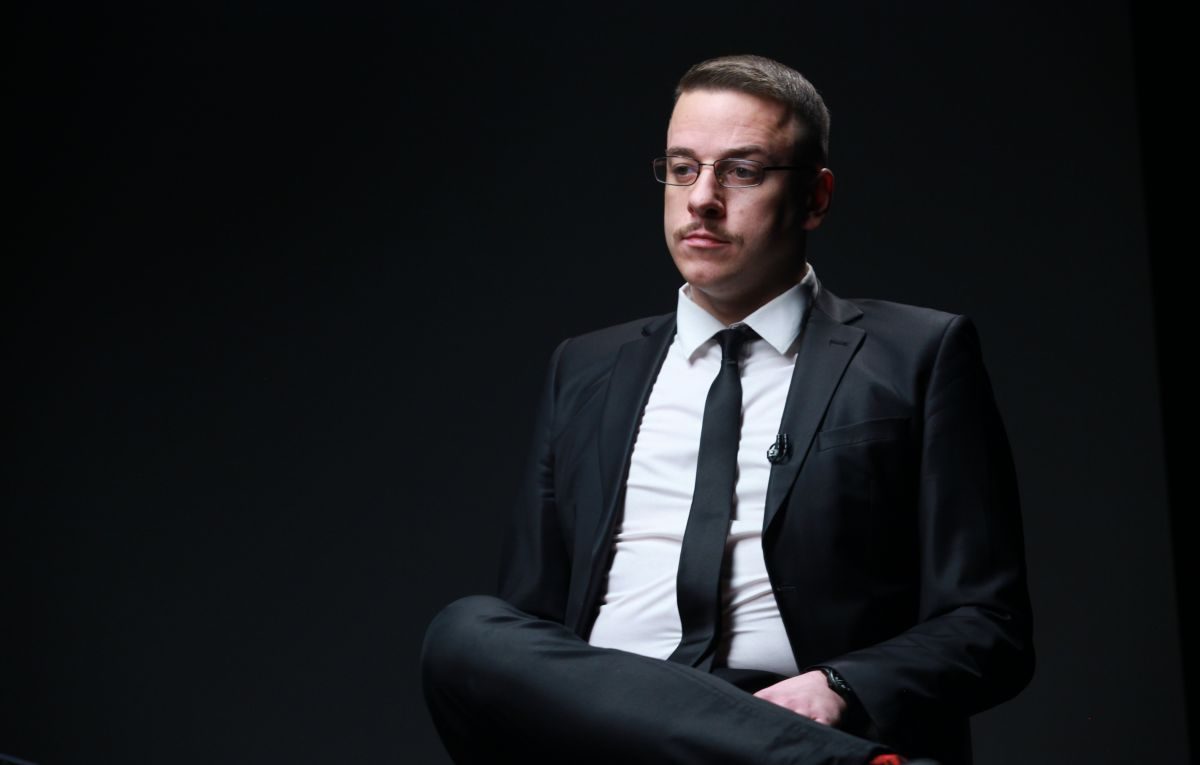
He believes that even if a comic performs in Russian but talks about Ukrainian realities, he is doing Ukrainian stand-up.
In the new episode of the program “Antipody” on the Islandia TV channel, stand-up comic and organizer of “Underground Stand-Up” Sviat Zagaikevych talked about Ukrainian stand-up, the business of humor, and his attitude toward performing stand-up in Russian.
Is underground stand-up a business or a social scene?
Both. One doesn’t get in the way of the other.
Why do you need a collective? I’m just asking because from my point of view, a collective is… they always make me tense. I consider collectivism, as such, a conscious deviation in general. There are conditions under which people are obliged to unite into collectives, but voluntarily, just out of nowhere…
Honestly, we have that kind of collective. We don’t impose many obligations on people. It’s more of a label that doesn’t leave people without some creative freedom. It simply tries to help work with a large number of comics. Our resources are sufficient for that many comics.
In general, we would like to work with even more comics. Even now, looking at it, you’d want to throw even more parties, have even more comics, and invite them more often.
You do 250. Much more often.
You mean per year?
I meant what is written on the official website.
Ah, right. Once there was a year when there were around 400 parties a year. Well, that’s me, plus a branch, where Uncle Zhenya, who also throws parties, is. Well, there’s the law of dialectics that quantity turns into quality. So that’s how Ukrainian stand-up began.
In 2015?
Underground stand-up, yes. Before that I performed alone at Shabanov’s.
Yes, I saw that. And in 2015, who were the founding fathers? Who got together first?
There was such a buzz that I started running my own “underground stand-up.”
I was at those, yes. In different clubs, I don’t remember anymore. I think it was at “Beach Under the Asphalt,” something like that.
Well, that was maybe 2016, or 2017. A year or two had already passed. For the first year we performed in hubs like an underground apartment that was half hookah lounge, half game room, half hub, and that’s where we started performing. Then an underground garage. And then we got to clubs, bars, and so on.
The very beginning was when I started doing my underground stand-up in these creepy places. For example, there were Lipko, Tymoshenko, Derzkaya, and Shatailo. They all also united into some kind of project. They held one party a month there, and I was already doing two a week there, or maybe one every week.
And at some point it turned out that “Underground Stand-Up” absorbed “Stand-Up Time.” And all the comics started working with me.
I know what feminists are going to throw at me: that I have a third stand-up comic who is a man.
Exactly, there is such a problem. So we opened our “Underground Stand-Up Club,” I hung up photos of legendary comics, and people came and said: “So, Sviat, why isn’t there a single woman?” Well, I hung up Sarah Silverman. And I think, thank God I have Richard Pryor, otherwise they’d say there are no Black comics.
What about Shatailo?
No, we didn’t hang up anything of Shatailo’s.
Well, I hope they won’t. Because he’s just promised a new show.
Well, among modern comics, I hung up, well, there wasn’t much space. I think there were seven comic slots, and I chose the modern comic Bo Burnham. Bo Burnham is a young comic, and he hangs closer to the stage than anyone else. And actually, as I like to say, it’s f***ing conceptual, meaning that Bo Burnham hangs there, and the next comic is the one on stage.
Did you watch his pandemic quarantine special? I think that’s what it’s called.
I’ll be honest, I didn’t watch it to the end.
Why?
I don’t know. I just didn’t have enough attention. I generally don’t like watching stand-up very much. I see so much stand-up live and rewatch so much of the stand-up we release ourselves that watching other stand-up is already intoxication.
I’m saying this so comics won’t take offense that I didn’t finish Bo Burnham, that I’m probably the only comic who didn’t finish Bo Burnham.
I don’t think Bo Burnham will take offense. Tell me, from a commercial point of view, is this a profitable story for you?
In the long run, yes. Right now, well, moderately profitable.
So you’re earning money? Is that all you do?
Basically, yes. Well, sometimes I also host corporate events or appear in ads. But still, maybe 80% of my work is underground stand-up.
What does a comic need to do to become a resident of underground stand-up? Say there’s some guy somewhere in Druzhkivka or Shepetivka.
Damn, I don’t know. Come to Kyiv, make some noise here so everyone says he’s a super cool comic.
And how will he make noise if he has nothing there, only talent? And even that’s not a given.
I often ask myself that question too.
Well, maybe according to the logic of a label, you have to scout, choose, and take them under your wing.
Well, basically that’s what I do. I always keep my finger on the pulse. I go to other stand-up clubs. And in general I try not to limit myself to just my underground stand-up. I go to some open mics, or sometimes I host an open mic myself to look at some young new comics.
And who has come up this way?
Kolomiets, Kochegura. They all went through open mics first, then parties at Uncle Zhenya’s. Uncle Zhenya is our kind of branch. It’s like a starter league. And then I bring them to our parties. Chyrkov is the same. He came to us. He did stand-up in Sumy. Then he came to Kyiv, and we immediately took him into our scene.
What obligations does a comic have to underground stand-up?
To be funny on stage.
No, I mean, like, giving a share of their earnings. Do you have some kind of common fund at all?
Well, the money is split between me and the comics, and some portion goes into the common fund.
And what are the proportions, or is that a trade secret?
Let’s say it’s a trade secret. All the comics know all these trade secrets anyway.
Why isn’t Ukrainian stand-up as popular as Russian? Look, even Russian-language Ukrainian comics don’t get the same number of views, even though they perform in Russian, the language used by, let’s say, residents of some internet projects. Why is that?
I think there are several reasons. First: they started earlier. Are we talking about where they’re popular at all, or here in our country?
Views, money, and so on.
Views and money. Well, that’s the main thing. Because they started earlier. Because Russia is much bigger, just in terms of the volume of these views.
But Ukrainian comics who speak Russian can be watched on YouTube even in Kamchatka.
They can, but how will a person from Kamchatka find this comic if in front of him there’s still a whole layer of comics from Irkutsk and Yekaterinburg? There’s a damn huge pile of them.
In short, it’s marketing?
Yes, and marketing is better, because there is funding. You discussed this topic with Shchegel once. I think the same.
You’re not just a comic, as far as I understand, but also a manager in a certain sense of the word. I want Ukrainian-language content, which is basically what we do, to shape the Ukrainian discourse. Ukrainian-language, this is very important.
Not the kind made on Suspilne public television. I don’t want to offend anyone, though frankly I don’t give a f***. And accordingly, I want Ukrainian-language stand-up, or at least Ukrainian stand-up, to be able to compete with Russian, Belarusian, and Kazakh. Damn, the Kazakhs are actually the masters of humor right now.
Sooner or later it will all happen. We just need time and probably money. The funding issue, with Gazprom’s TNT, I think, solves it.
Why does Ukraine need Russian-speaking comics? Not citizens of Russia, but Russian-speaking Ukrainian comics.
I think to show that there is still some freedom of choice. I don’t bully any comic who performs in Russian, because it has to come to these comics themselves. Because of all this bullying, I didn’t switch to Ukrainian either. Only because of that wave of people who write to you, “why not in Ukrainian,” “that’s it, Russian.”
And all this damn crap is exactly what stops you from switching to Ukrainian. That whole negative field. You think, “Damn, these are some f***ed-up nationalists, I don’t want anything to do with them.”
That’s the logic of a Donbas resident.
I don’t know what logic Donbas residents have.
I’m telling you. That’s exactly it.
Maybe. I think let there be Russian-speaking comics. If they’re very funny and still joke about some Ukrainian realities, then why force them to switch to Ukrainian?
But they still narrow the Ukrainian-language discourse this way, let’s say in the field of stand-up? That is, they don’t make Ukrainian-language stand-up more popular because of it.
Yes, but they still make Ukrainian stand-up anyway.
Stop. Let’s do it this way. Is Gogol a Russian writer or a Ukrainian one?
Ukrainian.
Why?
Well, he wrote more about some Ukrainian things, it seems to me.
Not a fact. He had different periods.
And is it generally considered that he’s Russian?
That’s a very disputed question. There is a genre, let’s say Russian literature, and he worked in that genre. His registration was Ukrainian at one time, and later, from his letters, we see how he actually treated us. Of course, this is imperial trauma, an inferiority complex, and so on.
We are experiencing this even now, but there are people who find the strength to spit on it and say, “I can create Ukrainian-language discourse.” It won’t be worse, it will be better than Russian-language. And there are people who think, “It’s more convenient for me, what’s the difference.”
Even speaking of people who are ultra-patriots on Facebook here. And the most fervent patriots are Russian-speaking. Well, these Facebook patriots are Russian-speaking. All these idiotic twists, “rusobandera” and so on, all of that. This is a serious question I’m asking you.
Okay. So how should this question be answered? Why do we need Russian-speaking comics? So that sooner or later they switch to Ukrainian.
Well, fine.
How do you think what defines Ukrainian stand-up? What meaning do we put into the phrase “Ukrainian stand-up”? Is it the language in which it is told or written, or the person who tells it?
I think it’s all very simple. Ukrainian literature is literature in what language?
In Ukrainian.
Ukrainian stand-up, accordingly.
Still, I just think that if a comic performs in Russian but talks about Ukrainian realities that Russian people won’t understand, then he is doing Ukrainian stand-up.
So Volodymyr Solovyov is a Ukrainian stand-up comic? Anatoliy Shariy is a Ukrainian journalist? Oleg Tsaryov is a Ukrainian politician, damn?
Damn, you jump between topics cleverly.
I’m not jumping, these are elementary parallels, I’m not even twisting them. Okay, I stretched it a bit in the case of Solovyov, but as for Shariy, who nominally has Ukrainian citizenship, I just don’t understand, why is that?
So in everyday life there are no questions. I can’t forbid Armenians from speaking Armenian, and on the contrary, it’s very good that they preserve their traditions. I generally think those roots should be in everyone. I myself, my parents are Russian-speaking. So that’s that.
But for you, whether you want it or not, you’re a phenomenon. You still carry a certain mission in shaping a new space, and you are shaping this space of Ukrainian stand-up comedy. This is very important. It is a very influential sphere. And I don’t understand the leniency with which you treat the Russian language in this sphere.
Again, this is a discussion, we are debating. I’m not insisting. If you convince me otherwise.
I have no goal of convincing anyone. I mean, stand-up is first and foremost freedom. Freedom of some thought. And which language to perform in is also part of that freedom.
That’s what musicians could say, and then they introduced quotas for us. We can’t sing in Russian.
Well, maybe Ukrainian comics will get quotas someday too, I don’t know. Time will tell.
Do you support it or not?
I support it.
Does your “underground stand-up” have a language policy at all? Or does a person come to you and performs in whatever language they want?
Yes, in whatever language they want, that’s how they perform. But there are separate shows, like where we do a Ukrainian-language show.
But I see that the number of people who perform in Ukrainian or consciously switch to it is growing. What is this due to?
I don’t know. Maybe comics are just realizing it themselves.
Is it becoming profitable, or is it for some patriotic reasons?
That, I think, is a personal question for each comic. For some it’s a realization that it’s better to perform in Ukrainian. For someone else, maybe they see the demand for it, and so they perform in Ukrainian.

Russian Attacks in Dnipropetrovsk Region: Two Killed, Seven Injured

Defense Forces Strike Four Russian Drone Control Points in Past Day, Including in Berdiansk

Britain Threatens Sanctions on Kremlin-Linked People; Poland Ready to Hand Ukraine Ammunition

Russia says it has completed "planned exercises" in the Black Sea

MVD: Fake Riots With Prop Blood Were Being Prepared Near Presidential Office

Law Enforcers Name Another Klitschko Deputy as Suspect

Berlin Holds Protest Against War in Ukraine; EU Prepares for Possible Russian Halt of Gas Supplies
North Korea Fires Ballistic Missile Over Record Distance in Five Years
Irish Fishermen Force Russia to Postpone Naval Drills

US sanctions in case of invasion of Ukraine could completely destroy Russia's economy, NYT reports
