
Donald Trump Unveils Israeli-Palestinian Peace Plan: What Is Special About It and Why Is Everyone Talking About It?
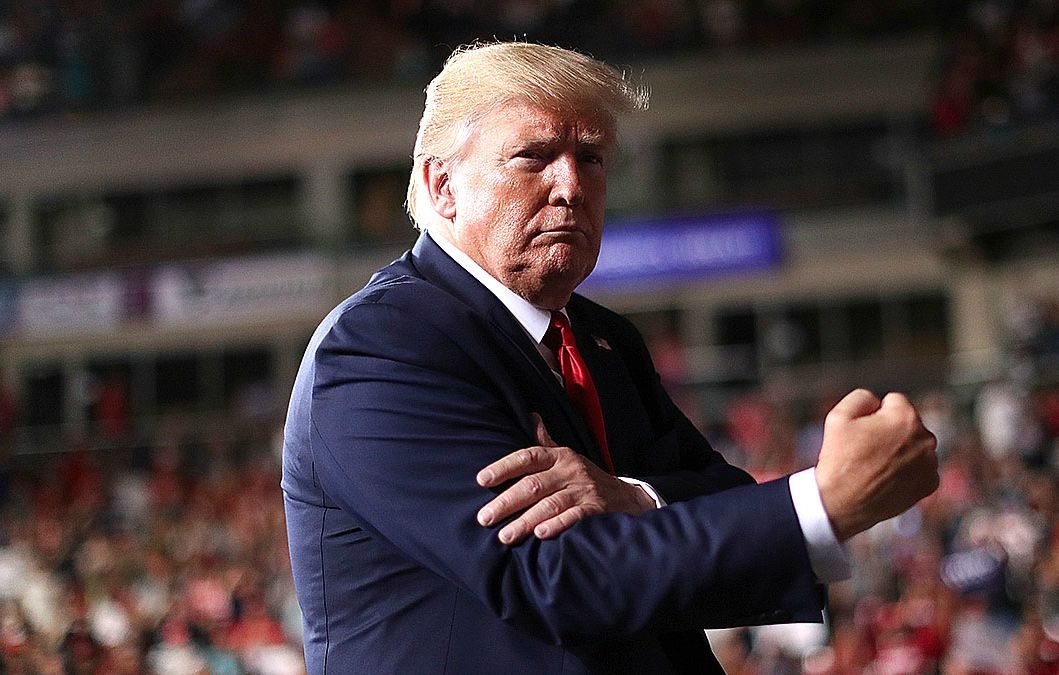
We look at what Trump said, what the “Deal of the Century” is, and why it has caused such a stir around the world.
January 28, 2020. US President Donald Trump revealed the details of his long-awaited peace plan for resolving the Israeli-Palestinian conflict. International media have dubbed this plan the “Deal of the Century.” Work on it took more than three years, from the moment Trump came to power in 2017.
At a joint press conference with Trump and Israeli Prime Minister Benjamin Netanyahu, the US president published the full version of his plan. It has caused mixed feelings around the world, and some analysts have spoken of a new potential conflict in the Middle East that this plan could lead to. We look at what Trump said, what the “Deal of the Century” is, and why it has caused such a stir around the world.
What is the essence of the Israeli-Palestinian conflict?
It is a confrontation between the political Zionist movement of Jews, which began its struggle for a state of its own in historical Palestine as far back as the late 19th century, and the indigenous Palestinian Arab population, which initially opposed the mass immigration of Jews and the creation of the State of Israel on its territory. Jewish Zionists believed that Palestine was their “Promised Land,” where Jewish tribes had lived long ago and which rightfully belonged to them since biblical times. The local Arab population living in Palestine also considers itself indigenous, tracing its genealogy to the ancient Philistines and Canaanites, who were later mixed with other peoples who invaded Palestine: the Hittites, Babylonians, Jews, Persians, Romans and others.
Even during World War I, with the support of British authorities, Jews began to migrate en masse from Europe to Palestine, which was under British control. The local Arab population, which opposed the immigration of people who were alien to them in ethnic and religious terms, did not like this. In the 1920s, a sharp phase of the conflict began, when numerous armed clashes broke out between the Jewish and Arab communities. These could be suppressed only through the direct intervention of British colonial troops.
After the Nazis came to power in Germany and other right-wing antisemitic regimes appeared in Europe, Jewish migration to Palestine increased. The situation reached a critical point in 1936, when Arabs responded to the British-supported migration and settlement of Jews by launching a full-scale uprising. It shook Palestine until 1939. In suppressing the uprising, around 5,000 Palestinian Arabs were killed and more than 15,000 were wounded. The British lost about 200 soldiers, and Jewish armed groups lost more than 300 people.
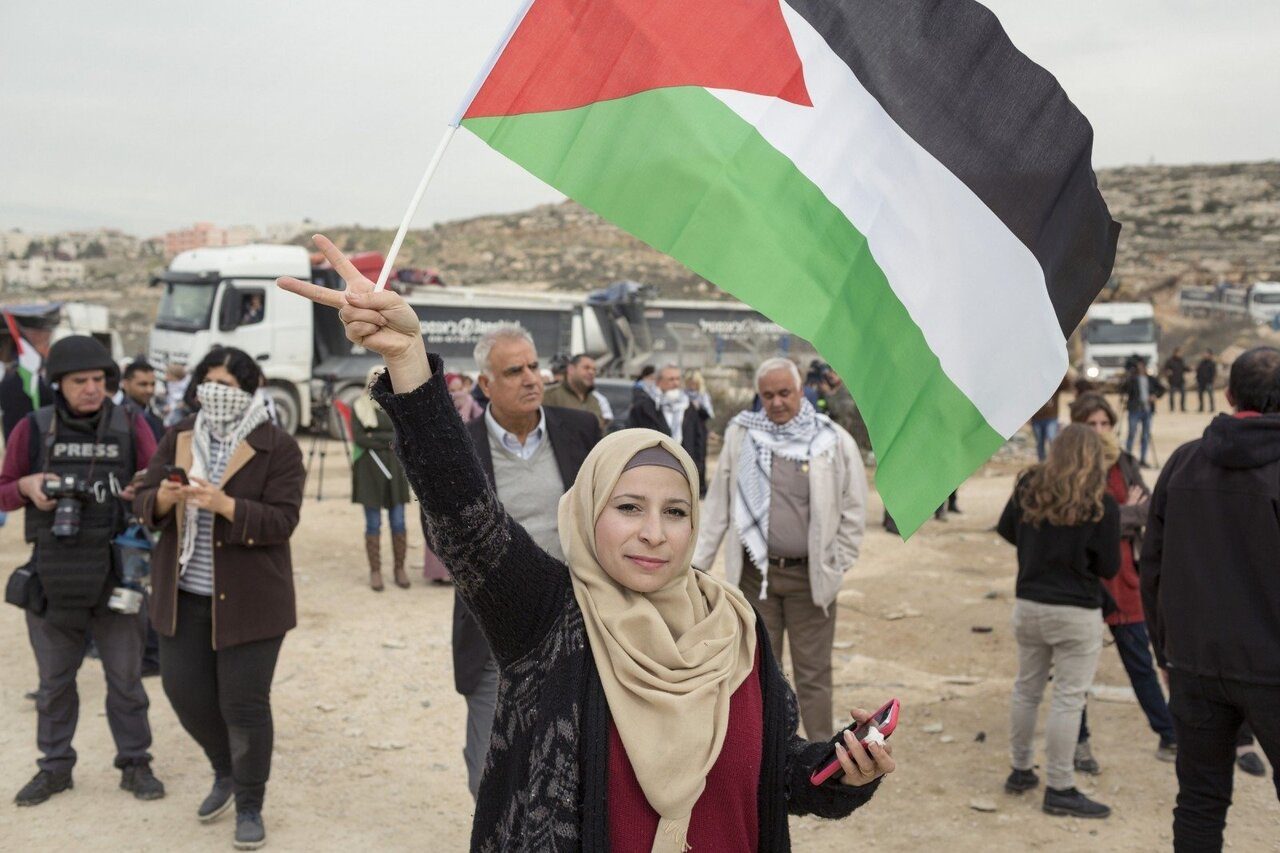
After the Second World War, the situation reached a critical point again. The Holocaust in Europe intensified Jewish emigration to Palestine, and the conflict with the Arabs flared up with renewed force. Soon international forces led by the UN stepped in. In 1947, a plan to partition Palestine was agreed upon, which envisaged the creation of two independent states on the region's territory: a Jewish state and an Arab state. At the same time, the holy cities of Jerusalem and Bethlehem were to be placed under international control.
However, Arabs and Jews rejected this plan. Each side considered it unjust in its own way. The rejection of the plan and the collapse of agreements led to the Arab-Israeli War of 1947-1949, which resulted in Britain's withdrawal from Palestine, the proclamation of the State of Israel, the mass exodus of Jews from Muslim countries and the flight of Palestinians from Palestinian territories captured by Jews, as well as the beginning of a long-running conflict between Israel and the Palestinian Arab population, which was supported by neighboring Arab states.
Since then, several major armed conflicts have erupted between Israel and the Arabs on this basis: the Suez Crisis (1956), the Six-Day War (1967), the War of Attrition (1967-1970), the Yom Kippur War (1973), the Lebanon War (1982), the Second Lebanon War (2006). All these conflicts only aggravated the problem and did nothing to resolve the dispute between Israel and the Arab population of Palestine. Numerous peace initiatives put forward by various international mediators repeatedly failed.
As a result of the Arab-Israeli wars, several fundamental problems emerged within the Israeli-Palestinian conflict, around which debates continue to this day:
- The question of Palestinian refugees and the prospects of their return to their ancestral lands, from which they were expelled in 1948.
- The status of Jerusalem, which was to be placed under international control (according to the 1947 plan) and later divided between Palestine and Israel (according to the 1967 plan). The final settlement of the city's status was supposed to be the result of Israeli-Palestinian negotiations.
- The question of the borders of Israel and Palestine. Under international law, Israel's borders have still not been defined and recognized at the global level. There are many disputed areas that the Palestinians claim.
- Occupied territories. During the 1967 war, Israel occupied parts of the territories of neighboring states: the Sinai Peninsula in Egypt, the Golan Heights in Syria, the Shebaa Farms in Lebanon and part of the Jordan Valley in Jordan. Sinai was returned to Egypt under the 1978 agreements, and issues with Jordan were settled on the basis of the 1994 peace treaty. The remaining occupied territories, including a significant part of Palestinian lands on the West Bank of the Jordan River, remain under Israel's de facto control. The Golan Heights, for example, were officially annexed by Israel in 1981.
- The settlement problem. Over the last 50 years, Israel has actively built on and colonized occupied Palestinian and other territories, which violates international law and is disputed by Arabs, who demand that the settlements be dismantled and their construction halted. Israel, on the contrary, considers them legitimate and is preparing to annex the lands on which they have already been built.
What does Trump's peace plan propose?
The administration of Donald Trump presented a document consisting of two parts: political and economic. The political part addresses all of the above-listed issues within the Israeli-Palestinian conflict, including the status of Jerusalem, Israel's borders, the format of a future Palestinian state, the rights of the local population, security arrangements and the humanitarian aspect. The economic part concerns the development of industry, trade and economic relations between Israel and Palestine, infrastructure construction, social payments and investment support for the region.
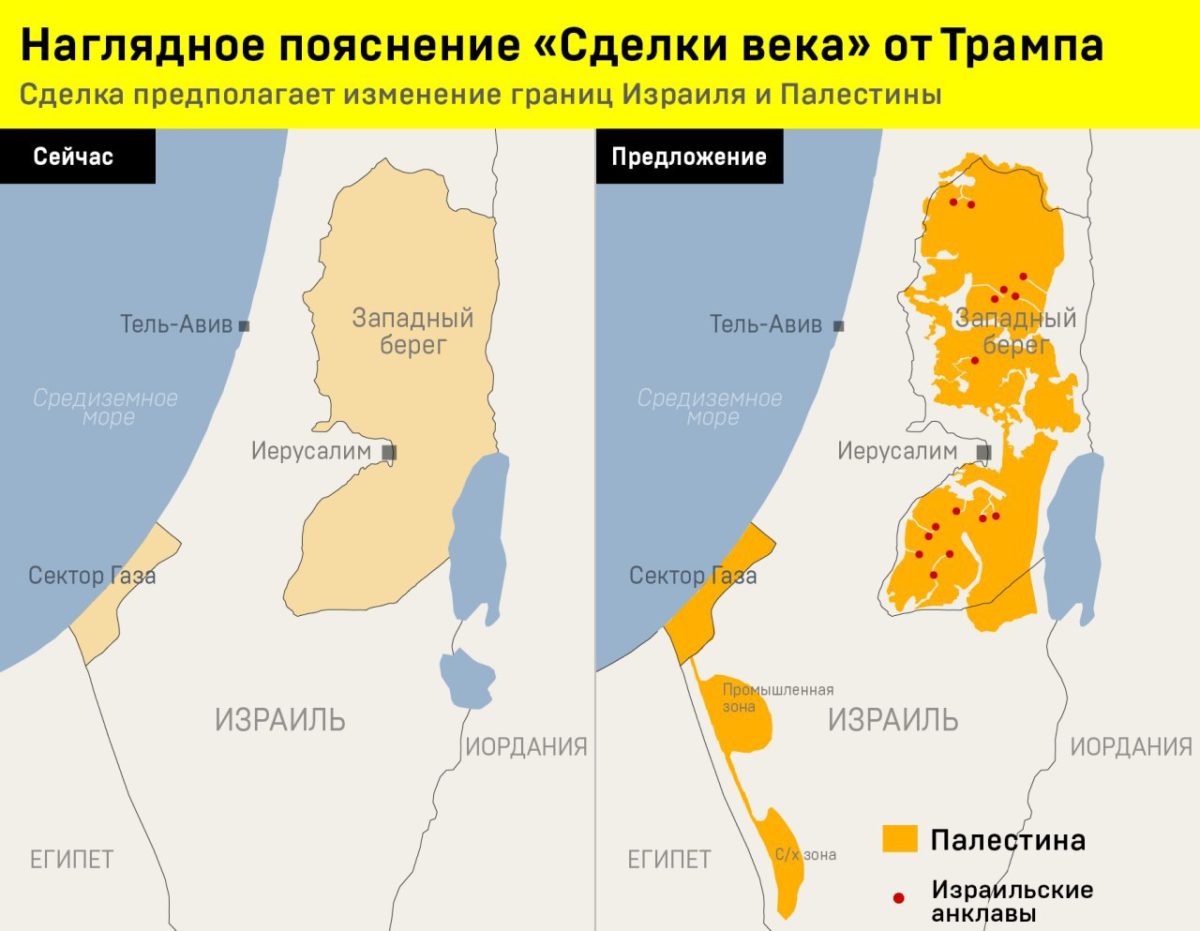
The plan proposes to settle the Israeli-Palestinian conflict and describes the conditions. If the parties accept them, then implementation can begin. Thus, analyzing all 180 pages of the plan, the following fundamental conditions that Donald Trump proposes can be identified:
- The city of Jerusalem goes to Israel and becomes its indivisible capital. The Palestinians are offered the option of placing the capital of their future state in one of the suburban districts of Jerusalem called Abu Dis.
- The Palestinians may obtain their own state, but it will have extremely limited borders, occupying only 17% of the entire original territory of historical Palestine.
- Palestinian refugees will not receive the right to return to their lands. This issue will not be resolved in negotiations; it is simply proposed to be closed and forgotten. The total number of Palestinian refugees today is between 3 and 5 million people.
- Palestinian Arabs must recognize Israel as a Jewish state in essence and ideology, and Jerusalem as its capital. In addition, they are asked to recognize its “new borders,” which take into account the territories annexed by Israel: the Syrian Golan Heights, East Jerusalem, and also the Jordan Valley, which Israel intends to annex in the near future.
- The US will officially recognize Israel's planned annexation of the Jordan Valley, the part of the Palestinian occupied territories on which Jewish settlements have been built, and the Golan Heights. The Jordan Valley will become Israel's official eastern border.
- The question of religious shrines on the Temple Mount in Jerusalem does not change. Everything remains as it is. Israel continues to guard the Temple Mount, including the Al-Aqsa Mosque, while Jordan remains the custodian of these shrines.
- Israel agrees to direct peace negotiations with the Palestinians, but only if they accept the terms of the peace plan.
- Israel freezes the construction of new settlements in the Palestinian occupied territories, which, according to the plan, are to become part of a future Palestinian state.
- The Palestinians must stop paying social benefits and assistance to the families of Palestinians whom Israel has convicted of “terrorism,” and also stop taking action against Israel in international judicial bodies, such as the International Criminal Court in The Hague.
- The new Palestinian state will not have its own armed forces or foreign policy. Israel will be responsible for these.
- The Gaza Strip must become a demilitarized zone, and its armed groups, such as the Islamist movement Hamas and the “Islamic Jihad,” must be disarmed.
- If the Palestinians accept the terms of this peace plan, then over 10 years they will receive $50 billion in investment from other countries. One million jobs will be created, and infrastructure facilities (bridges, roads, schools, tunnels, interchanges) will be built, but in coordination with Israel.
Who is the author of this plan?
A whole team worked on the plan, consisting of advisers and staff from the White House and the US State Department, working in close coordination with the Israeli political leadership. In particular, the following worked on the “Deal of the Century”:
- Jared Kushner, the son-in-law of the US president and his senior adviser overseeing the Middle East portfolio.
- David Friedman, US Ambassador to Israel.
- Jason Greenblatt, US Special Representative for Israeli-Palestinian affairs, a businessman.
- Avi Berkowitz, a lawyer and personal friend of Kushner, who replaced Greenblatt as US Special Representative.
- Mike Pompeo, US Secretary of State.
The Palestinians were not invited to develop the plan, and no negotiations were held with them. After the Trump administration recognized Jerusalem as Israel's capital in December 2017, Palestinian political leaders refused to engage in any dialogue with the US at all, and Washington lost its status as the main negotiator in the Israeli-Palestinian peace process.
In the following years, relations between the US and the Palestinians deteriorated. The Trump administration cut funding for UN programs supporting Palestinian refugees, closed all representative offices and offices of the Palestine Liberation Organization (PLO) on US territory, recognized Israel's annexation of the Syrian Golan Heights, and the legality of Israeli settlements in the occupied Palestinian territories of the West Bank of the Jordan River.
All of this “killed” any prospect of American-Palestinian negotiations. The Palestinians predictably did not attend the international conference in Bahrain in June 2019, where the economic part of the “Deal of the Century” was presented, despite an invitation from the Arab monarchies of the Persian Gulf. They had originally rejected any plan that the US would present.
What are the main problems of Trump's plan?
One of the first is its blatant unacceptability and unrealism for the Palestinian side. The plan essentially resolves all key issues related to the Israeli-Palestinian conflict in a one-sided way, in favor of Israel alone. No Palestinian political leader would agree to such a plan, since it amounts to suicide and effective total capitulation. This means that the plan is either “stillborn” in itself and serves only public relations purposes, or from the very beginning was designed so that the Palestinians would reject it.
The second problem of the plan is its one-sided, uncompromising nature. The Palestinians are asked to give up all the basic demands that have been the meaning of their lives and their struggle against what they consider “Israeli occupiers” over the past 70 years. In return, the Palestinians are supposed to receive certain unspecified guarantees, under which they would be paid roughly $50 billion over the next 10 years, part of which would be concessional loans and part grants. This option will not suit the Palestinians and serves only one side, the Israeli side, cornering the other, which often leads to radicalization and forces people to take up arms as a last argument in this dispute.
The third problem of the plan is that it is not peaceful in nature. The “Deal of the Century” black on white sanctions Israel's annexation of other people's territories. This concerns the Jordan Valley and parts of Palestinian lands on the West Bank of the Jordan River, where Israeli settlements stand. Annexation in itself does not bring peace; on the contrary, it provokes war and conflict. Unilateral implementation of these provisions by Israel could meet resistance from the local Arab population. And that is already a full-fledged pretext for an armed conflict and a new Palestinian uprising.
The fourth problem is that the plan contradicts international norms and laws, and therefore is not legitimate. Recognition of Jerusalem as Israel's capital, Israel's annexation of a number of territories, and the legality of building Israeli settlements on occupied lands, all of which is set out in the “Deal of the Century” as its main proposals, contradict the principles of international law and all UN resolutions adopted on the Israeli-Palestinian issue.
The fifth problem of the plan is the unresolved security question. According to the “Deal of the Century,” the Gaza Strip, a Palestinian enclave run by the Islamist movement Hamas and the armed brigades of “Islamic Jihad,” which frequently shell Israeli territory, must become a demilitarized zone, and its armed groups must be disarmed. However, the plan does not specify who should achieve this and how. Palestinian factions in the Gaza Strip will not voluntarily hand over their weapons to Israel's mercy. This threatens the collapse of the entire “Deal of the Century” and creates new preconditions for an armed escalation of the conflict between Israel and the Palestinians.
How did world public opinion and the Palestinians react to the plan?
The reaction of various parties to the publication of Donald Trump's peace plan can tell a lot about the balance of power in the region and the positions of states regarding the Israeli-Palestinian conflict, as well as about their interests in the Middle East. So let's take a look.
UN. The press service of UN Secretary-General Antonio Guterres reacted negatively to the White House initiative, noting that it violates the rules and agreements that the UN Security Council has established over the past 70 years. “The United Nations remains committed to the two-state principle, supporting the efforts of Israel and Palestine to resolve the conflict on the basis of UN resolutions and international law”, — said the press service. UN Special Rapporteur on the situation of human rights in the Palestinian territories Michael Lynk described Trump's plan as a “one-and-a-half-state principle,” adding: “This is not a recipe for a lasting and sustainable peace. This plan rather suggests the creation of a new 21st-century Bantustan in the Middle East.” This is a reference to the name of the South African enclaves during the apartheid regime.
In practice, this means that the UN does not support the US approach to resolving the conflict. It should be noted that relations between the UN and the current Donald Trump administration are tense, due to Trump's skepticism toward the UN and multilateral diplomacy in general, as well as his contempt for international rules. Moreover, in recent years the US has tried to push UN agencies out of the Palestinian issue, cutting their funding and pressuring them to scale back their work in the Palestinian territories. This has also turned the organization against Washington.
Palestine. One of the first to express protest in connection with the “Deal of the Century” was the President of the Palestinian Authority, Mahmoud Abbas. Speaking in a televised address, he said that “these conspiracies will fail.” He called the “Deal of the Century” the “slap of the century” and urged Palestinians to resist the implementation of Trump's peace plan. Two days later, Abbas announced that Palestine was severing all relations with Israel and the US, including in the areas of security and counterterrorism. The Islamist movement Hamas rejected the “Deal of the Century.” Deputy Chief of Hamas Political Bureau Khalil al-Hayya said that “Palestine is fire and flame that will burn everyone who touches it.”
The Palestinians' reaction is obvious and natural. The plan deprives them of all basic demands and essentially imposes a semi-colonial status within Israel. One of the consequences of the publication of the “Deal of the Century” could be the unification of rival Palestinian factions in Gaza and the West Bank to counter Israel's attempts to implement the plan unilaterally. In addition, after the plan's publication, a struggle will begin over the future new leader of the Palestinian Authority. In the spring of this year, elections are due to be held in the Palestinian territories for the first time since 2007, which will open the way to replacing 84-year-old Mahmoud Abbas as the leader of Palestine. Who the new leader is will also determine the future attitude of the Palestinian leadership toward Israel and the US.
Jordan. Jordan's Foreign Ministry expressed skepticism about the “Deal of the Century,” and parliamentary deputies openly condemned Trump's plan. Parliament Speaker Atef Abu Tayeh described Washington's plan as “a black day in the history of the Palestinian people, reminding us of the Balfour Declaration.” A protest was organized in the capital, Amman, which reached the US embassy. Jordanian Foreign Minister Ayman Safadi reminded in a separate statement that his country remains committed to the legitimate demands of the Palestinian people: the creation of a Palestinian state within the 1967 borders with its capital in East Jerusalem. Even King Abdullah II of Jordan stated that “our position is well known: we will never accept a plan that resolves the issue at our expense.”
Jordan is the second country in the region, after Egypt, to have a peace treaty with Israel, dating from 1994. However, relations with Tel Aviv have remained strained. Most of Jordan's population are Palestinian Arabs, who still consider themselves as such rather than as Jordanians. For them, the Palestinian question is no less important and painful than for Palestinians on the West Bank or in Gaza. In addition, the provisions of the “Deal of the Century” that envisage Israel's annexation of the Jordan Valley pose a threat to Jordan's security, and therefore Amman will never agree to them. Furthermore, relations between Jordan and Israel are currently strained due to land disputes in border areas and violations of the rights of Palestinian-origin citizens of Jordan.
Lebanon. Lebanese President Michel Aoun expressed solidarity with the Palestinian people in opposing Trump's peace plan. He immediately called Palestinian Authority President Mahmoud Abbas and assured him of support and of commitment to the 2002 Arab Peace Initiative as the basic document for resolving the conflict. Harsher criticism came from the Lebanese Shiite movement Hezbollah. Deputy Secretary-General of the movement Sheikh Ali Damoush described the “Deal of the Century” as “aggression against the Palestinian people.” In his view, the document “aims to liquidate the Palestinian national project and their historical and legitimate rights.” He called for uniting into a single front of resistance to Israel and the US.
As with Jordan, for Lebanon the Palestinian question is a matter of refugees and internal stability. There are 12 Palestinian refugee camps on Lebanese territory, home to more than 700,000 people. Settling the Israeli-Palestinian conflict in favor of Israel alone, with the risk of war breaking out, is unacceptable to the official Beirut, which supports the creation of a separate Palestinian state to which refugees could return, rather than the opposite.

Egypt. Egypt's Foreign Ministry issued a statement welcoming Donald Trump's peace initiative and thanking the US for its “continuing efforts to establish a sustainable and just peace for the Palestinians.” Official Cairo also urged Israelis and Palestinians to carefully consider the peace plan proposed by the United States and to begin direct negotiations on its implementation “with the aim of achieving the long-awaited peace and establishing an independent Palestinian state.”
Of all the Arab countries, Egypt is one of only two states that have official diplomatic relations with Israel and a signed peace treaty, which dates to 1978. Egypt and Israel have often cooperated over the past 40 years. In recent years, they have acquired many common interests. In particular, for Egypt, Trump's plan is an opportunity to take control of the Palestinian enclave of the Gaza Strip, which is run by the Hamas movement, and to weaken the influence of its regional rivals there: Iran, Turkey and Qatar. These three countries currently finance and support Hamas and the Gaza Strip.
In addition, for the past 12 years Egypt has helped Israel maintain the blockade of the Gaza Strip for the sake of the security of its own borders (a lot of weapons are smuggled from Gaza into Egypt's Sinai). And, of course, close relations have developed between Israel and Egypt after the discovery of new gas fields on their shelf, which they intend to develop together, after which they plan to pump gas to Europe with the support of the US, Cyprus, Greece and Italy. Egypt needs the lobbying connections and capabilities of Israel to gain political support in Congress and the White House administration. That is why the Egyptian political leadership supported Trump's plan for Palestine, although public opinion is opposed to it.
Syria. The Syrian Foreign Ministry said that it does not support Trump's “Deal of the Century,” calling the document “vile” and “unjust.” According to official Damascus, this plan aims to liquidate the Palestinian national project “in violation of international rules and resolutions.”
Syria's position on Palestine has not changed. Syria, as a participant in all the wars with Israel and still in a de facto state of war with the Jewish state, has been and remains an active defender of Palestinian rights. But recently Syria has little it can do to help the Palestinians. First, it has plenty of internal problems related to the war. Second, its relations with the Palestinians have somewhat deteriorated in recent years. In 2011, some Palestinians whom Damascus had actively accepted as refugees after 1967 did not support the central government and even sided with anti-government groups, stirring up the situation in their neighborhoods in the south of the capital. This led to a rupture in relations between Syria and the Palestinian Authority, as well as with Hamas, which was expelled from Damascus, where the movement had its headquarters. Relations between Syria and Palestine were restored only in 2019.
Saudi Arabia. The Saudi Foreign Ministry welcomed the publication of Trump's peace plan and called on Palestinians and Israelis to begin peace negotiations. However, the ministry made a reservation, mentioning previous peace initiatives, including the 2002 Arab Peace Initiative, which Riyadh had once supported. In addition, King Salman of Saudi Arabia expressed personal support for Palestinian President Mahmoud Abbas.
Saudi Arabia's position is ambivalent. On the one hand, in recent times the kingdom has drawn closer to Israel on the basis of shared opposition to Iranian influence and on security issues. On the other hand, the blatant “betrayal” of the Palestinians may provoke a negative reaction from the population, whose opinion sides with the Palestinian people. It is no coincidence that Saudi Arabia, being a close ally of both Israel and the US, nevertheless did not send its ambassador to the press conference of Trump and Netanyahu, where the peace plan was presented. Nevertheless, weakening the influence of Iran, Qatar and Turkey as a result of implementing at least part of Trump's plan will play into Riyadh's hands.
UAE. The United Arab Emirates expressed support for Trump's peace plan and called on the parties to negotiate. The UAE ambassador to the US, Yousef Al Otaiba, was one of three Arab representatives present at the event where the “Deal of the Century” was unveiled.
The Emirates, like Saudi Arabia, actively cooperate with Israel and the US on regional security issues, protecting maritime transport routes and trade lanes, confronting Iran, containing hostile proxies and expanding military infrastructure. Accordingly, the UAE is interested in strengthening the influence of the US and Israel at the expense of reducing the presence of Iran, Qatar and Turkey in the Palestinian territories. For the UAE, containing Iran and finding new allies for this has become more important than continuing to support the Palestinians in their struggle for independence and their own state.
Iran. The press service of Iran's Foreign Ministry called Donald Trump's plan “the betrayal of the century.” According to the ministry's spokesman, Abbas Mousavi, “the US plan does not provide for any interaction with the Palestinians; it legitimizes the occupation.” Iran's Foreign Minister Mohammad Javad Zarif also voiced his criticism on Twitter, comparing Trump's proposal to the South African Bantustan. And the representative of the president to the Islamic Revolutionary Guard Corps, Ali Shirazi, called the US “a global bandit and international robber,” in whose interests this plan works.
Iran's criticism is entirely justified. Tehran does not want to lose influence in the Palestinian territories, especially in Gaza, which it uses as one of the fronts of opposition to Israel.
Bahrain. The Bahraini Foreign Ministry supported Trump's plan, welcoming its publication and calling on the parties to begin direct negotiations under Washington's mediation. Bahrain's ambassador to the US, Sheikh Abdullah bin Rashid Al Khalifa, was one of three representatives of Arab countries at the press conference of Trump and Netanyahu during the publication of the plan for Palestine.
Bahrain's positive stance toward the plan is explained by the fact that the kingdom is not particularly interested in protecting the Palestinians. Its main problem is the threat from Iran across the Persian Gulf. In order to strengthen its confrontation with Tehran, Bahrain has entered into cautious cooperation with Israel and an alliance with the US. It was Bahrain that, in the summer of 2019, organized the international conference at which the economic part of the “Deal of the Century” was unveiled.
In addition, Bahrain is a small country, militarily defenseless, relying on its “big neighbor” Saudi Arabia and on US military bases on its territory for security. Therefore, its foreign policy position cannot go against the interests of these two patron states. Nevertheless, Bahrain cannot yet move toward full diplomatic relations with Israel because of negative public opinion. Most of Bahrain's population are Shiite Muslims, many of whom are under Iran's influence, while the ruling royal family, Al Khalifa, are Sunni Muslims.

Kuwait. In a statement from the Kuwaiti Foreign Ministry, it is said that “a just and comprehensive settlement of the Israeli-Palestinian conflict is possible only on the basis of a legitimate, internationally recognized solution referring to already agreed documents, taking into account the borders as of June 4, 1967, and a capital for the Palestinians in East Jerusalem.” In other words, Kuwait, although it welcomed “the efforts of the US to resolve the conflict,” came out against the plan, remaining faithful to the “two-state principle” and the idea of creating a Palestinian state within the 1967 borders with a full-fledged capital.
Kuwait has always taken an active pro-Palestinian stance, unlike neighboring Bahrain, which is fully controlled by Saudi Arabia. Last summer, when Bahrain was organizing a conference on Palestine, Kuwait's parliament became the only one among all Arab countries to formally vote for an official boycott of the event. Later, expressing its disagreement with the US position on Palestine, Kuwait appointed its first-ever ambassador there. For Kuwait, this stance reflects not only the sympathy of the ruling dynasty and population for the “Palestinian cause,” but also a desire to maintain stability in the Middle East, which Kuwait needs for further development through the export of oil and petroleum products.
Qatar. In its official statement Qatar welcomed the United States' publication of its plan for settling the Israeli-Palestinian conflict, but hastened to note that all this is good “provided the settlement does not contradict existing resolutions and international agreements.” Simply put, Qatar supported the preparation of the plan as a process, but not the substance of the proposals set out in it, which contradict Qatar's official position on the Palestinian issue and international norms. As an alternative to Trump's plan, Qatar proposes returning to the Arab Peace Initiative of 2002.
Unlike Kuwait, Qatar has taken a more balancing position, even leaning toward neutrality. However, official Doha could not possibly support Trump's plan. Today Qatar is one of the main financiers of the Palestinian Authority and the Gaza Strip, acting in tandem with Turkey and often with Iran. Clearly, given the US military presence in Qatar and its close ties with the Trump administration, the emirate must maintain the appearance of neutrality. But in practice, there will be no support for this plan from Qatar. Notably, back in the autumn of last year, Qatari Foreign Minister Mohammed bin Abdulrahman Al Thani openly wrote on his Twitter that “no Palestinian settlement can ignore international resolutions and rules, and we reject and condemn the occupation of Palestinian lands.”

Russia. At a press conference in the capital of South Sudan, Russian Foreign Minister Sergey Lavrov noted that he “had not seen” Trump's peace plan, and accused the US administration of “radical decisions” on various international issues. He also recalled the 2002 Arab Peace Initiative and hinted that the US should work in close coordination with Arab states and take into account the views of the Palestinians.
At a briefing at the Foreign Ministry, Maria Zakharova repeated the thesis of many Arab states about adherence to the traditional international legal framework on the Israeli-Palestinian issue. Russian Ambassador to Lebanon Alexander Zasypkin said that the “two-state” principle cannot be changed under any circumstances. And Deputy Foreign Minister and Special Representative for the Middle East and Africa Mikhail Bogdanov reported that the US had not consulted Moscow on the Israeli-Palestinian issue, and also stated that Trump is trying to resolve the conflict in favor of Israel alone, ignoring the position of the Palestinians.
Russia has decided to take a cautiously skeptical position toward Washington's initiatives. On the one hand, Moscow cannot accept this plan, since it was prepared without its participation, is potentially dangerous for the Middle East and contradicts the Kremlin's long-standing position on the Palestinian issue. On the other hand, Russia does not intend to reject the plan outright either, since it benefits from further discrediting the US in the eyes of the Palestinians, in order to then offer its own mediation efforts, given its good relations with all sides.

China. In its comment to the press the Chinese Foreign Ministry stated that it remains committed to the “two-state principle” and to settling the Israeli-Palestinian conflict on the basis of the UN resolutions already adopted by the Security Council. Beijing noted that any settlement must take into account the views of the Palestinian side.
This means that China does not support Trump's plan. It is simple. China benefits from the status quo. Armed conflict or other upheavals in the Middle East that could be caused by Trump's initiative would weaken China's position and threaten its trade and economic expansion into this vast and promising market.

Great Britain. Prime Minister Boris Johnson welcomed Trump's peace plan and became the only European leader to say that he supports the “Deal of the Century,” calling on the parties to hold direct negotiations.
Britain's position is directly linked to its relations with the US and Israel. These two countries are key for London in its efforts to offset economic losses from Brexit by concluding advantageous trade agreements with them. For this reason, it is important for Britain to maintain close, good ties with both Washington and Tel Aviv.

France. In its first comment after the publication of the “Deal of the Century,” the French Foreign Ministry thanked the US for its efforts to achieve peace in Palestine and said it would “carefully study Washington's peace proposals.” However, the very next day, French President Emmanuel Macron expressed himself more specifically: “I believe in two sovereignties. You must have the agreement of two parties to implement a peace initiative. It cannot be done with the agreement of only one side.”
Against the backdrop of weakening European diplomacy in the Middle East, France is trying to take the wheel. Official Paris wants to play a more active role in world affairs and often clashes with the US, whose interests do not coincide with those of Europe. France, like other European states, does not need a new conflict in the Palestinian territories because of refugee problems and an already deteriorating situation in the Eastern Mediterranean due to the gas disputes between Turkey, Egypt, Cyprus and Israel.

Turkey. Foreign Minister Mevlüt Çavuşoğlu stated that Jerusalem and Palestinian lands “are not for sale,” and called Trump's plan “stillborn.” Deputy Chairman of the ruling Justice and Development Party (AKP) Numan Kurtulmuş wrote on his Twitter that “Jerusalem will always remain the heart of the Islamic world and the capital of the Palestinian state.” Turkish President Recep Tayyip Erdoğan, speaking at a meeting of Turkey's National Security Council, called for the creation of a Palestinian state within the 1967 borders with its capital in East Jerusalem. His director of communications, Fahrettin Altun, called on the international community to condemn Trump's plan.
Turkey's position is dictated by Erdoğan's regional ambitions, as he seeks to become one of the leaders of the Muslim world. To achieve this, he must follow trends and activate the policy of Islamic solidarity in the region. The Palestinian direction is one of the most convenient and profitable. It allows Turkey not only to “take a hit” and score points on the theme of defending the rights of the Arab population, but also to counter its regional rivals: Egypt, Israel and Saudi Arabia.

Russian Attacks in Dnipropetrovsk Region: Two Killed, Seven Injured

Defense Forces Strike Four Russian Drone Control Points in Past Day, Including in Berdiansk

Britain Threatens Sanctions on Kremlin-Linked People; Poland Ready to Hand Ukraine Ammunition

Russia says it has completed "planned exercises" in the Black Sea

MVD: Fake Riots With Prop Blood Were Being Prepared Near Presidential Office

Law Enforcers Name Another Klitschko Deputy as Suspect

Berlin Holds Protest Against War in Ukraine; EU Prepares for Possible Russian Halt of Gas Supplies
North Korea Fires Ballistic Missile Over Record Distance in Five Years
Irish Fishermen Force Russia to Postpone Naval Drills

US sanctions in case of invasion of Ukraine could completely destroy Russia's economy, NYT reports
