
The 'Big Resignation' and 'Lying Flat': How Millions of Young People in the US and China Are Quitting in Rejection of the Lifelong Chase for Basic Goods

2021 was a record year for voluntary resignations in developed countries.
Around the world, millions of people are rethinking how they work and live, and how best to balance the two.
This has given rise to a new term, the 'Big Resignation,' which marks how sharply, in the US (and the term later spread to China, Japan and Germany), millions of people who quit their jobs in 2021 no longer plan to return to their usual way of life.
Here are the highlights from Bloomberg Businessweek's article 'From Big Quits to Idleness, Workers Are Turning Their Backs on Work'.
The 'Big Resignation'
The Big Resignation has led American workers to leave their jobs in record numbers — more than 24 million people did so between April and September this year — and many of them remain out of the job search.
Germany, Japan and other rich countries are seeing echoes of the same trend.
The coronavirus pandemic has had serious consequences: surveys show rising burnout and deteriorating mental health in many countries.
But pressure on developed countries has been building for decades. Incomes have stayed flat, and often fallen, job guarantees have become unreliable, and the cost of housing and education has risen sharply, as a result of which fewer young people have been able to build financially stable lives.
Although the Big Resignation is a phenomenon among those under 40, it is also reflected across the economy and is prompting broader conversations about work. Millennials (born between 1980 and the late 1990s) and Generation Z (the demographic cohort after them) are generally, if they manage to reach the point of marrying, buying homes and having children at all, able to do so later than previous generations could.
In the US, financial concerns among millennials emerged long before COVID-19. Thanks to a combination of a sharp rise in student debt and a slow recovery after the Great Recession, this generation is likely to become the first in US history to be poorer than its predecessors.
The pandemic appears to have intensified these concerns. According to a survey by Mind Share Partners, two-thirds of millennials who quit their jobs in 2021 cited mental health reasons, and the share among Generation Z was even higher at 81%.
The human and economic competition caused by the pandemic has also led many young people to question their priorities.
The movement in China
China's 'lying flat' movement, which began as a joking social media post from which it takes its name, also seeks to opt out of the exhausting race for basic goods.
What began as a witty expression of Chinese youth rebellion has become a movement that even Xi Jinping has acknowledged.
'I haven't worked for two years and I don't see anything wrong with that,' says an April post on the Baidu Tieba platform that made the movement go viral. 'The pressure mostly comes from comparison with your peers and the values of the older generation. But we are not obliged to follow them.'
This is a reaction that has become a rebellion against a system in which the grueling '996' work schedule — from 9:00 to 21:00, six days a week — is considered normal in industries such as technology. The same goes for the oppressive pressure from family, society and even the government to keep climbing the career ladder.
The country's economy has doubled over the past decade, but not everyone is reaping the benefits of such growth: in many major cities, the cost of living is rising faster than wages.
As a result, some see the 'lying flat' phenomenon as a warning of an impending Japanese-style stagnation that emerged unexpectedly at an early stage of economic development.
'It's essentially a coincidence that these two discourses (in the US and China — ed.) emerged at the same time,' says Xiang Biao, director of the Max Planck Institute for Social Anthropology in Germany. 'But we can draw a connection. It's about how the economy has become overheated and unstable, both in ecological and psychological terms.'
Jack, a 32-year-old tech worker who gave only one name out of fear of retaliation from his employer, was full of ambition when a telecom company hired him five years ago.
But the grueling workload did not bring the success he had hoped for, and over time his enthusiasm faded. He still works, but not as much.
'Many internet industries have reached a stage where there is no explosive growth,' says Jack. 'But all the hard work is still here. All the stress is still here. That's how you lose hope.'
In October, thousands of employees of companies including Alibaba Group Holding Ltd. and ByteDance Ltd., which owns TikTok, took part in an online campaign called 'Worker Lives Matter', posting information about when they start and finish their workdays in a publicly available spreadsheet . ByteDance has since demanded a shorter workweek.
In memes and online posts, young Chinese call their generation 'mousetraps' and 'salted fish' (in Cantonese, salted fish is a metaphor for a corpse, but it can also mean people devoid of ambition or drive).
If this attitude becomes widespread, it could accelerate population decline: China's birth rate fell to a record low in 2020, which is a serious concern because the workforce is already shrinking.
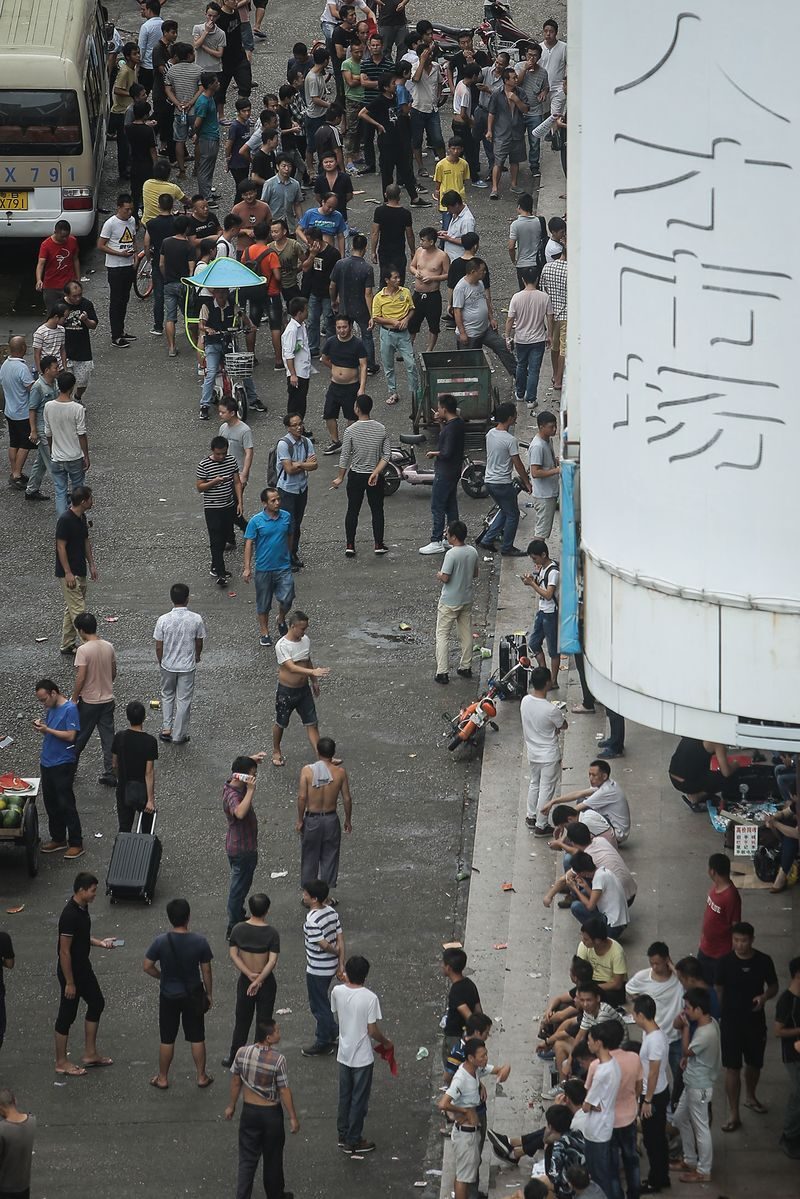
At the Sanhe employment exchange in north Shenzhen, dozens of recent arrivals from other parts of China gather to browse job listings. While migrant workers in the country were once famous for their diligence, these men and women have earned a reputation for passing the time playing online games or streaming TV, and taking day jobs only when they need money to pay a phone bill or rent.
Avoiding long-term work and factory jobs in favor of less demanding service roles, they sum up their lifestyle with a simple mantra: 'Work one day, play three.'
A long-standing phenomenon in Japan
Japanese people find the conversations about what is happening in China and the US, about how to balance work and other pursuits, familiar.
In the 1990s, local media painted an unflattering portrait of young 'free spirits' who rejected Japan's demanding office culture, with its rigid hierarchy and 15-hour workday, in favor of casual jobs.
Young people say their lifestyle was imposed on them by a stagnant economy and labor market deregulation, which led to fewer salaried positions and greater job instability.
By 2010, free spirits had acquired a less derogatory label as part of a larger phenomenon, the 'satori generation', referring to the state of enlightenment in Japanese Buddhism, achieved by renouncing material desires.
The growing recognition of the satori generation may reflect slower economic growth and less stable employment. The number of births in the country, which had been declining for decades, fell again to a record low in 2020.
Could this be an attempt to rethink the way the world works?
Often what is portrayed as a change in young people's views is simply a manifestation of long-term trends, says Bobby Duffy, director of the Policy Institute at King's College London, whose book 'The Generation Myth' challenges stereotypes about generational change.
According to Granger of Qualtrics, the huge number of people quitting their jobs in the US and Europe is a sign of a structural psychological shift. He says people are motivated to 'work on something meaningful, to have a higher purpose. We have seen a lot of evidence of this.'
In China, the shift may be even more fundamental. The Communist Party is trying to weaken the 'lying flat' phenomenon by promising continued upward mobility, with plans to double the size of the middle-income segment of the population by 2035.
But slowing economic growth is pushing the party to focus more on how these gains are distributed. Recent policies aimed at improving conditions for concert workers and reducing costs for housing and education, are aimed at supporting a better quality of life.
If these concerns about the value of work persist, they could over time affect the course of the economy.
'Lying flat and the Big Resignation raise complex questions but do not demand concrete changes. This is a good impulse,' says Xiang of the Max Planck Institute. 'It could be the energy to advance new growth paradigms.'

Russian Attacks in Dnipropetrovsk Region: Two Killed, Seven Injured

Defense Forces Strike Four Russian Drone Control Points in Past Day, Including in Berdiansk

Britain Threatens Sanctions on Kremlin-Linked People; Poland Ready to Hand Ukraine Ammunition

Russia says it has completed "planned exercises" in the Black Sea

MVD: Fake Riots With Prop Blood Were Being Prepared Near Presidential Office

Law Enforcers Name Another Klitschko Deputy as Suspect

Berlin Holds Protest Against War in Ukraine; EU Prepares for Possible Russian Halt of Gas Supplies
North Korea Fires Ballistic Missile Over Record Distance in Five Years
Irish Fishermen Force Russia to Postpone Naval Drills

US sanctions in case of invasion of Ukraine could completely destroy Russia's economy, NYT reports
