
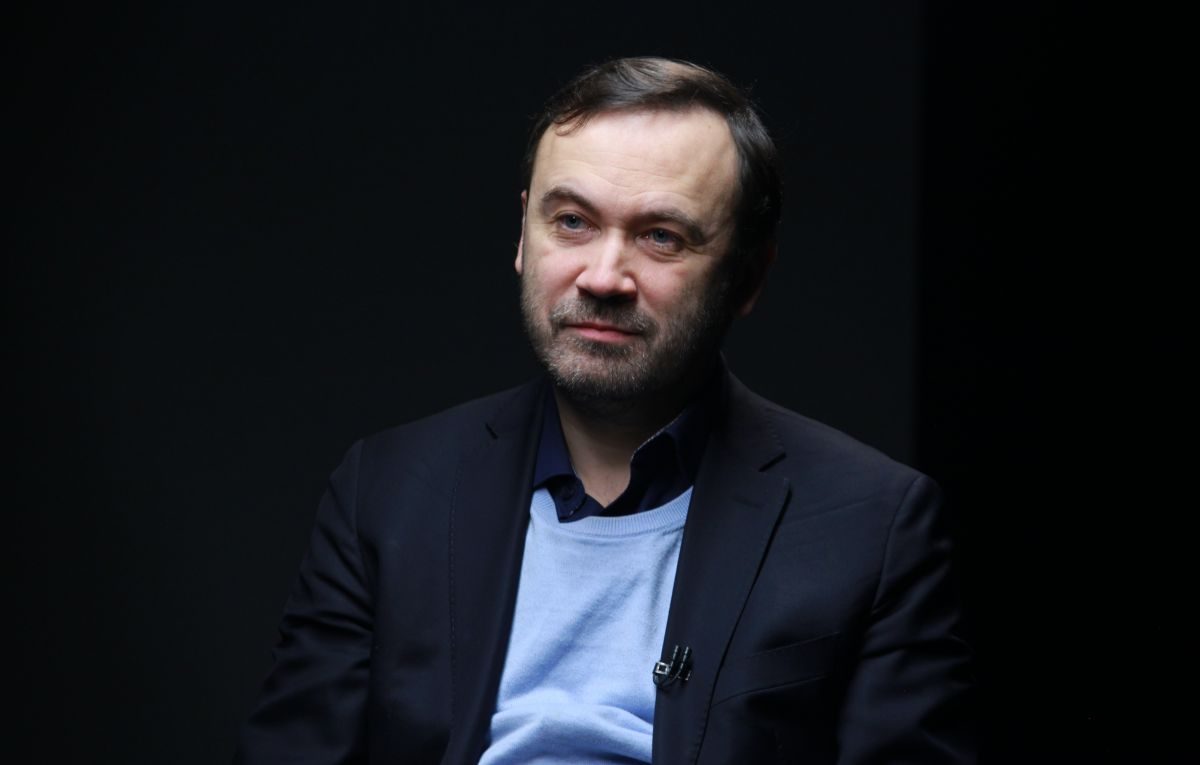
Russian political émigré Ilya Ponomarev: Putin is a classic White Guardist
He also believes that most Russians are subconsciously monarchist-oriented.
In a new episode of the Antipody program on the Iceland TV channel, Russian political émigré Ilya Ponomarev talked about why Russians love Stalin, Russian political emigration and the opposition, and the protests in Belarus and Kazakhstan.
You are a Russian political émigré. So what is the phenomenon of Russian political emigration itself? I'm interested in what kind of organism this is. How monolithic are these people, how capable are they of agreeing with each other, and do you have a single leader?
Even if we compare you with the previous waves of political emigration, because Russia has rich traditions of political emigration, if we compare you, so to speak, with the 'White' emigration and with the emigration of the 70s and 80s. How do you differ?
Well, now, I think, this emigration is a completely different phenomenon. In fact, there are many different waves of this emigration. There is political emigration, there is economic emigration, and scientific emigration. But in each of them, it is the carrier of certain political views and outlooks.
Even peasant emigration in the 1920s and 1930s is still a carrier of certain views. But if we limit ourselves to purely political matters, then those from the 70s were not a political force at all.
Yes, that was cultural intelligentsia, who were expelled from the country one by one, but there were no clearly defined political views; that is, they were not political fighters.
Well, if we don't count Bukovsky.
Yes. Well, just a few exceptions. But most of them were, after all, unwanted cultural figures. The 'White' emigration in this case looks like the losing side after all. The armed opposition that fought against the power that was coming. I think it's precisely with them that we should compare. My personal difference, of course, is that it was 'white' and 'red', that is, two different poles. A White Guardist is now in power in Russia.
This is what happened: a counterrevolution, and Putin is, quite obviously, a clear classic White Guardist. He draws his inspiration from the works of Ilyin. For him, all the heroes are precisely those who were in that very emigration. One of his first major foreign policy victories was the reunification of the churches with the Russian Orthodox Church Abroad.
By the irony of fate, he is a Chekist who achieved the reunification of these churches. And the main fifth column that is pro-Putin in the world today is precisely these White Guardists and their descendants. That is, all these princes, counts, barons and so on.
Who dream of reviving the greatness of Rus.
Yes, yes. They are absolutely clearly on Putin's side. They still dream of a Russia without Jews and Bolsheviks. That's their position, which is expressed quite openly. And so they've found each other. When people talk about Putin as a Stalinist and so on. Always, this is a trait of liberals: they see in Stalin an imperialist, a statesman…
A tsar. He is the red tsar.
Well, in my view, that is a very incorrect comparison. Stalin is a more complex figure than this villain; he is, without a doubt, a criminal, there's no doubt about that. But to simplify him, that is precisely what shows that people simply don't know history well, don't know Stalin's works well, don't know the statements he himself made well, and don't understand the ideals he himself expressed.
Even Dugin, I don't know how best to put it, a Russian philosopher, perhaps, or an alternative philosopher, says that respect for Stalin, loyalty to Stalin, is largely conditioned by the subconscious attraction Russians have precisely to the tsar.
But Stalin was the most powerful tsar since, say, Alexander II, roughly speaking. And Dugin claims that most Russians are subconsciously monarchist-oriented. Do you agree with this?
Yes. I think that's right. The Bolsheviks, when they came to power, were nevertheless carriers of the idea of modernization. I set aside all the atrocities, blood, violence, terror and so on; I'm talking about the idea that was there. It's no accident that Lenin wanted to switch the whole country to the Latin alphabet.
He didn't have time to do it, but nonetheless, by the mid-1920s, half of the Soviet Union, let's say, was writing in Latin rather than Cyrillic. The same Azerbaijan, the same Kazakhstan, Latin was still used there at that time. And in general, he was for a global republic of soviets; he didn't want to recognize any national borders at all.
Class solidarity, a single world republic under the red banner. Stalin adapted, so to speak, this modernization idea to this very deep Russian people. Because self-government, democracy, soviets, for Stalin, this was nonsense.
He was a graduate of a church parish school, and therefore he turned a communist idea into a religion and effectively made himself a tsar. But that's how citizens perceived it; from the point of view of the governing institution, the whole Soviet Union was, in essence, a parliamentary republic.
That is, there was no single figure of a president who could issue unilateral orders. All decisions were made by the Politburo, a collegial body; the supreme organ of power was the Supreme Soviet, the parliament.
Well, that's de jure. We know how these Politburos were constantly reshuffled, shot at each other and so on. You can't say it was democracy.
Well, on the one hand, yes; on the other hand, several times the country saw coups within the apparatus, which took place at the Politburo level. That would have been impossible if there had been a single dictatorship. The country didn't have a single dictatorship.
What Putin is doing now, trying to introduce direct inheritance of power, moreover on a family basis, to children. To create, in effect, these hereditary aristocracies in the regions. Nothing of the sort existed in the Soviet Union.
So Putin is trying to revive, in effect, to roll Russia back to the era of monarchy. Right?
Well, for Putin the ideal is Alexander III. It's definitely not Stalin. He, of course, addresses, tries, in this public propaganda, he understands that Stalin is very popular among Russians. As Vysotsky sang, 'there was a time when prices were lowered.' That is also an attribute of the Stalin era, so for Russians Stalin is the winner of the war, and Putin accordingly creates a cult of war: 'we can do it again.'
On the other hand, internationalism; on the other hand, a strong state, 'took over with a plow, left with an atomic bomb.' That's what he appeals to. But at the same time, his own domestic policy, ideals, views, philosophy, which he broadcasts, is, of course, the philosophy of conservatism and modernism that existed under Stalin, and this is characteristic of Alexander III, his main hero.
Do you think many of the political émigrés are people who work for the Kremlin and knowingly damage your image?
Of course. I'll put it this way: those who work quite consciously are a minority. Although I think it's a significant number, not just a few.
Are you talking about agents?
Yes, these are direct agents. That certainly exists. And there are some signs by which you can tell that a person is dependent.
Can you give an example of such a person?
Why? I have several people about whom I'm more or less sure that they work for Moscow. I have no evidence, so I simply try, so to speak, to neutralize the damage they can do to me. But periodically they manage to do it. They spread rumors about me personally, and they plant something else.
But there are people who act, so to speak, unconsciously, who are used in the dark. And with whom you argue openly: 'you shouldn't do this, it's a mistake for such-and-such reasons'; well, they don't think it's a mistake. I think they are playing into the Kremlin's hands.
I believe, of course, that the Kremlin's main interest is to maximally sink those people who express ideas that may be popular in society, and, conversely, to maximally raise people whose ideas are unpopular. Moreover, these can be extremely worthy people.
Russia. How cohesive a state is Russia? How much is Russia, in Moscow, St. Petersburg, Novosibirsk and Khabarovsk, a single state? Can one say that the idea often circulates that Russia is a territory of frozen or artificially suppressed interregional, interethnic conflicts?
Well, the further on, the more I agree with this thesis. That is, I don't think Russia is doomed to fall apart. Likewise, I don't think the Soviet Union was doomed to fall apart. There were reasons why the Soviet Union broke up, why the Ukrainian people, the Russian people, the ethnic Russian people, the Kazakh people and so on decided to go their separate ways.
Although I think it was economically more advantageous to be together. And in general I believe the future of humanity is a single world power. It's the elimination of all borders, unification. And the closest unification is precisely a pan-European one.
A union that would include both Europe and Russia, if there were a different government and a different system of management. I believe sooner or later this will inevitably happen. This space will inevitably come to a state in which there are no borders and all peoples will honor the same biblical values. But it happened the way it happened.
How can peoples have common biblical values if most of these people don't see the Bible at all?
No, I'm not saying these are believing Christians there.
Ah, you mean fundamental humanitarian values.
Yes, we still live by these very laws.
Well, we all understand anyway that any fundamental values break down at the moment when someone is forbidden to have five wives, or to stone their wife for betrayal, or to first meet the parents and then sleep with a woman. In that sense. This is utopia.
I don't think it's utopia. I think it will inevitably happen sooner or later. The fact that humanity is moving in this direction, and our entire historical path shows it. It's just that it won't necessarily happen next year or even in ten years. But the tendency for borders to disappear is, in my view, obvious. And most likely there will be some self-governing municipalities. But these won't be national borders.
National borders are a product of bourgeois capitalist society; they arose to protect the national markets of all these countries. Likewise, Europe before that existed in a different regime. There were feudal relations. And those weren't borders. I don't want to use that word; there were dividing lines. They were intricately intertwined. That's a passing history.
And borders will sooner or later disappear. If we talk about here and now, then, of course, Russia may follow the trajectory of the Soviet Union, unfortunately. It may well fall apart. This could happen in a single simple moment, when the interests of local elites become more advantageous for them to be separate than to be in one country.
Just as the Soviet Union fell apart. They will find a way to manipulate people in the territories under their control to convince them of the same thing.
But there has to be a suitable economic conjuncture, such as a fall in oil prices, when impoverishment begins, poverty begins, and then regional elites understand that the center has become very seriously weakened by these global processes.
Well, here's the question. It could actually happen both at the peak of a fall and at the peak of growth. Because take Siberia, for example. Russia's current tax system implies that everything is taken except for small pieces. Roughly speaking, a kind of requisition. When everything above a certain level is accordingly taken away. And the higher this price, the greater the temptation.
Guys, here you're selling at $100 a barrel, but roughly speaking, you're leaving it as if at $10. And why, actually? And the situation of weakening the federal center, and weakening can happen against any background, even just at the level of internal infighting. Putin sits at the center of this web. Then he disappears and there emerge separate Sechin, Chemezov, Shoigu and so on.
That is, they begin, so to speak, to tear it all apart. In this situation, of course, local bosses will say: 'Screw them all, this is a danger to us.' They force you to choose a side and at the same time to take money, and each of them will be on his own. Why the hell do we need this, we'd rather go and build this life separately. This could well happen.
Do you consider the peoples of Russia and Ukraine to be brotherly?
Yes.
Why?
By definition, so to speak. By origin.
How can people who live in Kyiv and representatives of Udmurtia who come here on tanks be brotherly?
As we know from our history, even setting aside the existence of Russia, how many times the sons of Kyiv princes killed each other, cut each other down there.
No questions there. Let's be purely cultural, purely even ethnic, and purely worldview-wise. Obviously, Ukrainians and those people who live in Khabarovsk are different people.
I don't agree. Not at all.
Then clarify it for me. I'm not saying this for no reason, because I have relatives there. And I don't feel any mental connection with them at all. Why, I don't know.
Well, I don't know why either. Because we know well that a significant part of the settlement of Siberia and the Far East came from Ukraine. And if you take the percentage of people with relatives in Ukraine, then the further east we go, the higher this percentage will be. Well, if we don't count separate national enclaves like Yakutia, Buryatia and so on.
Excuse me, I don't understand how my, as you say, 'brothers' can dislike freedom so much? Because I believe that for Ukrainians freedom is the most important, so to speak, value. And for the sake of this freedom we very often do irrational and really terrible things, very often.
But even more often we do truly heroic things. That is, for us freedom is our God, you could say. On the other hand, as far as I know Russians, not all of them, again, those Russians I am not satisfied with, so to speak.
For them, on the contrary, this subconscious paternalism, this happiness in slavery, is above all. And I don't understand how we can find common ground with them even in the context of our attitude toward freedom.
Look. When we started our conversation, we talked about the many differences that exist between peoples, and they do exist. But these differences also exist within Ukraine. If you compare the psychology of, say, Galicians, Little Russians.
Who are the Little Russians? I don't know.
Well, residents of the northern and central regions.
And why Little Russians? There's Slobozhanshchyna, there's simply a historical region of Ukraine.
Look, if the word 'Little Russians' offends you, we can talk about Slobozhanshchyna. I used it as a term.
This is some kind of circulating term from the times of the Russian monarchy.
I used it as a term. I didn't want to offend anyone. It's just that if we look purely sociologically at behavioral patterns, then we can identify in Ukraine at least three subethnic groups, if not four. Which have different electoral behavior, different value-based behavior patterns, different ways of life, and so on.
There are also very many such subethnic groups in Russia. Even if you exclude the national republics. Actually there aren't that many of them in percentage terms of Russia's population, about 20%. 80% are what are called Russians. It's a synthetic people, the Soviet melting pot.
This is rather scattered, not 'russkiye.'
It makes no difference to me. There you go. We'll still see many such territories where people have different psychology. It developed differently. And the origins of these mental differences have various causes. Siberians differ greatly from Urals people. Residents of southern Ukraine differ greatly from residents of the center.
I can say that I lived, I had a dacha in Vladimir Oblast, on the border with Moscow Oblast, in a village. It was about 15 kilometers from the town of Aleksandrov. Aleksandrov, Aleksandrovskaya Sloboda, the capital of the oprichnina. So, however much time has passed since then, you can still tell where the border of the oprichnina lands ran, because the psychology of people living in these villages differs from their neighbors.
Villages that were inside the oprichnina zone and outside it are different; they live differently, they relate to their households differently, they drink differently, they joke differently. You can see this with your own eyes. It's a large, diverse country. But that doesn't negate the fact that we are all still relatives. So when I talk about brothers and so on, there are still kinship roots.
When we talk about freedom, for example, if you take this one specific example. Then there's Khabarovsk and the Far East in general; the Far East, I'd say, and Kaliningrad too, are the real outposts. There is a very strong psychology of pioneers who came to this territory, occupied it, and reached it; it's very hard to live in the Far East, climatically and so on.
And so we defend it, we hold on to it. That's why they vote for the LDPR. How can you vote for the LDPR? Some, I know, vote for Zhirinovsky as a joke, but in my view a rational person cannot vote for the LDPR. Take Khabarovsk Krai, where the governor from the LDPR, Sergei Furgal, who was later jailed, won against United Russia.
And what happened in Vladivostok with elections, constantly. That's their understanding of freedom precisely. That's their understanding of their mission in life, their understanding of their place. It's not that they're slaves. It's about what they do, what they consider right. In Khabarovsk Krai, how many people from Ukraine, three quarters? Roughly such figures. Well, read 'Tigerhunters.' Those are such people.
And these aren't the worst Ukrainians who moved there. After all, the people who moved there were those who were mastering new lands and new territories.
Well, there was also the fact of the 'teplushki' being transported, so to speak, to dilute the demographic and ideological situation here.
The 'teplushki' transports happened much later. And the initial wave of resettlement was the Stolypin resettlement. I won't even mention that from the beginning there were Cossacks, Yermak and so on. But more or less en masse, it was people like my grandmother and grandfather, who came from Zaporozhian families and moved to Altai in this way. Also within the framework of this very Stolypin resettlement.

Russian Attacks in Dnipropetrovsk Region: Two Killed, Seven Injured

Defense Forces Strike Four Russian Drone Control Points in Past Day, Including in Berdiansk

Britain Threatens Sanctions on Kremlin-Linked People; Poland Ready to Hand Ukraine Ammunition

Russia says it has completed "planned exercises" in the Black Sea

MVD: Fake Riots With Prop Blood Were Being Prepared Near Presidential Office

Law Enforcers Name Another Klitschko Deputy as Suspect

Berlin Holds Protest Against War in Ukraine; EU Prepares for Possible Russian Halt of Gas Supplies
North Korea Fires Ballistic Missile Over Record Distance in Five Years
Irish Fishermen Force Russia to Postpone Naval Drills

US sanctions in case of invasion of Ukraine could completely destroy Russia's economy, NYT reports
