
Nord Stream 2: What the Launch Could Mean for Ukraine and Why the US-German Deal May Not Work
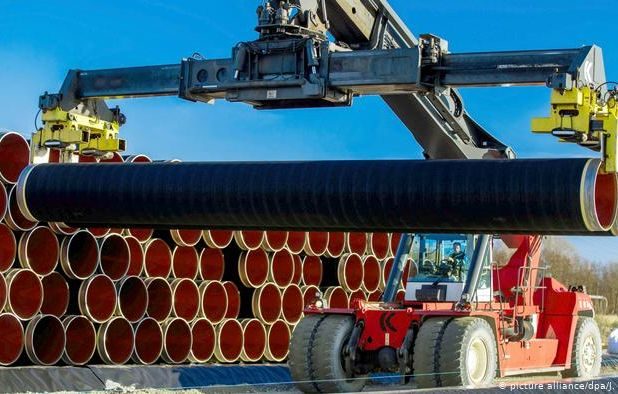
The gas pipeline bypassing Ukraine's gas transmission system could be completed as early as this year, yet Ukraine has still not received security guarantees.
Starting this year, Russia plans to deliver gas to Europe via the new Nord Stream 2 pipeline, laid on the bed of the Baltic Sea.
In theory, launching this pipeline could lead to Russia abandoning gas transit through Ukraine's gas transmission system, which could hit Ukraine on several fronts: its energy independence and its loss of leverage in the conflict between Ukraine and Russia. That is precisely why it is often called a "political weapon" against Ukraine.
We look at what is currently known about Nord Stream 2: how it all started, what the launch could lead to, and what the chances are of reducing the risks.
Why is the new pipeline being built?
That Russia wants to cut Ukraine out of its gas supply chain to European countries, gaining more leverage over both, has long been no secret to many.
Ukraine's gas transmission system (GTS) is designed to transport 150 billion cubic meters of gas. Ukraine was previously the only transit country for Russian gas to Europe, pumping up to 80 billion cubic meters in its best years. However, the picture began to change at the start of the previous decade.
For example, the first Nord Stream was launched in 2011 along a route near where the second one is now being built, and in January 2020 another pipeline bypassing Ukraine was launched: Turkish Stream, with a capacity of 30 billion cubic meters, supplying gas to Turkey and a number of southern EU countries.
Such an abundance of bypass "streams" has already led to a record low volume of gas passing through Ukraine's GTS, and Russia has stopped reserving additional capacity for transit.
For example, the contract for transporting gas from Russia, signed in 2020, already envisaged only 65 billion cubic meters of gas per year. In practice, only 55 billion cubic meters passed through the GTS. Under the same contract, transit volume for 2021-2024 is expected to be at the level of 40 billion cubic meters.
The Ukrainian government has repeatedly stressed that the construction of Nord Stream 2 is not rational, since the existing networks between Russia and the EU are loaded with gas to no more than half their capacity.
What the launch of Nord Stream 2 threatens Ukraine with
The launch of Nord Stream 2 primarily threatens Ukraine with Russia being able to transport all of its gas to Europe bypassing Ukraine. This would result in significantly higher gas tariffs for the population.
The absence of transit through the GTS would also badly affect the distribution of gas within Ukraine: constant pumping of gas from Russia maintains pressure in the distribution networks in eastern Ukraine, which is precisely why it may become urgently necessary to pump gas in reverse, from Europe into Ukraine, at much higher prices.
There is also a possibility of provocations from Russia, and the lack of leverage over Russia could prompt it to escalate the conflict with Ukraine.
Opposition to Nord Stream 2
Not only Ukraine is fighting the new pipeline, but also some EU countries and the United States. Governments of the Baltic states, Poland, the Czech Republic, Romania and Moldova openly oppose the project, arguing that Russia's expansion of geopolitical influence is unacceptable.
Civic environmental organizations warn of the pipeline's harm to the Baltic Sea environment, while disputes within Germany itself over the need for the project do not subside even though it is already 99% complete.
In Germany, the greatest opponent of the pipeline is the Green Party, which actively calls for an end to the construction of the project.
US sanctions policy also prevented Russia from carrying out its original plan: it was expected that the project would be completed in 2020.
However, this year the administration of US President Joe Biden changed course on this issue. Biden explained the decision not to extend sanctions against the project by saying that it is supposedly impossible to stop it now because it is 99% complete.
Instead, Biden struck a deal with Germany. In talks with German Chancellor Angela Merkel, they agreed that "if Russia uses the pipeline against Ukraine, appropriate measures will be taken."
However, the community and the Ukrainian government expressed doubt about this "deal," since no preconditions were specified at all, nor a definition of "use against Ukraine," and the agreement itself was rather oral in nature.
President of Ukraine Volodymyr Zelensky, in his latest interview, also noted that he "does not really trust" these agreements, and that during his meeting with Biden he will again ask the American leader to intervene in the situation with sanctions against the pipeline.
What the realities are
Gazprom states that 5.6 billion cubic meters of gas will pass through the pipe as early as this year (which can still be questioned given the forecasts usually embellished by Russia), while Nord Stream AG 2 has stated that the pipeline is 99% ready.
Ukraine, meanwhile, is considering several scenarios in case the pipeline is launched: either the aforementioned reverse flow of gas from Europe, or constant injection into gas storage facilities. Under the contract, Russia is obliged to use Ukraine's GTS until 2024; the contract in any case is drawn up on "take or pay" terms.
What will happen after the contract expires is not known for certain. Germany is calling on Russia to extend its contract with Ukraine after 2024, and has committed to seeking an extension of gas transit through Ukraine by Russia for 10 years. US Secretary of State Antony Blinken also supports this.
The head of American diplomacy argues that it is necessary to gradually reach a point where Ukraine continues to receive payments for gas transit for many years to come.
For its part, Ukrainian Foreign Minister Dmytro Kuleba said that acceptable conditions for Ukraine to recognize the pipeline would be the withdrawal of Russian forces from occupied territories.

Russian Attacks in Dnipropetrovsk Region: Two Killed, Seven Injured

Defense Forces Strike Four Russian Drone Control Points in Past Day, Including in Berdiansk

Britain Threatens Sanctions on Kremlin-Linked People; Poland Ready to Hand Ukraine Ammunition

Russia says it has completed "planned exercises" in the Black Sea

MVD: Fake Riots With Prop Blood Were Being Prepared Near Presidential Office

Law Enforcers Name Another Klitschko Deputy as Suspect

Berlin Holds Protest Against War in Ukraine; EU Prepares for Possible Russian Halt of Gas Supplies
North Korea Fires Ballistic Missile Over Record Distance in Five Years
Irish Fishermen Force Russia to Postpone Naval Drills

US sanctions in case of invasion of Ukraine could completely destroy Russia's economy, NYT reports
