
On the Day General Soleimani Was Killed, US Ran Another Secret Operation Against Iranian Officer in Yemen
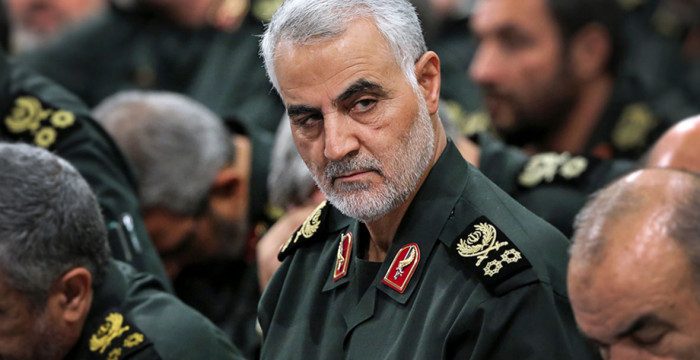
Translation of material from The Washington Post.
On the day American forces eliminated the Iranian military leader in Baghdad, the US was carrying out another secret operation against a senior Iranian military officer in Yemen, US officials told The Washington Post.
The operation was unsuccessful. The strike, aimed at the sponsor and key commander of the elite Quds special forces unit, Abdul Reza Shahlai, did not result in his death. Four people familiar with the situation said.
The failed operation may indicate that the killing of Maj. Gen. Qasem Soleimani, carried out on the orders of the Trump administration last week, was part of a broader operation than previously thought. It also raises the question of the ultimate aim of the strike: was it intended only to prevent an attack on Americans, as the US initially stated, or was the military's task to decapitate the leadership of the Islamic Revolutionary Guard Corps?
US military operations in Yemen, where a civil war has created one of the world's most severe humanitarian crises, are shrouded in secrecy. US officials say the operation against Shahlai remains strictly classified, and many declined to discuss any details, noting only that it ended in failure.
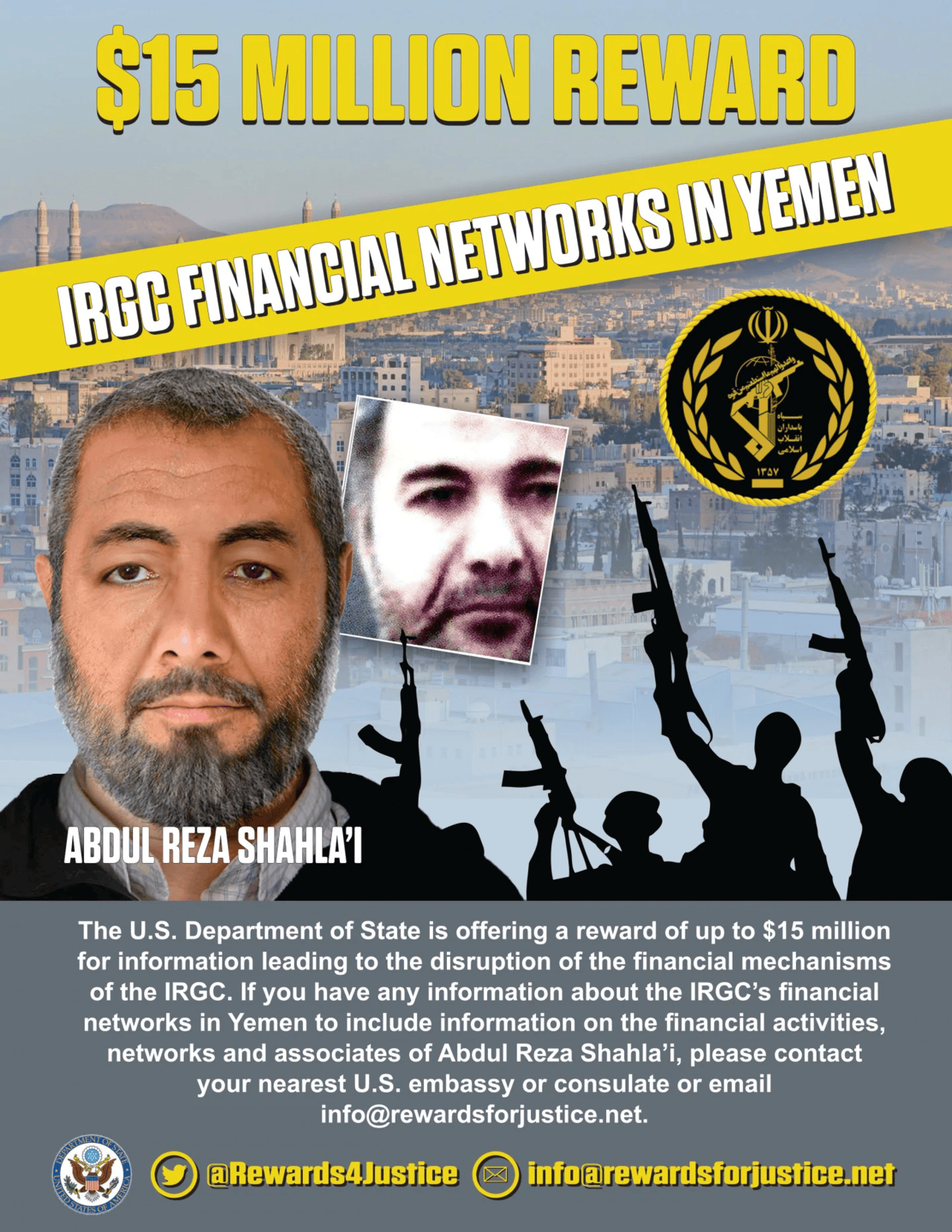
Poster offering a reward for Abdul Reza Shahlai (US State Department)
Officials at the Pentagon and in Florida tracked both strikes and planned to announce them simultaneously had both operations succeeded, sources say.
"If we had killed him, we would have bragged about it that same night," said a senior official who, like the other sources, agreed to comment on condition of anonymity, as the matter involves a classified military operation.
Another senior officer says orders for both strikes were issued at about the same time, and that the US is silent about the mission against Shahlai because it did not go according to plan. He says Shahlai could become a US target in the future, although both countries have expressed interest in de-escalating the crisis.
The Trump administration's decision to kill Soleimani has sparked debate in Congress. On Thursday, the House of Representatives passed a resolution restricting the president's right to strike Iran without Congress's authorization.
Officials at the Department of Defense and State Department said the strike on Soleimani saved "dozens," if not "hundreds," of American lives that were in immediate danger. But the attempt on Shahlai could potentially call that argument into question.
"It may indicate a mission with longer planning and a larger goal. And the question arises why it was necessary to cite an imminent threat in explaining our actions publicly," said Suzanne Maloney, an Iran expert at the Brookings Institution.
The Trump administration regards Shahlai as a particularly dangerous enemy. Last month the State Department offered a reward of $15 million for information that would help locate him and disrupt the financial operations of the Islamic Revolutionary Guard Corps. The announcement said Shahlai is based in Yemen and is known for a "long history of involvement in attacks against the US and our allies, including the 2011 assassination attempt on the Saudi ambassador."
US officials suspected that Shahlai, born around 1957, was linked to attacks on US forces in Iraq, including a complex 2007 operation in which pro-Iranian militants kidnapped and killed five American soldiers in the city of Karbala.
At last year's press conference, US Special Envoy for Iran Brian Hook said the US remains "seriously concerned about Shahlai's presence in Yemen and his possible role in supplying the Houthis (fighters against the Saudi-led coalition battling for control of Yemen – ed.) with advanced weapons like those we managed to intercept."
Iran has provided support (including training) to the Houthis, who are fighting the coalition led by Saudi Arabia, which is Iran's regional rival.
It is unknown why the operation failed. The Pentagon, State Department and White House declined to comment.
The strike on Soleimani was the first targeted killing by America of a senior military commander of another state since World War II, – prompting retaliation from Iran, which on Wednesday fired on US bases in Iraq (no casualties have been reported).
President Donald Trump said his country would respond with economic sanctions against Iran, and noted that "the US is ready to embrace peace and those who seek it."
Trump's top advisers insist on the "imminence" of the threat from Soleimani, although their claims about the timing of a possible attack have become less specific.
"There is no doubt that Qasem Soleimani was planning a series of imminent attacks," US Secretary of State Mike Pompeo said in an interview with Fox News on Friday. "We don't know exactly when and where, but they were going to happen."
General Mark Milley, chairman of the Joint Chiefs of Staff, and Defense Secretary Mark Esper also supported the version of an imminent danger.
"Was it known precisely who, whom, when and where [would attack]? No, – Milley told reporters this week. "But he was planning, coordinating and synchronizing important combat operations against US forces in the region, and the attack was inevitable." Milley went on to vigorously defend US intelligence during a classified briefing with members of Congress on Wednesday, a source familiar with the situation said. Some lawmakers left the meeting, complaining of a lack of specifics in the intelligence data.
Republicans in Congress supported the president's decision to kill the Iranian commander whose name is linked to the deaths of American soldiers after the US invasion of Iraq in 2003.
The operation against Shahlai was sanctioned despite the UN calling for a political end to the war in Yemen, which began in 2015 with a campaign by the Saudi-led military coalition against Houthi rebels. The Yemeni government, backed by Saudi Arabia, tried with all its might to defeat the Houthi movement, leading to a severe humanitarian crisis in which thousands of Yemenis died from disease, hunger and fighting.
The US believes Iran is steadily expanding its assistance to the Houthis and has sent several of its commanders to Yemen as advisers to the rebels. Experts say a number of members of Lebanon's Hezbollah are also helping the Houthis.
The Trump administration displayed what it claimed was Iranian weaponry, which it said was intercepted or discovered in the Yemen area – this is supposed to show that Iran is arming the Houthis for attacks on Saudi Arabia, including with high-tech projectiles.
Experts say that in recent months the Saudi-led coalition has sharply reduced the frequency of its attacks on Houthi targets, since the rebels have largely stopped strikes on Saudi Arabia.
Houthi leaders are divided between those inclined to show loyalty to Iran and those ready to strike a deal with their northern neighbor.
According to the Long War Journal, which tracks US overseas counterterrorism operations, in 2019 the United States carried out eight strikes against rebels in Yemen (by comparison, in 2017 there were 125 strikes). The targets of the attacks were members of al-Qaeda in the Arabian Peninsula and the local branch of the Islamic State.
The attempt on Shahlai also shows that the Pentagon has moved away from its previous mission in Yemen, in which Americans avoided direct involvement in fighting between the Houthis and the coalition. In 2018 the military suspended a program under which US aircraft were to refuel military ships in the Gulf. The reason was criticism of the US over civilian deaths caused by coalition airstrikes.
The US has not yet conducted operations against Houthi or Iranian leaders in Yemen — at least, it has not publicly announced them — despite Special Forces trying to track Iranian movements and intercept weapons shipments to the country.
Text: John Hudson, Missy Ryan and John Dawsey (The Washington Post)
Translation: Marina Moynihan, TK Media

Russian Attacks in Dnipropetrovsk Region: Two Killed, Seven Injured

Defense Forces Strike Four Russian Drone Control Points in Past Day, Including in Berdiansk

Britain Threatens Sanctions on Kremlin-Linked People; Poland Ready to Hand Ukraine Ammunition

Russia says it has completed "planned exercises" in the Black Sea

MVD: Fake Riots With Prop Blood Were Being Prepared Near Presidential Office

Law Enforcers Name Another Klitschko Deputy as Suspect

Berlin Holds Protest Against War in Ukraine; EU Prepares for Possible Russian Halt of Gas Supplies
North Korea Fires Ballistic Missile Over Record Distance in Five Years
Irish Fishermen Force Russia to Postpone Naval Drills

US sanctions in case of invasion of Ukraine could completely destroy Russia's economy, NYT reports
