
"Squid Game": Fantasy Fiction or Real Reflection of South Korea's Debt Crisis?
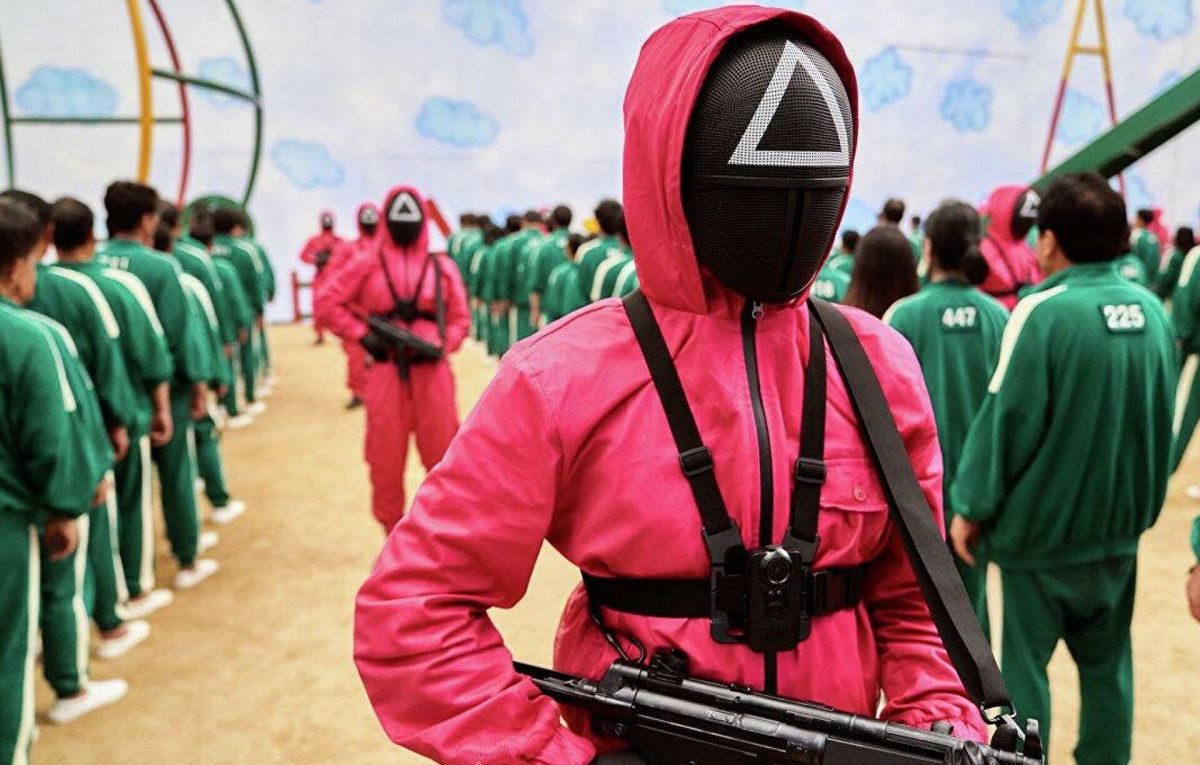
The new series has topped Netflix's charts in many countries, including Ukraine.
The new series "Squid Game" has become the first South Korean scripted production to top the international charts of the Netflix streaming service.
We explain the phenomenon of the popularity of "Squid Game" and how its seemingly fantastical plot is closely intertwined with the real debt crisis in South Korea.
What the series is about
According to the plot of "Squid Game," a group of 456 people in extremely dire financial straits, who owe huge sums, are invited to take part in an exciting quest, with the winner promised a multimillion-dollar cash prize.
Battered by life's circumstances, these people agree and find themselves in a closed territory, where the most terrifying events begin.
Every seemingly harmless children's game turns into a survival contest in the literal sense: every round of these games, starting with the very first, ends in mass shootings of the least successful players.

Notably, the deadly game can be ended if the majority supports this idea, yet the most desperate, driven by life's hardships, voluntarily continue the bloody battle in pursuit of the prize.
The creators of "Squid Game" show, in an exaggerated form, how people in pursuit of prosperity lose their virtue and their true belief in themselves.
Why the series reflects Korea's reality
"Squid Game" has quite literally hit a sore spot of South Korea: poverty and the enormous debt of a population living within a closed economy that depends on external inflows of funds. This simply breeds crazy competition for jobs.
Household debt in South Korea currently amounts to about 105% of GDP. No other country in Asia has such a level. And this is only the statistics on official loans, which do not account for shadow loans.
Public debt goes hand in hand with a sharply widening income gap, aggravated by rising youth unemployment and soaring property prices in big cities, which are out of reach for most ordinary workers.
As "Squid Game" shows, a sudden emergency, a failed investment or simply bad luck can force people to turn to high-risk lenders charging high interest, just to make ends meet over the next few days.
Lee In-chul
Chief Executive, Real Good Economic Research CenterThe total debt of ordinary South Koreans exceeds GDP by 5%. On an individual level, this means that even if you save every penny you earn over an entire year, you still will not be able to pay off your debt. And the number of people with debt problems is growing exponentially.
In response, the country's Financial Services Commission and Financial Supervisory Service recently decided to prevent more South Koreans from falling into debt by introducing limits on the amount of loans banks can issue.
The Guardian cites the desperate situation of former programmer Choi Yun-su, one of a large and constantly growing number of ordinary South Koreans who are suffocating under debt in a country where taking out a loan is as easy as buying a cup of coffee.
"I think other people consider me a loser, so I only leave (the tiny hostel room where 30 people live) at night, to smoke and watch the stray cats," Choi says.
All that Choi was able to find amid fierce competition was a part-time job as a delivery driver in another part of the country.
Like many of the 456 fictional participants in Squid Game, who are invited to play Korean children's games and risk their lives for a multimillion-dollar prize, Choi fell into debt at a frightening pace.
Just two years ago, he worked as an IT engineer at a company in Pangyo, South Korea's equivalent of Silicon Valley. Years of overtime shifts and lack of sleep undermined his health.
After lengthy discussions and a year spent planning and saving, he and his wife decided to open a pub in their hometown of Incheon.
They regretted this decision, despite their modest ambitions. "We did not hope to become millionaires," he says. "We would have been happy to earn the same as we did at our old jobs. All I really wanted was to sleep more... even one extra hour a day."
After a promising start, their business fell victim to the coronavirus pandemic. After bars and restaurants were ordered to close as early as 9 p.m. to prevent the spread of the virus, the number of customers dropped sharply and then dried up completely.
"Sometimes we didn't have a single customer," Choi says. "The two of us played loud music to cheer ourselves up, even though we knew it would lead to higher electricity bills. But we could not turn it off."
After failing to pay rent for four months, the couple realized they were testing their landlord's patience and sought help. Getting a bank loan turned out to be surprisingly easy, but they were shocked to discover that the daily interest rate was 4%.
Over several months, they took out loans from all five major South Korean banks, using their home as collateral. Inevitably, they had to borrow more to repay existing loans, joining long queues of struggling business owners eager to get cash from commercial lenders at interest rates above 17%.
In a desperate attempt to escape their downward spiral, Choi's wife found a job at a restaurant in another part of the country, and the couple asked his parents to look after their two young children.
Choi says he has heard a lot about "Squid Game," but cannot watch it.
"You have to pay to watch it, and I don't know anyone who would let me use their Netflix account," he says. "Anyway, why would I watch a bunch of people with huge debts? I can just look in the mirror."

Russian Attacks in Dnipropetrovsk Region: Two Killed, Seven Injured

Defense Forces Strike Four Russian Drone Control Points in Past Day, Including in Berdiansk

Britain Threatens Sanctions on Kremlin-Linked People; Poland Ready to Hand Ukraine Ammunition

Russia says it has completed "planned exercises" in the Black Sea

MVD: Fake Riots With Prop Blood Were Being Prepared Near Presidential Office

Law Enforcers Name Another Klitschko Deputy as Suspect

Berlin Holds Protest Against War in Ukraine; EU Prepares for Possible Russian Halt of Gas Supplies
North Korea Fires Ballistic Missile Over Record Distance in Five Years
Irish Fishermen Force Russia to Postpone Naval Drills

US sanctions in case of invasion of Ukraine could completely destroy Russia's economy, NYT reports
