
Three Days After the Plane Crash: How the Investigation Unfolded and How Versions Changed in Iran and Ukraine Reacted
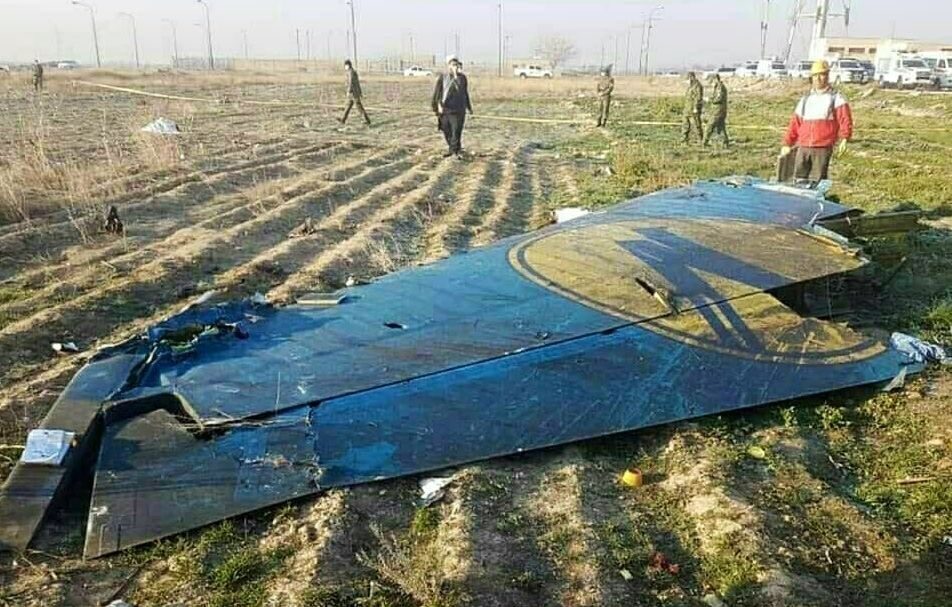
How did Iranian officials change their versions, and how did Ukraine react?
On the morning of January 8, a Ukrainian UIA airliner crashed minutes after taking off from Tehran’s airport, the capital of Iran. There were 167 passengers and 9 crew members on board the Boeing 737-800 flight PS752. Among them were 82 citizens of Iran, 63 citizens of Canada, citizens of Sweden, Afghanistan, Germany and Great Britain, and 11 Ukrainians. None of them survived. The plane was heading to Boryspil airport in Kyiv.
On the night before the crash, Iran fired missiles at US military bases in revenge for the death of IRGC General Qasem Soleimani and nine other Iranian servicemen, who had been killed earlier in a US intelligence strike. Because of the timing of these events, many people began to doubt the officially announced causes of the UIA plane’s fall on the very first day.
Initially, Iranian representatives stated that the plane had crashed for technical reasons. However, after statements by the presidents of the US and Canada and the British prime minister, who said that international intelligence showed the plane had been shot down by an Iranian missile, the state took responsibility. On January 11, Iranian television broadcast an official admission that the crash was caused by the mistaken launch of a missile: air defense systems had perceived the Ukrainian plane as a “threat.”
TK Media looked into how the investigation into the crash of the Ukrainian plane in Tehran was conducted and what will happen next.
Iran’s position
Initially, Iranian authorities stated that the plane had crashed for technical reasons.
Ali Abedzadeh, head of Iran’s Civil Aviation Authority, rejected the statements of Western leaders and said that any assumptions that the crash was caused by an Iranian missile could not be considered true until the results of analysis of the black boxes from the plane were available. The organization itself refused to hand over the black boxes to the American company Boeing, which built the plane.
Abedzadeh claimed that after takeoff the plane continued flying for another five minutes, and that “the pilot tried to return to the airport but failed.” He said he does not understand “how a plane can be shot down by a missile or a shell” if the pilot then “tried to return to the airport.”
At the same time, according to statements by Ukrainian officials, Iran did not obstruct the investigation. On January 10, Iranian Foreign Minister Abbas Mousavi said that Ukraine, as the owner of the plane, and Boeing, as its manufacturer, had been invited to join the investigation into the causes of the crash. Mousavi also invited experts from countries whose citizens died in the crash to take part in the investigation. He himself claimed that the crash was caused by an engine fire.
On January 9, Iranian user Nariman Gharib published a video showing a missile hitting a plane flying in the sky, saying that sources had sent him the recording. Experts from The New York Times and Bellingcat verified and confirmed the authenticity of the video.
Later, Nariman Gharib published a new video, filmed from a different angle and, probably, from a different location: it shows the plane flying in the air, engulfed in intense fire.
On January 9, the outlet Censor.net, citing sources in the commission, reported that no traces of fire were visible on the engines. Traces were also not visible in photographs from the crash site.
This undermined the version of possible technical causes.
On January 11, Iran’s leadership took responsibility for the crash of the plane and admitted that it had been accidentally shot down by a missile due to “human error.” The authorities’ statement was broadcast on Iranian TV early on the morning of January 11. Iranian President Hassan Rouhani also said that the Islamic Republic of Iran deeply regrets the catastrophic error and extends its condolences to the families of the victims. Official Tehran claims that all those responsible will be held accountable.
As Volodymyr Zelensky said about the results of his conversation with Iran’s president, the countries agreed on full legal and technical cooperation, including the issue of receiving compensation. “We agreed that no one will get away with it,” the president said.
Iranian authorities explained that the plane was mistakenly perceived as a hostile target, since Iran was expecting a response from the US after the shelling of American military bases, and was shot down by a missile after it approached one of the military facilities of the Islamic Revolutionary Guard Corps (IRGC).
US position
The first report of the alleged downing of the Ukrainian passenger plane by the Tor surface-to-air missile system appeared on January 9 in the American magazine Newsweek. The news outlet cited anonymous sources at the Pentagon and in American intelligence. A Pentagon official and an intelligence representative suggested that the missile, which took 176 lives, had been fired by accident. Later, CBS News and CNN confirmed the same information, citing their own sources. This theory was under development and was based on satellite information and electronic data regularly collected by US intelligence.
A few hours later, US President Donald Trump, answering journalists’ questions, said he doubted that mechanical failures of the plane could have led to the catastrophe, and added that “someone could have made a mistake.”
The US handed over data on the crash of the UIA plane to Ukraine, Foreign Minister Vadym Prystaiko reported. A visit by US Secretary of State Mike Pompeo to Kyiv is expected at the end of January.
Canada’s position
Canadian Prime Minister Justin Trudeau, in his statement, said that he was shocked and saddened that the crash took 176 lives, including 63 citizens of Canada. The Boeing 787-8 flight PS752 of UIA was shot down by an Iranian surface-to-air missile. Trudeau stated this on January 9 during his briefing, which CBS News broadcast, citing data from Canadian intelligence. The prime minister noted that the missile launch could have happened by accident.
Great Britain’s position
British Prime Minister Boris Johnson said that the Iranian government bears responsibility for the downed plane, but added that its actions could have been unintentional. Like the US and Canada, Johnson called for a full and transparent investigation into the incident, which killed 176 people, including 4 citizens of Britain.
Ukraine’s position
In the first hours after the air crash, the Ukrainian embassy in Iraq stated that the plane had crashed for technical reasons and that a terrorist attack or missile strike was ruled out. However, the statement soon disappeared from the embassy’s website. A new version said that the commission would establish the causes of the disaster and that other statements were not official. The same day, UIA stated that the crashed plane had been manufactured in 2016 and had passed inspection on the eve of the fatal flight, on Monday, January 6. The airline’s representative also noted that the pilots on board were experienced and had between 7,000 and 12,000 flight hours, and that given the crew’s experience, a pilot error was not possible.
Secretary of Ukraine’s National Security and Defense Council Oleksiy Danilov said on January 9 that there are four versions of the plane’s fall, including a hit by a Tor surface-to-air missile, a collision with a drone or other flying object, damage and explosion of the engine for technical reasons, and an explosion inside the plane due to a terrorist act.
The Office of the Prosecutor General of Ukraine opened a criminal case over the killing of Ukrainian citizens, according to the agency’s website.
A commission from Ukraine, consisting of 45 specialists, flew to Tehran on January 9 aboard a Ukrainian Armed Forces plane to establish the circumstances of the UIA plane crash and identify the bodies, according to the president’s website. The operational group included representatives of various Ukrainian agencies, including UIA.
On January 10, information emerged that the Ukrainian commission was not being shown the cockpit, and that bulldozers were haphazardly raking up the wreckage at the crash site. One member of the interagency commission investigating the air crash reported this. At the same time, CNN, citing an eyewitness, reported that all large pieces of the plane had already been removed from the crash site. According to CNN correspondent Richard Quest, all experts should examine the intact wreckage at the crash site.
However, Ukrainian Foreign Minister Vadym Prystaiko said at a briefing that there were no grounds to speak of insufficient cooperation between Iran and Ukraine. According to the minister, the Ukrainian investigative group had gained access to the black boxes and to recordings of conversations between dispatchers at the Tehran airport control center and the plane’s pilots. The bodies of the dead were taken to hospitals in Tehran for DNA testing. Prystaiko’s statement came before Iran’s official announcement of its admission of guilt for the crash.
On January 10, after the statements by the leaders of the US, Canada and Britain, Zelensky wrote that the version of a missile hitting the plane was not ruled out.
On January 11, after Iran took responsibility for the tragedy, Ukrainian President Volodymyr Zelensky promised in his address to Ukrainians to return the bodies of all those killed in the air crash in Iran, so that relatives and loved ones could say goodbye. It was reported that the bodies of Ukrainians will be returned as early as next week.
“We worked systematically, without hysteria, for one purpose: to achieve a result. Namely, to establish the truth about the circumstances of the air crash,” Zelensky explained the absence of statements.
UIA’s management held a briefing on January 11, at which they stated that at the time of departure from Boryspil airport the airline had no information about possible threats, just as it had none at the time of departure from Tehran airport. Vice President of the company Ihor Sosnovskyi also noted that, according to Flightradar24, a website that shows the flight paths of planes from various airlines, the plane was strictly on its flight path and did not deviate from the route.
UIA believes that Tehran should have closed the airport.
Ihor Sosnovskyi, UIA Vice President
If you are playing at war, then play as much as you want, but there are normal people around who needed to be protected. They were obliged, if they were shooting from somewhere, to close the airport. Obliged! And shoot as much as you want.
UIA President Yevgeny Dykhne stated that UIA will pay all due insurance payments and compensation to the families of the deceased passengers in accordance with international rules.
According to Zelensky’s address to Ukrainians, a group of Ukrainian experts in Iran is now reconstructing the plane. The result of the phone call with Iran’s president was an agreement to order the completion of identifying the bodies of the dead and their return to Ukraine.
In connection with Iran’s authorities’ acknowledgment of the “missile version” of the air crash in Tehran, Ukraine’s Foreign Ministry will send a note listing the legal aspects of settling compensation for the families of the victims, according to the president’s website.
Ukrainian Prime Minister Oleksiy Honcharuk said that the state will allocate 200,000 hryvnias each to the families of those killed in the crash of the UIA passenger plane in Iran. However, not all payments that the victims’ families are expecting will come from this. They are also expecting compensation from UIA and the Iranian authorities.
Polina Brazhnikova, TK Media

Russian Attacks in Dnipropetrovsk Region: Two Killed, Seven Injured

Defense Forces Strike Four Russian Drone Control Points in Past Day, Including in Berdiansk

Britain Threatens Sanctions on Kremlin-Linked People; Poland Ready to Hand Ukraine Ammunition

Russia says it has completed "planned exercises" in the Black Sea

MVD: Fake Riots With Prop Blood Were Being Prepared Near Presidential Office

Law Enforcers Name Another Klitschko Deputy as Suspect

Berlin Holds Protest Against War in Ukraine; EU Prepares for Possible Russian Halt of Gas Supplies
North Korea Fires Ballistic Missile Over Record Distance in Five Years
Irish Fishermen Force Russia to Postpone Naval Drills

US sanctions in case of invasion of Ukraine could completely destroy Russia's economy, NYT reports
