
Ukraine-EU Summit in Kyiv: Open Skies Agreement, Preparations for a “Gas War” and Plans for the Future
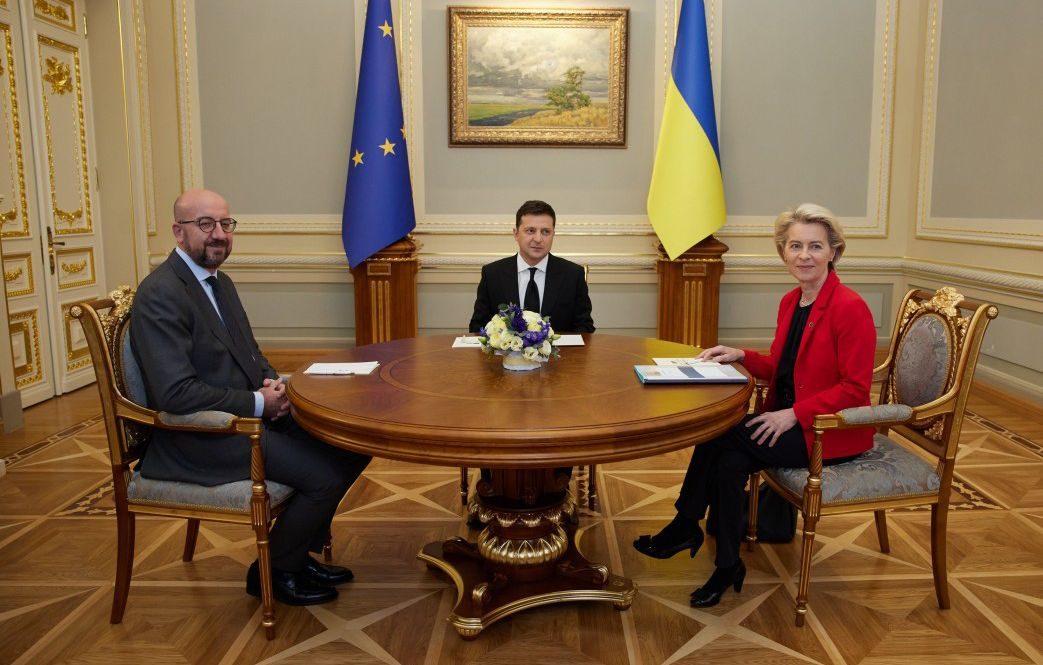
Zelensky urged EU leadership to grant Ukraine a European perspective.
On October 12, a meeting of the 23rd Ukraine-EU summit took place in Kyiv. It was attended by Ukrainian President Volodymyr Zelensky, European Council President Charles Michel and European Commission President Ursula von der Leyen.
The heads of the European Union institutions arrived at the Mariinsky Palace, where they were welcomed by Zelensky. The Ukrainian president expressed confidence that the dialogue “will be fruitful and will further contribute to Ukraine’s integration into the European community.”
The Open Skies Agreement
As part of the summit, Ukraine and the EU signed the long-awaited Open Skies agreement. On the Ukrainian side it was signed by Prime Minister Denys Shmyhal, and on the EU side by High Representative Josep Borrell and Slovenia’s ambassador to Ukraine, Tomaž Mencin.
The Open Skies agreement equalizes Ukrainian and European airlines in certain rights, lifts the monopoly on certain routes established by bilateral agreements, facilitates the opening of new routes between Ukrainian and European cities and, as a result, reduces ticket prices.
The EU notes that one of the consequences of signing this agreement should be the entry of new low-cost airlines into Ukraine and an increase in Ukraine’s tourist appeal.
The European Perspective
Zelensky called on the EU leadership and member states to be “bold and farsighted” and to grant Ukraine a European perspective.
Volodymyr Zelensky
President of UkraineWe very much expect the leadership of the European Union and its member states to show courage and foresight in viewing Ukraine as an integral part of the European space. Granting Ukraine, which shares common values with the EU, a European perspective in accordance with Article 49 of the EU Treaty is a logical and expected step. To achieve this goal, Ukraine will persistently work with all partners and EU states.
On the eve of the summit with the EU, the Verkhovna Rada called for recognition of Ukraine’s membership prospects.
“Industrial Visa-Free Regime”
President Volodymyr Zelensky expects to sign an agreement on an “industrial visa-free regime” at the next Ukraine-EU summit in a year.
Volodymyr Zelensky
President of UkraineWe are starting a conversation about updating customs tariffs and revising the deep and comprehensive free trade area. There is movement toward an industrial visa-free regime, which is very important for Ukraine. We aim to sign this agreement already at the next Ukraine-EU summit.
He added that a dialogue on the European Green Deal has begun: “We are ready, together with the EU, to move toward climate neutrality.”
The ACAA agreement (on conformity assessment and acceptance of industrial products), which is called the “industrial visa-free regime,” is the recognition of the equivalence of the technical regulation and conformity assessment system with European standards. It would allow industrial producers to obtain the necessary certificates in Ukraine rather than traveling to the EU in search of an official representative who can obtain this certificate.
Sanctions Pressure on Russia
Zelensky called on the EU to expand sanctions against Russia, in particular after the recent elections to the State Duma of the Russian Federation. He thanked the EU for continuing sanctions against Russia year after year: “But the need to increase sanctions pressure has been overdue for a long time.”
The president stated that everyone who took part in organizing and holding the State Duma elections in occupied Crimea, Sevastopol and the temporarily occupied territories of Donbas must be placed on sanctions lists: “Systemic human rights violations in temporarily occupied Crimea must not be left without attention either.”
He noted EU sanctions against eight representatives of the so-called judicial authorities of Crimea. On October 11, the EU Council imposed restrictive measures against eight people for actively supporting actions and implementing policies that undermine or threaten the territorial integrity, sovereignty and independence of Ukraine.
Among the individuals on the sanctions list are representatives of law enforcement bodies—judges, prosecutors and security officials responsible for enforcing Russian legislation in illegally annexed Crimea and Sevastopol.
Preparing for a “Gas War” with Russia
The EU and Ukraine agreed to work out “all scenarios” for developments around gas supplies to Ukraine. The President of the European Commission said that developments in the gas market were a subject of discussion during the summit.
Ursula von der Leyen
President of the European CommissionI understand your concern about gas supplies, and this issue concerns not only this winter but the future as well. The task for the Commission is to work out all scenarios together with Ukraine.
According to her, this means working out the possibility of increasing the volume of gas reverse flow via Slovakia’s gas transmission system. The EU also plans to actively use Ukraine’s gas transportation infrastructure.
The President of the European Commission noted: “We must also explore the use of Ukraine’s underground gas storage facilities.” She advised Kyiv to focus its efforts on improving energy efficiency.
“Energy efficiency must change the rules of the game. Ukraine should not import gas at all; it must be self-sufficient,” said Ursula von der Leyen.
Three Paths
The President of the European Commission named three paths along which to move in order to bring relations between Ukraine and the EU to a new level.
Ursula von der Leyen
President of the European CommissionThe first concerns Ukraine’s focus on implementing reforms. Ukraine has come a long way, and I want to congratulate you, President Zelensky, on this. I want to state clearly that we will continue to support Ukraine’s efforts to carry out key reforms.
According to her, this primarily concerns judicial reform, including reform of the Constitutional Court, the fight against corruption and limiting the influence of oligarchs. The second path is to use the potential of the Association Agreement.
“It can still offer a lot. We have discussed this. For example, in the digital sphere. Ukraine is very progressive in this area, and we can do a lot together here,” said the President of the European Commission.
The third path is aimed at increasing trade, investment and economic cooperation: “Our agreement on a deep and comprehensive free trade area remains the cornerstone of our relations. A lot has already been done, and I call on us to be ambitious so that both sides can benefit.”
Adoption of the “Anti-Oligarch” Law
The EU supported Ukraine for its commitment to combating the influence of private interests, in particular the adoption of a law on oligarchs. Summit participants stressed the need for further efforts to ensure the independent and effective functioning of anti-corruption and law enforcement bodies, including through a depoliticized process of selection for leadership positions based on merit.
“The EU welcomed Ukraine’s efforts to limit opportunities for corrupt actions and its commitment to combating the influence of private interests (‘deoligarchization’), including through the legally grounded adoption and implementation of relevant legislation, and called for further steps by Ukraine in this direction,” the statement says.
The EU confirmed its ongoing support for Ukraine’s efforts aimed at large-scale reforms, especially in the judicial system and the fight against corruption. For its part, Ukraine confirmed its commitment to ratifying the Rome Statute, as provided for in the Association Agreement.
Two More Agreements
At the Ukraine-EU summit, an agreement was signed on Ukraine’s participation in the Horizon Europe and Creative Europe programs.
“Signing the document will provide a legal basis for cooperation in the scientific and scientific-technical sphere and create the prerequisites needed to accelerate Ukraine’s emergence as an influential European state by expanding international scientific and technical cooperation, and will ensure the necessary steps for our country’s integration into the European Research Area,” the message says.
Horizon Europe for 2021-2027 is the EU’s largest program for funding science and innovation, with a total budget of more than €95.5 billion.
“The purpose of concluding the agreement is our country’s participation in the EU’s Creative Europe program for 2021-2027, aimed at supporting and strengthening the competitiveness of the European cultural, creative and audiovisual sectors, as well as developing and promoting cultural and linguistic diversity and preserving Europe’s cultural heritage,” Zelensky’s press service said.
Creative Europe for 2021-2027 has a budget of €2.4 billion and is implemented in three areas: culture, media and cross-sector cooperation.

Russian Attacks in Dnipropetrovsk Region: Two Killed, Seven Injured

Defense Forces Strike Four Russian Drone Control Points in Past Day, Including in Berdiansk

Britain Threatens Sanctions on Kremlin-Linked People; Poland Ready to Hand Ukraine Ammunition

Russia says it has completed "planned exercises" in the Black Sea

MVD: Fake Riots With Prop Blood Were Being Prepared Near Presidential Office

Law Enforcers Name Another Klitschko Deputy as Suspect

Berlin Holds Protest Against War in Ukraine; EU Prepares for Possible Russian Halt of Gas Supplies
North Korea Fires Ballistic Missile Over Record Distance in Five Years
Irish Fishermen Force Russia to Postpone Naval Drills

US sanctions in case of invasion of Ukraine could completely destroy Russia's economy, NYT reports
