
Journalist and blogger Yuriy Romanenko: stupidity is driving Ukraine further toward dire consequences
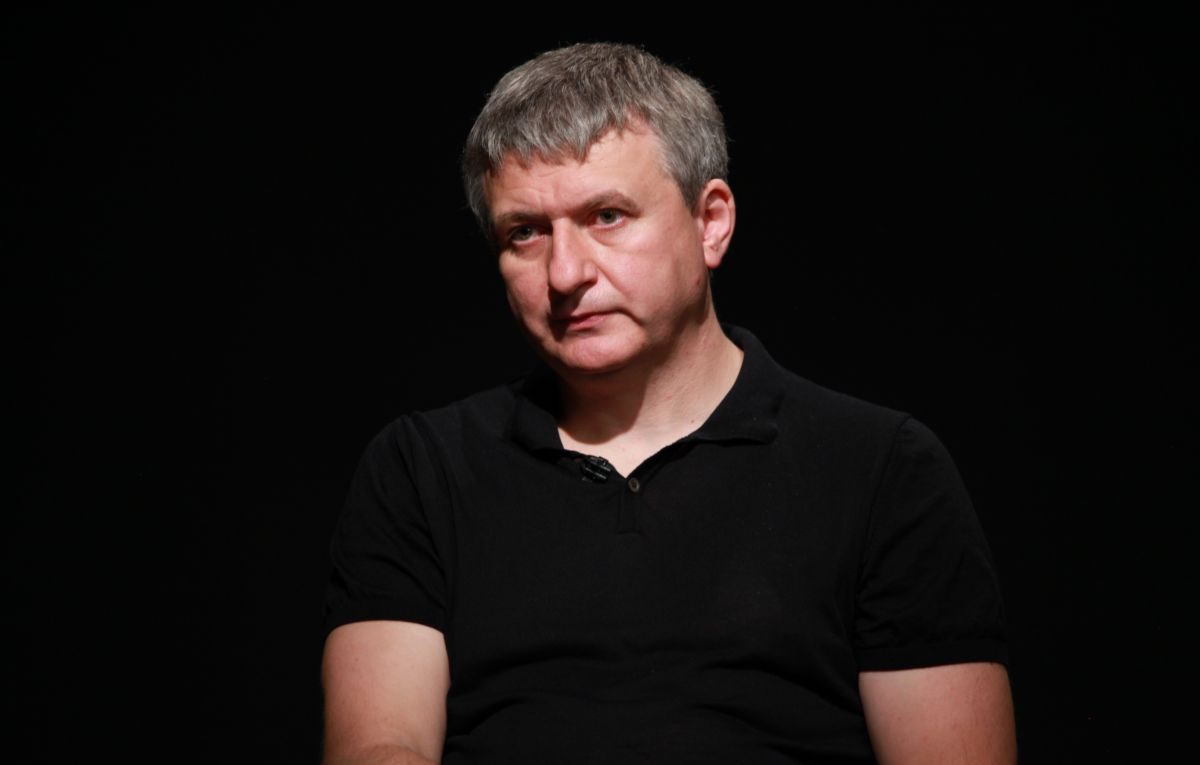
In his view, no one should speak Ukrainian just because others want them to.
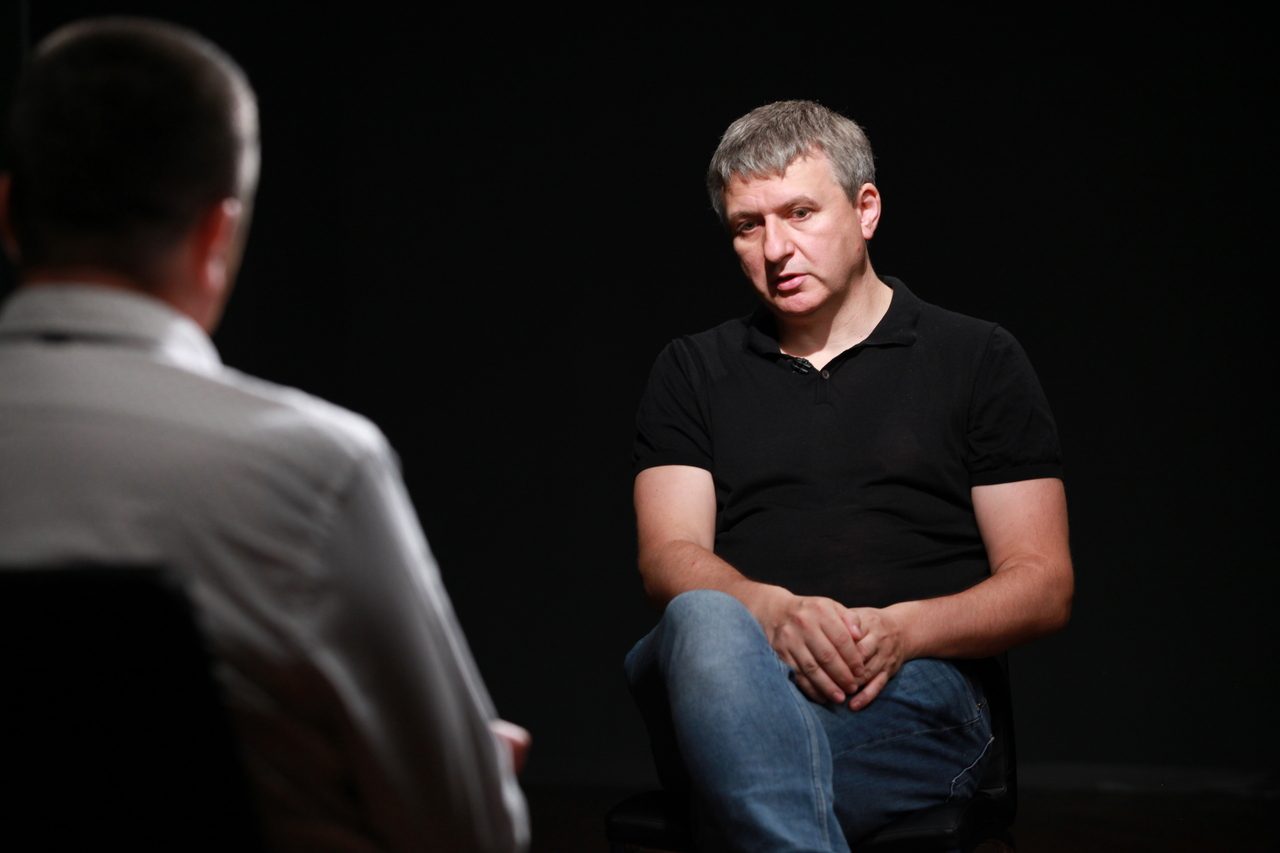
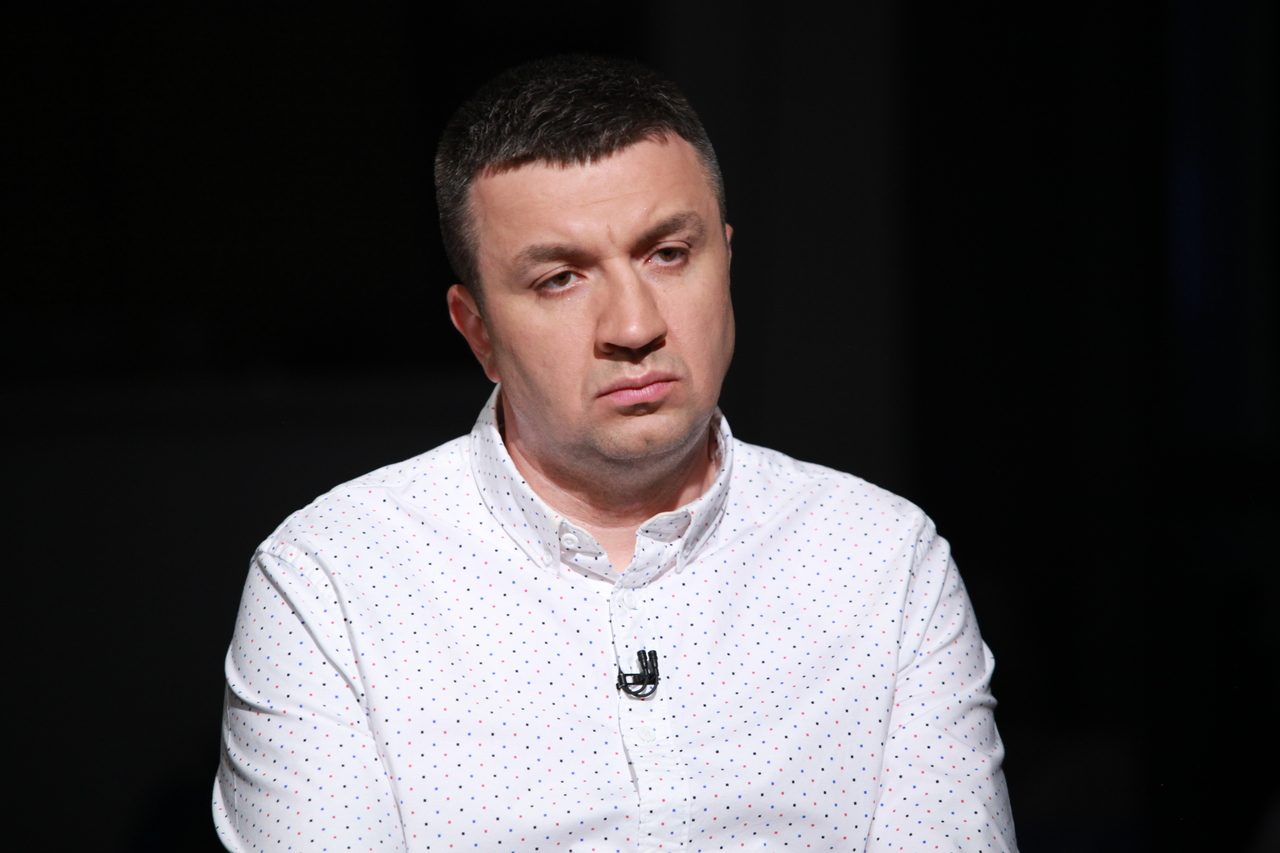
In a new episode of the Antipody program on the Iceland TV channel, chief editor of the information and analytical portal Khvylya, journalist and blogger, and co-founder of the Ukrainian Institute of the Future Yuriy Romanenko spoke about Ukraine's problems over 30 years of independence, and discussed with host Sergey Ivanov the issues of the Russian language in our country and Russian literature.
Do you like how our country is developing?
No normal person who thinks about such things could like where we are heading.
What bothers you the most?
Stupidity. Stupidity at every level. When we, our society, are so saturated with stupidity, when people have simply turned into one-day mayflies, grabbing whatever they can, with a grabbing instinct, and think about nothing else. That, probably, irritates me the most. And the stupidity is being cultivated, it is reproduced at the level of institutions. This is a very serious reason that keeps driving us further and further toward increasingly sad consequences.
In your opinion, what is the main systemic bug? Is it the authorities, the people, or the Soviet legacy after all?
Let's put it this way, it is a combination of factors whose roots go back centuries and even decades. When people tell me that we should repeat the fate of Poland or the fate of the Baltics, or someone else, that we could have gone that way back in the 90s. No, we could not have done anything like that, because we were fundamentally different at the start.
Unlike Poland, for example, we did not have a consensus among the elites about where to go. And, in fact, we did not have an elite as such that would not be secondary to Moscow. And the Second Ukrainian Republic was a product of chance, it appeared as a product of chance, as a product of chaos in Moscow.
And as a result, this chaos pushed the elites, who feared this chaos and feared that some new Stalin or something like that would come to power, to play at independence. And as a result, this very rupture was not prepared: neither the population, nor most of the people, nor the elites were ready for it.
We saw this in the vacillations that took place throughout 1991, when first everyone went together to the referendum on March 17, 1991 and voted to preserve the Soviet Union, and then just as unanimously on December 1 the same people voted for Ukrainian independence.
Because everyone hoped that something would change for the better, since the Soviet Union was already in such an obvious dead end and such hopeless need and problems that for most it was some kind of way out. What kind of way out, nobody understood. And accordingly, when there was such enormous disorientation and essentially everything had to be learned on the fly, then, of course, the elite did what it wanted to do already under the Soviet Union.
That is, to 'privatize', to take these assets that they actually controlled, to legitimize all of this and thus remain at the helm. People simply survived. And the only thing the Second Ukrainian Republic could form was a layer of people, over time, decades later, which you and I belong to, who began to somehow find their bearings.
Over these decades they formed a system of coordinates: those who traveled around the world, earned some capital, and received some education. They adapted to the rules of the game that exist in the modern world, understand them, and therefore achieve some success, prosperity, self-sufficiency, and so on.
These people are in an absolute minority, while those who did not fit in or did not flee from here are in an absolute majority. And therefore the real successful future of Ukraine depends on this narrow layer, which may still turn Ukraine toward something constructive.
In general, the problem is not that these people are in the minority, because in principle the minority has always determined the course in any country. It is just that the ideas of the minority over time become the ideas of the majority. This takes time.
This combination of bugs and the legacy left over from the Russian empire and the Soviet Union, which were aggravated by the fact that homo sovieticus turned into this kind of homo-zhlobicus in Ukrainian realities. When the worst of the Soviet system, because there were also normal moments in the Soviet system, no point in hiding that.
What kind?
Well, for example, systematicity. There was systematicity, systematicity in education, systematicity in upbringing.
The Holodomor was also quite a systematic phenomenon.
Look, I am talking about positive aspects. From the point of view of education, it was perhaps not the best, but it was systematic. That is, it gave a complex of knowledge that allowed a person to exist within some system of coordinates.
Today's Ukrainian education is absolutely unsystematic, some kind of chaotic set, eclecticism, which does not answer the question of what a person goes out into the world with. Soviet education did answer that question. It knew how to sort people into certain clusters: this one here, that one there.
If you had good math skills, they would push you into some Bauman institute, and push in the literal sense of the word. That is, you were evaluated at top universities based on your skills.
But for us all this has turned into such segmentation and clustering, where each social cluster fiercely fights for its own rights. The teachers' estate fights so that under no circumstances will their base be narrowed, and resists any serial reforms.
The prosecutors' estate, I think you yourself know what it represents; it likewise constantly guards the zone it has and tries not to let outsiders in. We already have families, prosecutor families, SBU families.
That's true. So in fact it's a caste system.
Yes. And in essence this has led to the formation of such an estate-caste-clan spirit, in which a person's position is determined by loyalty to the clan head. The clan head may be a person, say Avakov, head of the police clan, or SBU officers whose generals nobody knows, but who have shaped internal policy in the special services for decades and are very influential. People like Naumov.
Conventionally speaking, the framework was never formed as a whole. It was formed only by Kuchma. Kuchma is the only one who tried, based on his ideas about how the state should be structured, and because he worked at a design bureau, he approached the construction of the Second Ukrainian Republic as an engineer.
He essentially designed it, and he also built into it those flaws that today are the cause of our very serious problems.
But unlike Kuchma, there is no one to control them. Have I understood correctly?
Because yes, after Kuchma left, everything was left to drift. That is, Kuchma tried to maintain some balance. But probably because he nevertheless preferred money, which in the end is what destroyed him.
Is this similar to a situation where, say, there is a mafia structure and suddenly the godfather is killed, and a war begins between these small factions?
You see, no one killed the godfather here; he himself decided what was more important to him. In this dilemma of power and gold, he, conventionally speaking, chose gold.
If we turn to the original source, the book, we do remember that Don Corleone left to grow tomatoes and left everything to his brothers, who started cutting each other up.
Well, look, Don Corleone still chose power, and he chose to leave because he realized he was no longer adequate to the era. By the way, this is very important for a politician, and for a serious top manager in general, not only for a politician: it is always important to understand how well you sense the era.
And how similar to him is Kuchma in this?
Kuchma left under pressure of circumstances; Kuchma resisted to the last. That is, this maneuver of 2004, conventionally speaking, when he tried from the start to introduce a parliamentary republic, remember, in spring 2004, when there were not enough votes. And that was such a moment of truth.
Because his plan to reformat Ukraine into a parliamentary republic, where he would remain in executive power as prime minister, failed, and Kuchma was forced to agree to let Yanukovych run, whom he could not stand, so that by setting him against Yushchenko he could still play the game in which one could jump out and repeat this hat trick with the parliamentary-presidential republic.
But something went wrong in the end, and it went wrong because he ceased to be needed by the elites. The elites saw in him a competitor, an obstacle that did not allow them to resolve issues related to further privatization of property and strengthening their positions. That is precisely why they needed to dismantle the institution of the president and weaken it.
And here the interests of the elites and the transnationals spontaneously coincided, because for the West it was also important to open the market, try to strengthen its positions here and, using this conjuncture, penetrate this market and gain some positions. And the Russians were also interested in this.
I think sooner or later we will get to the cassette scandal and all those things that happened in the 2000s, at the beginning of the 2000s, and I am sure that this was the first hybrid war that the Russians played against Kuchma.
Because in the late 90s Kuchma quite actively tried to secure Western support; he very insistently tried to get closer to Western institutions and integrate Ukraine into Euro-Atlantic structures. We remember what maneuvers there were regarding NATO, and GUAM was an attempt to create something then.
I even remember there were posters like this: Kuchma sitting at a table in some institution, with the words 'A politician respected in the world', which equals recognition of the state. Something like that. Some kind of insanity.
Well, those are typical Ukrainian insanities, because we constantly have such things.
No, well, the fact itself: he was not sitting in the Kremlin.
I am just saying that this is our backwater culture, a tradition of trying to fit into some global context such gimmicks that are understandable only to us, which are actually very funny. But that is not the point.
The point is that then, in the 90s, when Gorbulin headed the National Security and Defense Council, this course really existed; he tried to implement it and tried to play these games, although along the way he also successfully maneuvered with regard to the Russians. That was the policy of two vectors.
Whatever anyone says, the policy of two vectors was the only right one at that moment. Maybe it is even so now. I will tell you, we will have to return to a policy of multiple vectors. I think we will soon understand this, and we will have to think about how to live with our own minds, and not rely only on the Russians, or the West, or someone else.
And this situation, when Kuchma in the late 90s first let the oligarchs develop and decided in this way to solve the problem of restarting the economy, and then thought about how to weaken them, because, conventionally speaking, he saw their function in this. He raised them, because after the start of the crisis of the 90s, when everything simply lay in ruins, it was necessary to somehow start the economy.
And since the red directors could not cope with this, again for the reasons I mentioned: disorganization, the rupture of Soviet markets, a lack of understanding of how things work on world markets. People like Taruta, for example, who were engaged in foreign economic activity at the metallurgical plant in Mariupol, there were relatively few of them, that is, those who under the Soviet system went to Germany and elsewhere and knew how to work on the world market.
And therefore the tragedy and crisis of the red directors lay in the fact that most of them were used to working as Gosplan dictated, and when all of that disappeared, everything quickly collapsed. I remember very well how in the small town where I lived, in the early 90s in the Kharkiv region in Pervomaisk, we had a huge chemical plant.
And everyone, on Sundays and Saturdays, took the chlorine there, everything this chemical plant produced, and went to Belgorod to sell it at the market in order to barter for something. That is the classic picture of what happens when management cannot organize logistics and cannot solve problems that arose under new conditions.
So, Kuchma launched the oligarchs. There were two models he considered with Academician Yukhnovsky and other such smart people. The first tried to follow the path of Central and Eastern Europe, that is, the path of Poland: attracting transnationals and betting on small and medium business. And they considered such a path.
And there was logic in this, because they feared there simply would not be enough time. They understood that the arrival of transnationals would weaken their positions; from the point of view of managing the processes, they would need more time to try to speed up the economy, because small and medium business, having fewer resources, needs more time to get going into something serious.
And therefore they decided to go quickly, along the path of this cheap privatization, quickly unloading assets. Besides, there was also a personal interest in this, because they understood that in this way they could get some cash. And so the process of oligarchization and the rule of big capital was launched.
It cannot be said that this is fundamentally a completely wrong path, because if we look at the world economy and, say, at South Korea, the state there also followed the path of forming large financial-industrial groups, with the help of which South Korea turned into a world gold medalist, showing brilliant economic growth for decades.
What were Russian speakers supposed to get after 2014?
Well, at a minimum, normal respectful treatment of the fact that they can use the Russian language as they want.
So who is stopping them?
Wait, when you use it, some person comes up to you and says you must speak Ukrainian just because he wants to. Well, that's wrong.
Where does this happen?
In everyday life. After the relevant laws were adopted, which I called idiotic, we created an environment for a bunch of everyday conflicts, which periodically end with some idiot running up to a cashier who then gets angry, because he demands that she speak Ukrainian. Well, tell me, in the logic of that fundamental crisis.
I believe there should be corporate conditions, which in turn are subordinate to the laws. If you can't speak Ukrainian, go work where knowledge of it is not required.
Listen once more. You come to have your receipt printed in a supermarket; well, if she prints your receipt answering in Russian, are you going to not eat the pear or whatever it is you're buying? Seriously. Or if she answered you in Chinese, and you really wouldn't understand her, but everyone understands Russian and Ukrainian perfectly well.
The question is not that we don't understand.
The question is that there are people who want to impose Ukrainian on others so that they literally communicate in it. For a Ukrainian speaker, what problem is there today in satisfying all their needs in the Ukrainian language? The language of instruction is Ukrainian, Ukrainian-language cinema, books in Ukrainian; for God's sake, go buy whatever you want.
The only thing is that not as much gets translated as one would like. And you yourself above advocate for unified rules.
Wait, when they started imposing such rules, I immediately ask the question: why the hell should I submit to what I don't want? For example, when I had a broadcast with Drozdov, when that conflict arose. That is exactly a conflict over communication rules.
They dragged me onto the broadcast for a month and a half, just begging me to come, but first there was no time, then something else. In the end I came to them for the broadcast. And he says to me, like: 'What language are we speaking?' I say: in Ukrainian, in Russian, however it goes, that's how I'll talk; I don't fuss over it much. I speak both languages excellently.
The broadcast starts, I spoke first in Russian; he moves into the second part and starts telling me, 'why don't you speak in Ukrainian?' Well, the hell with it, if I don't want to speak Ukrainian. What difference does it make to you whether I want to or not; it's my right.
And the funniest thing is that I would actually have switched to Ukrainian, because there was a context connected with some deputy from the People's Front, and his speech was semantically constructed in such a way that I built my answer in Ukrainian. And this is not a question of language, it is a question of freedoms.
Our state must produce and develop freedoms. The more freedoms people have, the better it will be, and the faster it will develop.
Freedom ends where another person's freedom begins.
Of course. Well, look, if you don't like that I communicate in Russian, then don't communicate with me. Or if I can't resolve my question, my problem in Ukrainian, those are my problems.
It seems to me you are distancing yourself. And who are you? Aren't you citizens of this state?
Wait, if the state starts segmenting us, that concerns not only Russian speakers, it also concerns Hungarians, and we have gotten into an absolutely idiotic situation with them. There were agreements.
So will we also make Hungarian official?
It was already official in Berehove, at the regional level. There 90% of Berehove speaks Hungarian. Does it bother you that they speak Hungarian there in Berehove? Or if you come to a shop in Berehove, surely you wouldn't refuse to buy a piece of sausage.
If they speak Hungarian there, I don't think they'll understand me there.
Listen, they will surely sell you that sausage, because you haven't seen suicides over someone not buying a piece of sausage in Berehove. Exactly the same as with the Crimean Tatar or the Bulgarian language. We are driving ourselves into some archaic nonsense.
Because when we have been fighting over language for 30 years, while everything is falling apart right before our eyes, from nuclear power plants to the education system, which has already become so bad that it's easier to send a child to study in Poland or Slovakia, and for less money, so that he gets educated.
Look at what we are doing when we argue about language. You have been speaking Ukrainian the whole broadcast, and I have been speaking Russian. What did we not understand about each other in this communication?
No, we understood. But we are talking about other, conceptually different things. I am telling you, the Russian language occupies a very serious segment in public discourse. So why is Russian there, and why is English not there? You know that the new generation, in principle, knows English from the age of seven.
Again, I was writing back in 2014: let's make three state languages, English, Russian and Ukrainian. And let the Cabinet speak in all the languages they want. Well, what's the problem, explain it to me?
The problem is that, first of all, people here listen to Russian music.
Well, so what? They will listen, because it's more interesting.
Who, Russian music?
Yes, it's more interesting.
Which Russian music is more interesting?
Open Google Trends and you'll see.
Google Trends show that it is easier to get hooked on it. Morgenshtern is more easily 'consumed' than, say, Palindrome, our Ukrainian-language artist.
Well, that's Palindrome's problem.
No, that's not Palindrome's problem. These are different budgets. Because Palindrome is an indie musician, and behind Morgenshtern stands an industry. On the other hand, there is Pharrell Williams, who, excuse me, can go screw this Morgenshtern. Or Snoop Dogg, or Denzel Curry, or whoever you like.
The group KAZKA, in which the soloist has no vocal talent to speak of, but she created the hit 'Plakala', which the whole world listened to, in Ukrainian. 'Plakala' made the whole world cry, it went down wonderfully, they listened to it in Morocco, they listened to it in Germany, and so on.
So if someone cannot create a product in Ukrainian that gets broadcast all over the world, the way KAZKA did, with hundreds of millions of views, then that is a problem with the content of the person creating in Ukrainian. And that is not Morgenshtern's problem.
Create your own Ukrainian Morgenshtern in Ukrainian and compete. That's it. That is the problem. This restriction actually depends on the economic interests of our singers, who are not capable of creating products that can compete.
No, listen, I am talking about something else entirely. We have a lot of young groups that sing in English. Because our global segment is Russian-language music that comes from Russia, since our people, the listeners, understand this language.
And maybe if they did not have this language and these tracks in Russian, they would somehow learn, as I did in 1991, to understand what Thom Yorke is singing about, do you get it?
I opened, in a completely random order, a track by Morgenshtern, let me quote: 'Milady, I beg you, if you suck me off, do it culturally, don't slurp and observe etiquette. Let's go, la-la.' Well, I just typed it into Google, and that's it.
Well, what does that say? American rappers who sing in English use a ton of profanity. What are you trying to say? That because someone, say Eminem, in his English songs says 'suck me off, baby', I'm somehow going to get closer to some more cultured level just because it's in English? Or what?
So if Morgenshtern says 'suck me off', that's lower culture, but if Eminem says 'suck me off' in English, then what is that? It's the same thing.
It's a calque, an absolute calque of Western rappers.
Serezha, understand one simple thing: people suck in Britain, in the States, and in Russia. And regardless of what language you use, it's a pleasant process.
Well, I don't know, if they're not forcing you to do it.
Well, again, that's a question of who does what and what they like. But this is not a question of language, you understand? That's the point: if you create awesome content, and you make it even in Ukraine, you will ultimately break through with it. Because today you can operate on the global digital market very easily.
I am talking about the constant narrowing of our opportunities. Instead of working with the Russian market, with the Russian-speaking German market, with the English-speaking one, for God's sake, of course I am for our English-speaking market expanding as much as possible, I am all for it with both hands.
Look, here is a simple example: the Bihus tapes, which are clear to the audience. The Bihus tapes became a shock for many of those porokhobots, for many of our patriots. Some suspected, but suddenly they saw what many had suspected and talked about, and those who, let's say, were in narrow circles and knew, but this is a shock not only for our audience network, it is also a shock for that part of the audience.
What Ukrainian propaganda and the Ukrainian state should be doing now is, at every step, on all Russian websites, VKontakte and so on, telling a very sad story to the 'vatniks' about how they are being used to the full.
It turns out you can calmly work with Nazis, with those who crucify bullfinches, boys in underpants and so on, calmly negotiate for money, trade, sell whatever you want: gas, oil, electricity. And from these conversations it follows that there is no conflict, no contradictions at all.
In general, it turns out you can calmly have direct contact with the president of a country you attacked and accuse of Nazism. So why not use that, just because you understand this culture and have command of this language? Why should you think about how to amputate yourself, just because Putin uses this language?
Well, that probably depends on one's worldview. Earlier you mentioned the Protestant worldview paradigm, and I can tell you just the same that Russian literature is literature of constant moral decline.
Russian literature: if we kept reading it instead of Pushkin or Tolstoy, if we read Faulkner and Steinbeck. If it had been in the curriculum in its time, we would have a completely different firmware.
30 years of independence, who is stopping you from doing everything you are talking about?
I am talking to you about the school curriculum, about the arts curriculum.
Who is stopping good English teaching in Ukrainian schools, is it Putin who's stopping it? Well, who is stopping it, for heaven's sake.
I am talking to you about a way of thinking, because right now, through one person who believes that Russian culture, Russian literature, is 'a haven for rebellious souls'.
One has to be like some damn Anna Karenina, one has to be Natasha Rostova, one has to be like the doomed ones, instead of being like, say, the heroes of Steinbeck and any representative of the normal Western canon.
And when you say, but we don't have a tradition of Protestantism, I say, well, we don't have a tradition of the Western canon either, because we have read a lot of crap.
Look, is this what you want to prove to me, that Russian culture is crap? It isn't so. It produced interesting, cool cultural models, it produced Chekhov, Dostoevsky and many others, Berdyaev, it produced Bulgakov. Are you saying Bulgakov is crap?
Bulgakov is crap.
I don't think so. Bulgakov is definitely not crap. The Master and Margarita is a great work.
Yeah. Merezhkovsky and Andreyev are crap.
Everyone has messed something up somewhere. No big deal.
It's a compilation. In Averchenko, Merezhkovsky and Andreyev.
Philosophy, and much of literature, is all compilation, because after Aristotle, after Plato, Heraclitus or someone, it is very hard to come up with anything new. Nevertheless people come up with things, compile, and reach some level.
So, if you make yourself more complex with the help of Russian, English, Swahili or Hungarian, you are doing well, you are great. If you simplify yourself with English, German, Russian or Ukrainian, then you are an idiot.

Russian Attacks in Dnipropetrovsk Region: Two Killed, Seven Injured

Defense Forces Strike Four Russian Drone Control Points in Past Day, Including in Berdiansk

Britain Threatens Sanctions on Kremlin-Linked People; Poland Ready to Hand Ukraine Ammunition

Russia says it has completed "planned exercises" in the Black Sea

MVD: Fake Riots With Prop Blood Were Being Prepared Near Presidential Office

Law Enforcers Name Another Klitschko Deputy as Suspect

Berlin Holds Protest Against War in Ukraine; EU Prepares for Possible Russian Halt of Gas Supplies
North Korea Fires Ballistic Missile Over Record Distance in Five Years
Irish Fishermen Force Russia to Postpone Naval Drills

US sanctions in case of invasion of Ukraine could completely destroy Russia's economy, NYT reports
