
Zelensky Meets Putin. What Did Russia and Ukraine Agree On? Results of the Normandy Summit in Paris
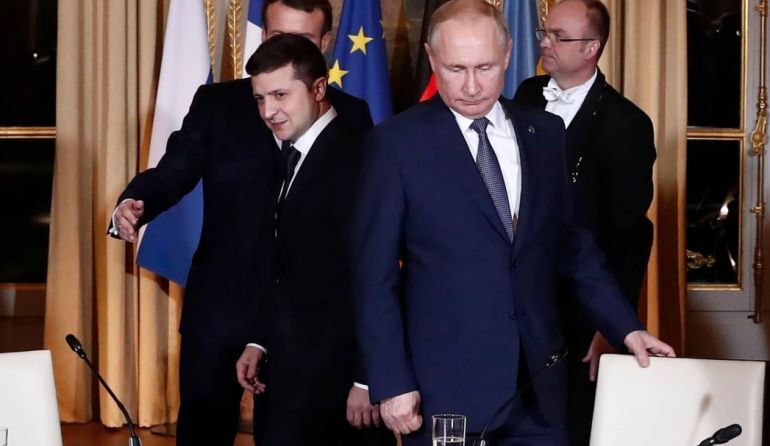
They agreed to keep talking and meet again.
The first meeting of the “Normandy Four” in three years took place in Paris: the leaders of Germany, France, Russia and Ukraine had not gathered together since 2016. Preparations for the summit took more than six months; for the meeting to take place, Ukraine had to fulfill a number of conditions, including withdrawing troops from Petrovske and Zolote.
Ukraine was the main initiator of convening the “Four”: securing a one-on-one meeting with Putin and reviving the “Normandy format” was the main foreign policy goal announced by President Zelensky. Another goal announced during the election campaign — to expand the Normandy format and include the United States and Britain — was not achieved.
The Russian side also expressed readiness for dialogue with the new leadership of the country: in August, a prisoner exchange was achieved, including Oleg Sentsov and sailors who had been held prisoner, and in November Russia handed over to Ukraine the ships seized in the Kerch Strait. The parties stressed that the prisoner exchange became possible only through personal agreements between the leaders of the two countries. The implementation of these agreements was handled by Vladimir Zelensky's aide Andriy Yermak and his Russian counterpart Dmitry Kozak.
However, closer to setting the date of the Normandy meeting, new stumbling blocks emerged: Russia demanded that the gas issue be included on the agenda, while Ukraine raised the stakes by proposing to discuss Donbas and Crimea as one package. Ultimately, the parties agreed to discuss the gas issue in Paris, while Crimea was not revisited, at the categorical insistence of the Russian side. The absence of the Crimea issue from the agenda of the Normandy meeting was confirmed to journalists at the Elysee Palace by Yulia Mendel: “not currently planned,” the press secretary said.
Nevertheless, what exactly the president is taking to Paris and what plan for settling the conflict in Donbas Zelensky's team has prepared remained unclear (as it still remains unclear): Zelensky did not disclose details, in order “not to harm the negotiation process,” and people were simply urged to “trust the president.” Due to a lack of communication from the Office of the President, an atmosphere of tension arose, so activists and opposition parties set up a camp on Bankova Street, calling on the president not to surrender Ukraine, with the slogan “No capitulation!”
How the talks went
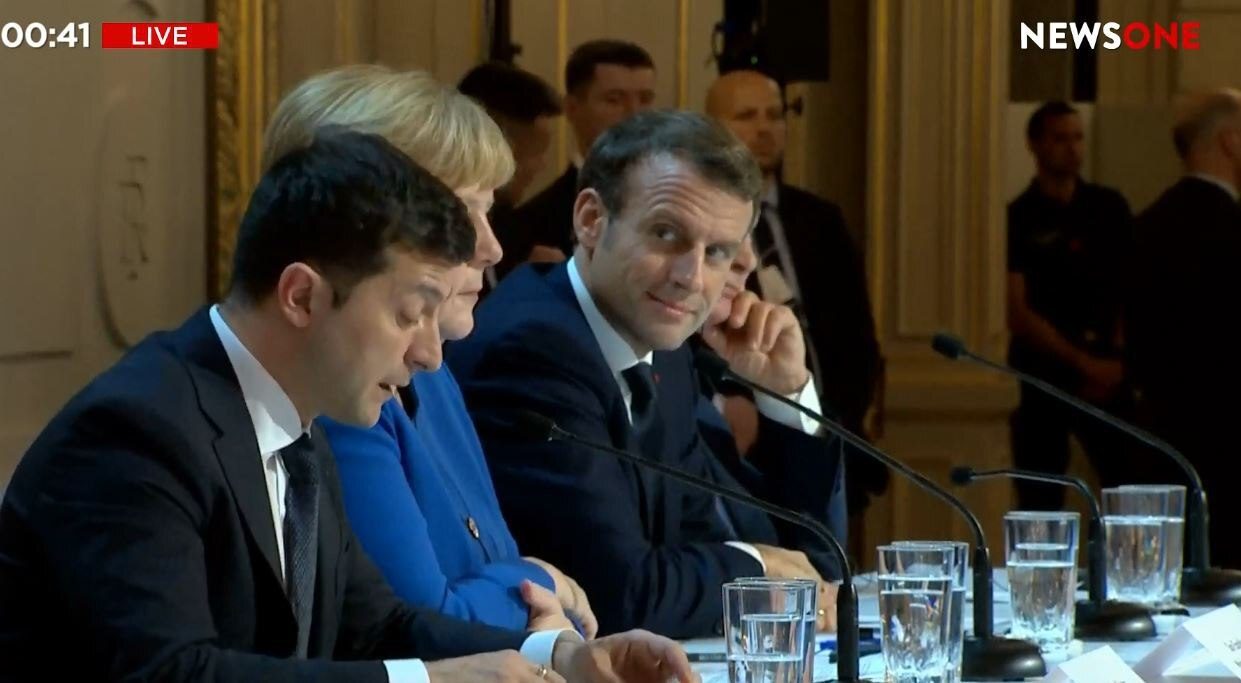
“It was long, but to the point,” Vladimir Zelensky summed up the meeting at a joint press conference, exchanging glances with Macron. The meeting of the leaders of the four countries did indeed drag on: around 16:00 (Kyiv time) the presidents arrived at the Elysee Palace, and only after midnight were they able to come out to the press.
The schedule of the “summit” was as follows: first, a bilateral meeting between Vladimir Zelensky and French President Emmanuel Macron, then a bilateral meeting between Zelensky and German Chancellor Angela Merkel, followed by a general meeting of the leaders of Germany, France, Ukraine and Russia, and after that a bilateral meeting between Vladimir Zelensky and Vladimir Putin.
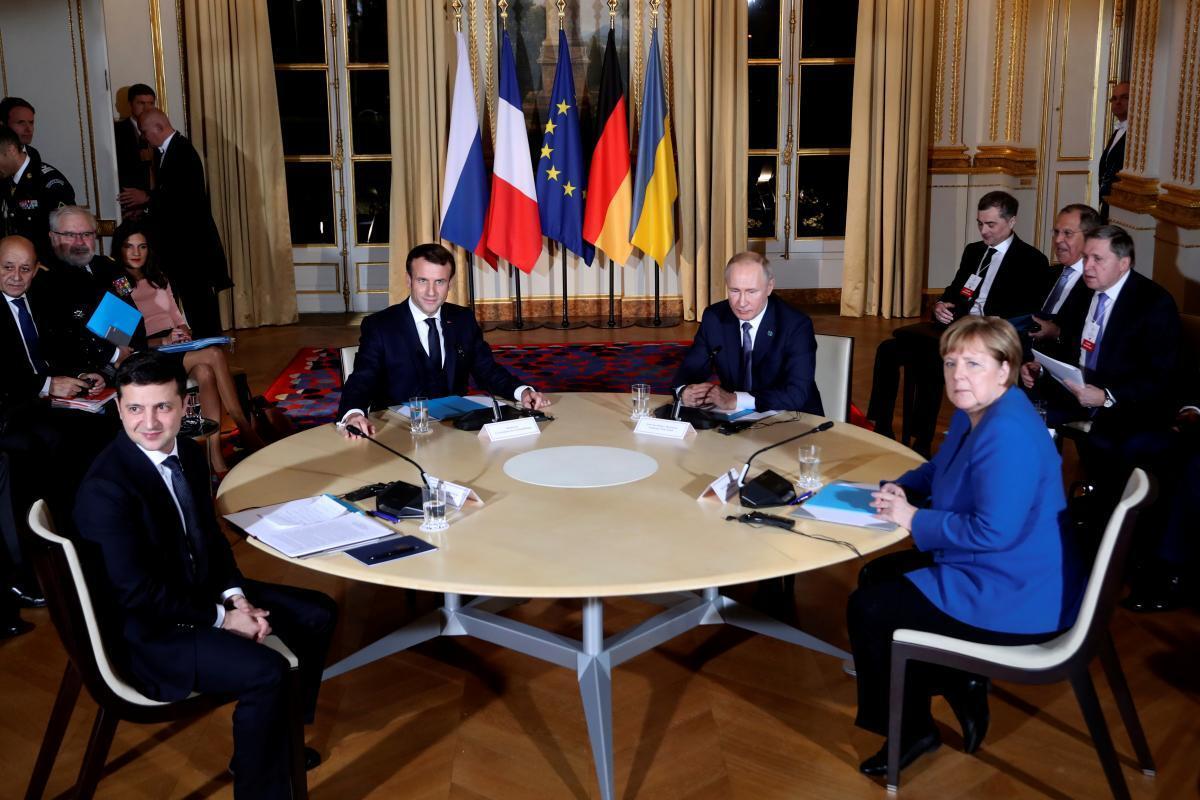
After the one-on-one talks between the leaders of Ukraine and Russia, the countries returned to discussions in the “Normandy format” over dinner with the leaders of the four countries.
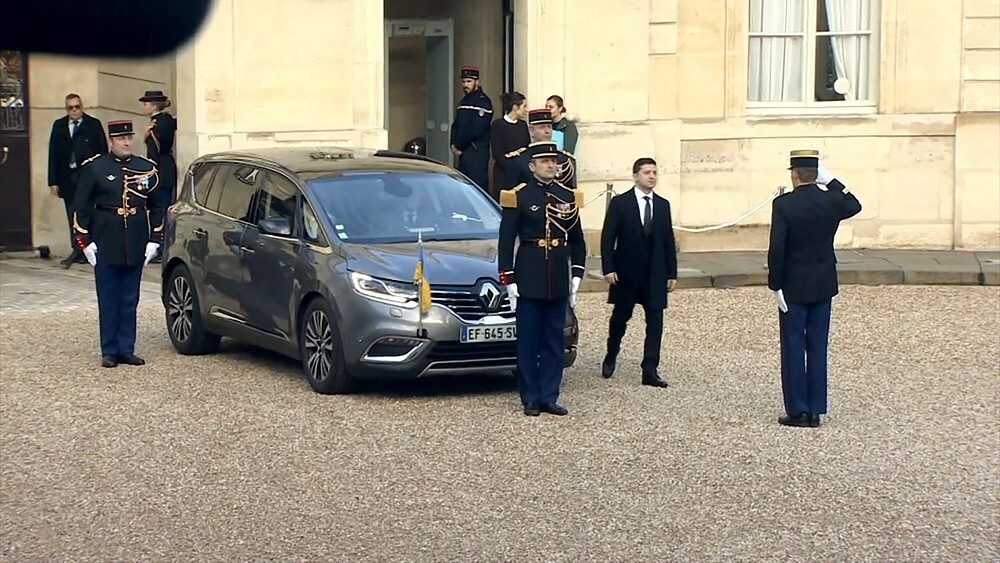
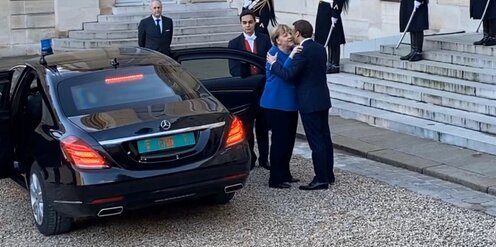
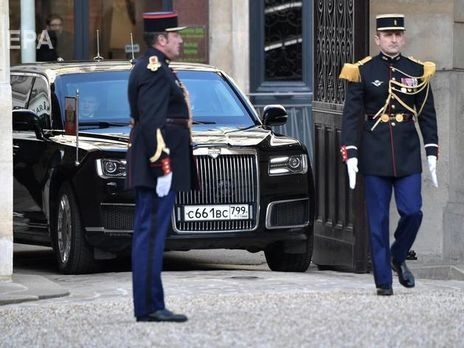
There was little information during the series of bilateral and general meetings: journalists mostly discussed ceremonial matters. Online, attention was drawn to the cars in which the state leaders arrived. Vladimir Putin arrived at the Elysee Palace in a Russian-made Aurus limousine (though it is based on the Rolls-Royce Phantom), costing 12 billion rubles. Angela Merkel arrived in a German Mercedes. Zelensky arrived in a budget car of the French brand Renault (you can view all the photos by switching the slider).
Despite the fact that the media had built up an aura of a “decisive” meeting around the summit of the leaders of the “Four” countries, which had not gathered together for three years, expectations among experts were modest. Many political scientists expressed the view that President Zelensky would get nothing from the outcome of the meeting but disappointment.
“At the moment there are two purely ceremonial questions on the agenda: will Zelensky and Putin hold a public handshake, and which of them is taller?” — wrote journalist Svetlana Kryukova.
Zelensky himself also allowed for the possibility of no results: shortly before the “Four” meeting, the president said that if it was not possible to get territories back, Ukraine would build a wall on the border with Donbas. Even earlier, such a scenario was admitted by presidential aide Andriy Yermak.
Troop disengagement at three points, a prisoner exchange and a meeting in 2020. What did Russia and Ukraine agree on?
“We agreed to continue negotiations,” is how Yuriy Vitrenko, CEO of the National Joint Stock Company Naftogaz of Ukraine, described the gas talks to journalists near the end of the summit. Vitrenko confirmed that the company does not plan to withdraw its claims against Gazprom and considers the decisions of international arbitration tribunals binding.
Naftogaz head Andriy Kobolev also confirmed on ICTV television that no agreements had been reached on the gas issue. According to Kobolev, Ukraine's position on the gas issue is to preserve Ukraine's transit status as owner of the transit asset in the form of the Ukrainian gas transmission system, as well as Russia's compliance with the decisions of the Stockholm arbitration court.
Interior Minister Arsen Avakov rated the talks “4 out of 5” and stated that “so far everything is going correctly from the state's position.” In the corridors, Avakov told the press that “there is no betrayal” and that President Vladimir Zelensky is “a good fellow, holding the position correctly and firmly.” According to journalist Yulia Koltak, Avakov also assessed the leaders of the Normandy Four countries: in particular, he said that “Merkel is a good fellow, she helped us,” that “Macron was just interested,” and that “Putin constantly lied and relied on OSCE reports.”
After midnight the leaders of the countries came out for a joint briefing and summed up the meeting. The French president emphasized the need, over the next four months, to create the preconditions for holding elections in Donbas, while the German chancellor said it was important to continue the withdrawal of troops and the demining of territories. Vladimir Zelensky said that an agreement had been reached to carry out troop disengagement at three more points, as well as to hold a new prisoner exchange.
Separately, addressing the Ukrainian audience, Vladimir Zelensky outlined the principles that the president's team will not violate in the negotiation process. Among them:
- Impossibility of federalization;
- Impossibility of reaching a compromise through territorial concessions.
Vladimir Putin referred to the Minsk agreements and the need to enshrine a special status for Donbas in the Constitution of Ukraine. “No conflict in the world has been resolved without direct dialogue,” — as is traditional, the Russian president referred to the need for dialogue between Kyiv and the unrecognized republics.
What did the parties agree on?
- Troop withdrawal at three points of humanitarian significance. Demining of territories and defortification of structures.
- Holding a new prisoner exchange. Verification of prisoner lists and access to them for members of the Red Cross.
- Expansion of the powers of the OSCE.
- Implementation of the “Steinmeier formula” in Ukrainian legislation.
- Holding a new meeting in spring 2020 after the above items are fulfilled.
The presidents of Ukraine and Russia categorically disagreed on establishing control over the border; as Vladimir Zelensky admitted to journalists at the press conference, he and Vladimir Putin have completely different views on this process. The president's team continues to insist on transferring control of the border to Ukraine before local elections in Donbas.
Vladimir Zelensky
President of UkraineI'll be frank: with the President of Russia we have a different, probably completely different, view on the handover of the border and when it is possible. Indeed, I can speak about this openly. The President of Russia says that in Minsk our former president Petro Alekseyevich signed that the handover of the border [must take place] after the elections. Of course, I raise the question of transferring control before the elections.
Russia refers to the Minsk agreements signed by Petro Poroshenko and reminds that control over the border could be established the day after local elections are held in Donbas, hinting that revising the Minsk agreements could completely derail the negotiation process.
Vladimir Putin
President of the Russian FederationIt is very simple to understand us: we are for the Minsk agreements being implemented. Take and read what is written there. It says: Ukraine begins establishing control over this territory, over this section of the border, the day after the elections, and the process is finally completed after all political procedures are fully implemented. Why open the Minsk agreements and rewrite them? If we start rewriting one thing, we will lose everything.
“We expected more, but this is already the beginning of a dialogue,” and “it is good that we met” — the common leitmotif of the speeches by the leaders of the Normandy Four countries. The sides set a “homework assignment” and a deadline for completing it: 4 months. Whether the next meeting in this composition takes place in 2020 depends on its implementation.

Russian Attacks in Dnipropetrovsk Region: Two Killed, Seven Injured

Defense Forces Strike Four Russian Drone Control Points in Past Day, Including in Berdiansk

Britain Threatens Sanctions on Kremlin-Linked People; Poland Ready to Hand Ukraine Ammunition

Russia says it has completed "planned exercises" in the Black Sea

MVD: Fake Riots With Prop Blood Were Being Prepared Near Presidential Office

Law Enforcers Name Another Klitschko Deputy as Suspect

Berlin Holds Protest Against War in Ukraine; EU Prepares for Possible Russian Halt of Gas Supplies
North Korea Fires Ballistic Missile Over Record Distance in Five Years
Irish Fishermen Force Russia to Postpone Naval Drills

US sanctions in case of invasion of Ukraine could completely destroy Russia's economy, NYT reports
