
A Collusion of Regimes, Unity in the Face of Aggression and a Move Toward the Future: What Zelensky Said in Poland
2020 saw a number of foreign trips by President Zelensky, each of which was accompanied by scandals and embarrassments.
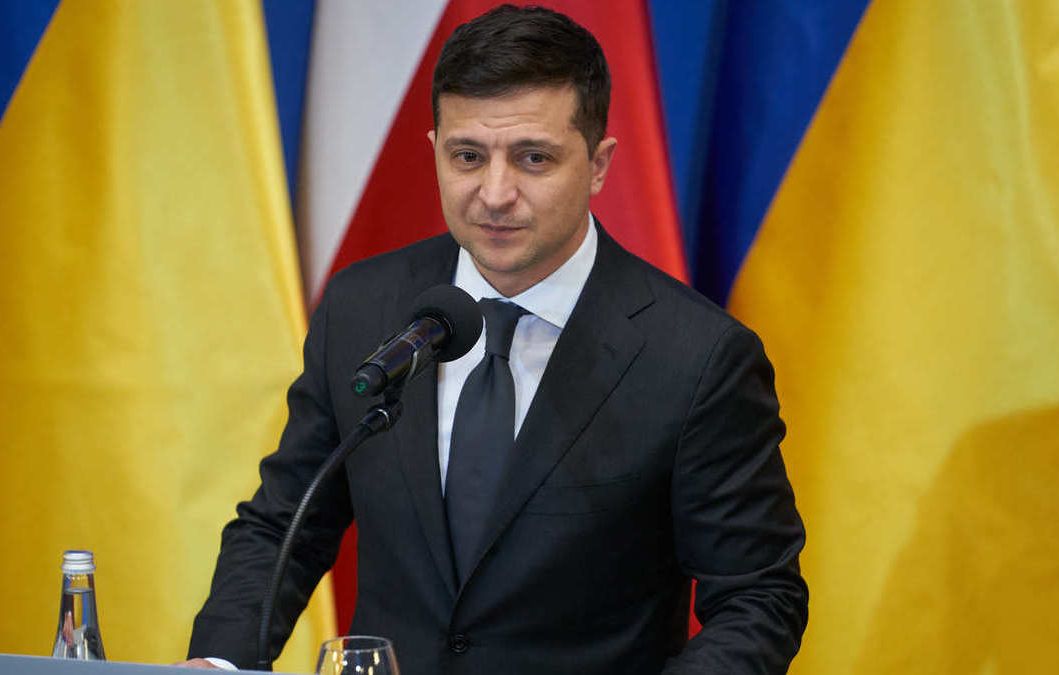
On January 26, the Ukrainian leader arrived on a two-day visit to neighboring Poland, and the next day met with Polish President Andrzej Duda. The event was timed to the 75th anniversary of the liberation of the Auschwitz-Birkenau concentration camp near the Polish town of Oświęcim. During the war, up to 1.5 million people were killed in the camp, the vast majority of whom (over a million) were Jewish.
During his speech, the president of Ukraine put forward a number of important points. First of all, they concerned relations with Poland. Zelensky spoke of a “new page” and a “lowering of the level of tension.” Among other things, the president emphasized global unity in the face of possible aggression, the inadmissibility of a repeat of events like those of World War II, and made several statements on historical topics. The latter caused an extremely ambiguous reaction both inside Ukraine and beyond its borders, and could potentially lead both to a drop in the head of state’s support among the population and to complications in relations with several world states. So what exactly did the Ukrainian president say in Poland?
The text is published in the “Opinion” section. The editorial board may not share the author’s position.
Why Zelensky flew to Poland: the foreign policy context
2020 began not very successfully for the head of Ukraine. First, there was a scandal over a secret flight to Oman, which was later hastily presented as an official visit, although that trip still left many questions. Then came Israel, where Zelensky got into a scandal by refusing to attend an international forum commemorating the victims of the Holocaust (for which, in fact, the event had been organized). The official position of the Office of the President was that the Ukrainian delegation headed by Zelensky had decided to give its seats to real people who had survived the Holocaust. This drew sharp criticism from the Israeli side (at the level of the media, the foreign ministry and the Yad Vashem memorial). Israel said it was surprised and deeply disappointed by Zelensky’s act, since there had been no shortage of seats for those wishing to attend the forum. At the same time, a number of media outlets and experts linked this demarche to the Ukrainian side’s unwillingness to attend an event where one of the main speakers was Russian President Putin, and where the Israeli leadership had officially thanked the Red Army for its help in fighting Nazism.
It should be noted that Polish President Andrzej Duda also refused to take part in the forum. According to the Polish head of state, the event is being “used by Russia” to “promote its view” of past events. For this reason, the Polish president “saw no point” in personally attending the forum, especially given that Duda had not been included in the list of speakers. Thus, Zelensky acted in unison with the head of Poland, as if silently showing solidarity with him. This decision by the Polish side was also unequivocally criticized by Israel and Russia.
The negativity and scandal surrounding the demarches of Ukraine and Poland proved more serious than both sides had probably anticipated. Meanwhile, Polish-Ukrainian relations had been in a far from good state in recent years, primarily because of the humanitarian policies of both countries. The reason for the visit had been overdue for a long time, and only a pretext was needed. That pretext became International Holocaust Remembrance Day, marked annually around the world on January 27, the date of the liberation of Auschwitz. On the evening of January 26, Zelensky flew to Poland to take part the next day in a solemn event marking the anniversary. By the way, both sides were also solving image tasks with this meeting: a joint appearance by the two presidents on the day of the liberation of Auschwitz, as a tribute to the Jews who died in the genocide, was supposed to drown out the negative aftertaste caused by the refusal to attend the forum in Israel a week earlier.
What the Ukrainian president said in Warsaw
First, Zelensky met in Warsaw with people who had endured the horrors of camp life and managed to survive. He addressed them with warm words, saying that they were “rays of the Sun that overcame the darkness.”
The next day, the president of Ukraine met with his Polish counterpart Andrzej Duda. They held a joint briefing, where they made a number of statements that were received ambiguously.
Zelensky’s message to the Polish leader was the need to “turn the page” on past relations, find what unites the Ukrainian and Polish peoples, and move forward together into the future. According to the president of Ukraine, the shared history of our countries is “full of tragic moments,” but one must move on. In particular, Zelensky spoke of “lowering the level of emotions” in relations with his western neighbor, and said that it was necessary to “build unifying positions.”
It is no surprise that in this context the initiatives of the sides are predominantly humanitarian in nature. Thus, Zelensky announced the unblocking of work for Polish specialists on the territory of Ukraine (as a rule, Poles in our country work at burial sites). In response, the Polish side promised to begin the process of restoring the grave of UPA soldiers on Mount Monastyr. Duda also unexpectedly stated that Poland “remembers and respects the feat of Ukrainian soldiers” during the Polish-Soviet conflict in the 1920s, and proposed commemorating both the defenders of Poland and the Petliurite warriors who fought against Soviet Russia. Zelensky agreed and immediately announced a number of joint Polish-Ukrainian events for 2020. One of them is to be a return visit by Duda to Kyiv, to which the president of Ukraine invited his Polish counterpart right during the speech.
Zelensky’s traditional request to invest in Ukraine was not missing either. He emphasized that Poland is Ukraine’s fourth-largest trading partner in the world, which opens the possibility for many joint projects. The president spoke about the reforms carried out in Ukraine and the improvement of the business climate, expressing hope that Polish investors would “appreciate this accordingly.” Zelensky also formally thanked Poland for supporting our country’s territorial integrity and called for general unity in the face of aggression.
However, the main outrage within Ukraine and abroad was caused not by this quite productive conversation between the two presidents. In discussing the Holocaust and the liberation of the Auschwitz camp, neither Duda nor Zelensky (whose grandfather was a holder of the Order of the Red Star) mentioned the Soviet army, which, in fact, liberated Auschwitz and the prisoners held there. Instead, it was said that the Ukrainian Front had been involved (which, nevertheless, was part of the Red Army, a fact that no one mentioned either).
Many social media users, as well as a number of experts and politicians, were outraged by this framing from the Ukrainian president. The Russian Foreign Ministry called these words “erroneous and offensive.” From Zelensky’s speech it follows that Auschwitz was liberated exclusively by Ukrainians. But the Ukrainian Front was named that not because it consisted only of Ukrainians, but because it advanced through the territory of Ukraine. Until 1943 it was called the Voronezh Front. Many Ukrainians served in this formation, but it was also staffed by natives of the USSR from all other republics. As for Auschwitz itself, its liberation was indeed commanded by Ukrainians, Poltava natives Vasily Petrenko and Anatoly Shapiro. However, under their command, besides Ukrainians, representatives of other nationalities fought and died: Russians, Belarusians, Tatars, Chechens and others. From this point of view, emphasizing only Ukrainians and not mentioning all the others was at the very least incorrect.
Another highly controversial statement was one implying that the Soviet Union was to blame for Nazi Germany’s launching of the Holocaust.
“Poland and the Polish people were the first to feel on themselves the collusion of totalitarian regimes. This led to the start of the Second World War and allowed the Nazis to launch the deadly flywheel of the Holocaust,” — said the president. This again caused outrage in Russia, as well as within Ukrainian society. In addition to social media users, representatives of the expert community and a number of political figures, head of the Ukrainian Jewish Committee Eduard Dolinsky also reacted very negatively to this remark. He stated that the USSR had never been the initiator of the destruction of the Jewish people.
“I categorically disagree with such an assessment. This is a form of Holocaust denial… The Soviet Union and Germany did not agree on the extermination of the Jews,” — Dolinsky summed up.
What the visit to Poland showed and what to expect going forward
The visit to Poland itself is an unequivocally positive moment. Relations between our countries, which reached a peak in 2014–2015, have since 2016–2017 steadily moved toward cooling. In this context, one can speak of a certain easing and a reduction in the level of aggressive rhetoric, which is expressed in mutual humanitarian initiatives, talks of possible investments, and Duda’s promise to make a return visit to Kyiv already this year. Nevertheless, the joint briefing of the two presidents once again showed the existence of problems in relations both between Ukraine and Poland and with key world players.
Volodymyr Zelensky continues the policy of “internal multi-vectorism” and centrism, trying to please “both yours and ours.” Ukrainian society today is split into several groups antagonistic to one another, as confirmed by any sociology. Zelensky is trying to be president of all of Ukraine, and therefore, on the one hand, goes to the grave of his Red Army grandfather and speaks of “light” in relations with Russia, while on the other hand, he talks about the “collusion of regimes” and does not mention the USSR during the ceremony dedicated to the liberation of Auschwitz. Nevertheless, in this situation one can notice a clear tilt toward the rhetoric used by his predecessor in the presidency. That Zelensky’s words were supported by people such as Viatrovych or Ariev is further proof of this. One can assume that with such multifaceted actions the Ukrainian leader is trying to unite the country by becoming a kind of public arbiter. Nevertheless, at times such statements sound simply illogical: for example, the claim that the USSR contributed to the Holocaust while the USSR liberated Europe from Nazism, or the proposal to commemorate the Battle of Warsaw, as a result of which a significant part of Western Ukraine was seized by Poland.
These statements, setting aside the predictably negative reaction from Russia, may provoke a crisis including with Israel (which regularly accuses Ukraine of glorifying Nazism), and even with the United States, where the Israeli lobby is very strong and a number of ruling elites are “tied” to Israel. Similar consequences may await Poland as well. Relations between Warsaw and Moscow sharply cooled after 2014, and in the US in 2018 the “477 Act” was signed, allowing Jewish organizations to demand $300 billion in reparations from Poland for property lost during the genocide, while Israel directly accuses Poles of complicity in the Holocaust. Meanwhile, despite local warming, the global problems in Ukrainian-Polish relations (the humanitarian and historical policies of both countries) also remain unresolved. Even half of the above conditions is enough for a systemic political crisis in relations of “all against all.”
For Zelensky, the trip to Poland was an attempt to cover up internal problems with foreign policy activity. These are the society’s divisions and the rejection of the humanitarian policy being pursued by a significant part of it. Simply put, the president is trying to solve the communication problem caused by humanitarian policy through diplomatic efforts, without changing anything fundamental inside the country. In places he is succeeding, but the likelihood of a positive outcome of these actions is small.
The president should understand: those who did not support him are hardly going to start doing so. But those who gave him their votes (in the Southeast and Centre Zelensky received up to 80–90% support) are already becoming disillusioned with him, and this trend will continue if the policy against which 73% of Ukrainians voted in the presidential elections is continued. The unity of society and state can be built only on the basis of a new “social contract” that will be a compromise for all regions of Ukraine. The policy of “two chairs,” as practice shows, may be good tactically, but is inevitably a failure strategically.

Russian Attacks in Dnipropetrovsk Region: Two Killed, Seven Injured

Defense Forces Strike Four Russian Drone Control Points in Past Day, Including in Berdiansk

Britain Threatens Sanctions on Kremlin-Linked People; Poland Ready to Hand Ukraine Ammunition

Russia says it has completed "planned exercises" in the Black Sea

MVD: Fake Riots With Prop Blood Were Being Prepared Near Presidential Office

Law Enforcers Name Another Klitschko Deputy as Suspect

Berlin Holds Protest Against War in Ukraine; EU Prepares for Possible Russian Halt of Gas Supplies
North Korea Fires Ballistic Missile Over Record Distance in Five Years
Irish Fishermen Force Russia to Postpone Naval Drills

US sanctions in case of invasion of Ukraine could completely destroy Russia's economy, NYT reports
